A focus on extremism, radicalisation and prevention
Hearing Block 8 begins today looking at antisemitism and extremism in Australia, including religious, far-right and other ideologically motivated extremism and radicalisation.
Islamic State and al-Qaeda are driven by an antisemitism embedded in their reading of Islam, and believe in a global conspiracy in which Jews and Christians are united to subjugate Muslims, the Royal Commission on Antisemitism and Social Cohesion has heard.
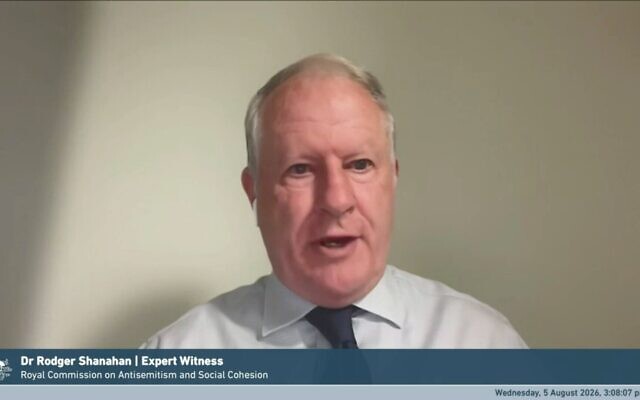
Dr Rodger Shanahan, a Middle East analyst and former army officer holds a PhD in Arabic and Islamic studies from the University of Sydney and a master’s degree in Middle Eastern studies and international relations from the ANU.
He is a former research fellow in the Lowy Institute’s West Asia programme and a former associate professor at the ANU’s National Security College.
He served as a UN military observer in southern Lebanon and Syria in the 1990s, as a military liaison officer in Beirut during the 2006 war, and as defence attaché in Abu Dhabi. He is the author of Islamic State in Australia, published in 2023.
Dr Rodger Shanahan. Photo: Screenshot.
He has given expert evidence in more than 35 terrorism prosecutions in Australia, in 20 control or supervision order cases, and at the coronial inquest into the Lindt Cafe siege.
Dr Shanahan began by distinguishing mainstream Muslim practice from violent extremism.
“Any religious denomination has extreme interpretations of the faith, whereas the vast majority of believers get on with their day-to-day lives, just practising their faith in what we consider to be a non-extreme version of it,” he said.
He described Salafism as a minority movement within Islam, and Salafi jihadism as a minority within that. Groups such as al-Qaeda and Islamic State, he said, were its contemporary expression.
He said their hostility to Jews was not incidental. Salafi jihadist groups reject anyone outside their own interpretation, including other Sunni Muslims.
“They’re anti-Christian, they’re anti-Shia, they’re antisemitic, they’re anti pretty well everybody that doesn’t follow their interpretation of the faith,” Dr Shanahan told the commission.
He said such groups reached back to accounts of conflict between the early Muslim community and Jewish tribes to argue that Jews were inherently untrustworthy. Islamic State ran a lead story in one of its online magazines claiming the Shia faith had been founded by a Jew in order to break Muslim unity.
“So they are a strongly antisemitic movement,” he said.
Dr Shanahan also gave evidence on Shia extremism, which he said was a different phenomenon. Shia Muslims make up an estimated 10 to 15 per cent of the world’s Muslims and have historically been politically quietist.
The 1979 Iranian Revolution changed that, and after Israel’s 1982 invasion of Lebanon, Iranian Revolutionary Guard personnel helped mobilise the Lebanese Shia community, leading to the formation of Hizballah. Shia extremism, he said, tended to be state-backed in a way Salafi jihadism was not.
Turning to radicalisation in Australia, Dr Shanahan identified the speed of online information as a key driver. Conflicts that would once have rated a paragraph in a newspaper now generate immediate, edited video that resonates powerfully within small extremist circles.
Family networks also played a role. He told the commission that at least 21 Australian family groups have had two or more members charged with terrorism offences or who travelled to Syria and Iraq, accounting for about 51 people, a figure that rises if relationships by marriage are counted.
On preachers, Dr Shanahan said no formal religious training was required.
“If you want to set yourself up as a preacher or a speaker, you can gather an audience,” he said. “Doesn’t mean that you have to have formal qualifications to do it.”
He said some influential figures were highly skilled at operating within the law. One prominent overseas preacher held both a law degree and religious qualifications.
“He skirts that area,” Dr Shanahan said. “He prepares the ground in a way that would indicate that he knows what he’s allowed and what he’s not allowed to say.”
He named the late Anwar al-Awlaki as the single most influential Salafi jihadist voice among people convicted of terrorism offences in Australia and elsewhere, and said his influence had endured well after his death in a US drone strike.
“He not only talked the talk in jihadist circles, he walked the walk,” Dr Shanahan said.
Counsel assisting the Royal Commission put to Dr Shanahan the comments made by Sheikh Ibrahim Dadoun at a rally in Lakemba on 8 October 2023, the day after the Hamas attacks on southern Israel, when he said: “I’m smiling, I’m happy, I’m elated. It’s a day of courage. It’s a day of pride. It’s a day of vigour.”
The commission also heard that Dadoun subsequently issued a statement on social media saying he did not condone the loss of innocent life on any side.
Dr Shanahan said a community leader, let alone a religious one, should have been condemning violence against civilians rather than describing the day as a victory, and that a clarifying statement issued a day or more later carried nowhere near the weight of the words delivered in front of a crowd. Describing violence as victory, he said, normalised it.
Dr Shanahan told the commission that the absence of any single authority speaking for Australian Muslims complicated efforts to counter extremist messaging. Both the Australian National Imams Council and the Australian Federation of Islamic Councils have appointed a Grand Mufti.
“There is no single person who speaks for the Muslim community,” he said.
Asked about possible responses, he said the answer was sometimes counterintuitive. Shutting down halls and venues rented by radical preachers could push them into private homes and spaces where they were far harder to monitor.
Allowing them to speak in public venues, he said, gave authorities a better picture of who was listening.
He added that the community itself remained best placed to identify who was preaching what.
Antisemitism has become a uniquely powerful mobilising force for extremists across the political spectrum because it offers a single, all-purpose explanation for grievances, a Royal Commission on Antisemitism and Social Cohesion hearing was told this afternoon.
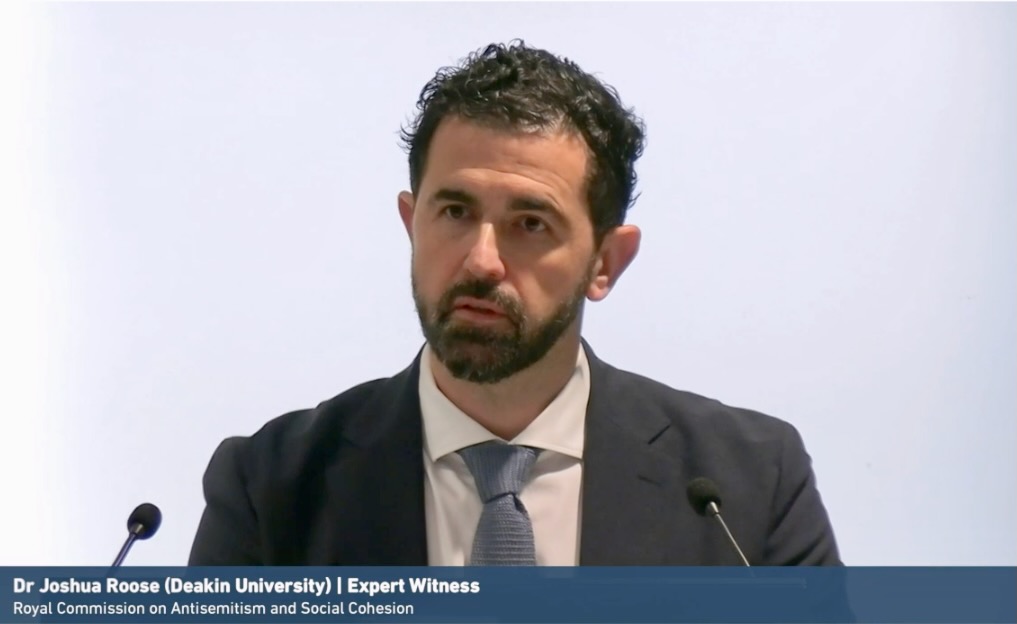
Dr Joshua Roose, Associate Professor of Politics at Deakin University and an expert in political and religious violent extremism, masculinities and radicalisation, told the Commission that antisemitic conspiracy theories have thrived online in a way “it couldn’t in a face-to-face environment.”
He said the narrative that a “Jewish lobby” secretly controls governments had become “a really powerful mobilising force” over the past 10 to 15 years, because it lets people attribute all their problems to a single group: “Everything that’s going wrong with my life, it’s not me, it’s not this other group, it’s the Jews”.
Asked by Commissioner Virginia Bell whether the idea was influential across the extremist spectrum, Dr Roose said antisemitism functioned as the “perfect enemy” for the far right, far left, and Islamist extremists alike.
Among Islamist communities, the belief that Jews are “mischievous” and sowing division has long circulated, amplified by online hate preachers.
On the extreme left, Zionists had become the “perfect enemy” because, he said, “there’s no diversity in this framing of what a Zionist is” — in his words, “a Zionist is a bad person who is loyal to a state that’s hurting others.”
And among conspiratorial “sovereign citizen” movements, an anti-globalist worldview holds government to be a corporation controlled by Jewish interests.
“It’s the perfect enemy across so many different layers of these ideological narratives,” he said, adding that it is ultimately “about the target”.
A ‘blind spot’ in Australia’s anti-racism frameworks
Dr Roose said there is “a significant blind spot” in Australia’s multicultural and anti-racism frameworks when it comes to identifying antisemitism, because those frameworks are built around visible disadvantage — and Jewish Australians, who statistically tend to be highly educated and comparatively well off.
He later linked the blind spot to Australian “tall poppy syndrome” — targeting people perceived to be doing well and “attempt[ing] to bring them back down” — and said Australia’s otherwise world-leading anti-racism frameworks “need work” specifically in relation to antisemitism.
Part of the problem, he said, is coded language: “Zionism” had become, for a segment of the population, a coded way of framing hostility toward Jews.
He said criticising Israel on the basis of foreign policy is one thing, “but when you criticise the right of a people to their homeland, to me that speaks to antisemitism.”
Push, pull and personal factors
Dr Roose described “push” factors such as the housing affordability crisis and, for example, growing numbers of men unable to afford a home or find a partner, which intersect with masculinity and social disadvantage to make people more receptive to extremist “pull” factors — the narratives themselves.
Those narratives, he said, are spread not only by violent extremist groups and hate preachers but by online “grifters” who profit from anti-Jewish content, citing misogynistic influencers who have “branched into antisemitism.”
He also pointed to “personal” psychological factors, including mental health issues and, per some research, links between autism spectrum disorder and vulnerability to extremist narratives.
Regulation ‘critical’ but eSafety Commission under-resourced
Dr Roose said online regulation is essential but has proven “almost impossible” to achieve. He praised the eSafety Commissioner’s efforts but said the agency was badly under-resourced: “I believe they’ve got 30 or 40 active people. I think that could be 10 times the size and still struggle.”
He also called for greater transparency from technology platforms about the algorithms steering users toward extremist content, arguing this was in the national interest for any platform doing business here.
It’s a dynamic he linked to the rise of encrypted platforms from around 2014, alongside a documented rise in antisemitism from the same period, which he described as “deeply, deeply dividing and damaging to Australian social cohesion.”
Funding allocation questioned
Under questioning from counsel assisting and then Sophie Callan representing the State of NSW, Dr Roose said Australia’s multicultural framework can tend to position community groups as “rival claimants” competing for resources, with decisions not always evidence-based.
He said there was “a good reason to be allocating funding to the Jewish community” given the evolving threat environment, including the Bondi terror attack, but more scrutiny was warranted over a block grant to the Australian National Imams Council, which he understood was not allocated competitively and “should be unpacked further.”
Questioned by counsel for the Commonwealth, Peter Melican, Dr Roose acknowledged he had not researched security risks facing Muslim communities and had no direct evidence the Imams Council decision was political, calling his view surmise.
But he was direct about his overall risk assessment: “I’ve been researching Muslim communities now for 20 years… It is my informed, my research expertise that the Jewish community threat is significantly greater in Australia than it is facing in the Muslim community at the moment.”
He cited the Bondi attack and “a significant increase in anti-Semitism” as the basis, while acknowledging funding to the Executive Council of Australian Jewry had also not been competitive.
The Royal Commission into Antisemitism and Social Cohesion has heard that far-right movements in Australia are actively working to shift the “Overton window” — the range of political ideas considered acceptable in mainstream discourse — through alternative media and online networks.
Macquarie University professor Julian Droogan told the commission that while he did not consider mainstream conservative discourse to be far right, extremist groups sought to move public debate closer to their own positions. “One of the objectives, I think, of the far right in Australia and elsewhere through their propagandising is to shift that public debate, those public narratives and discussions further into their space,” Droogan said.
Droogan identified three key drivers of far-right extremism: structural conditions, targeted recruitment, and individual vulnerability. On structural drivers, he pointed to a “polycrisis” of overlapping pressures — including the pandemic, geopolitical instability and economic anxiety — combined with what he called an “epistemic crisis” eroding shared standards of truth. “It’s harder today for people to know what is true, but perhaps more importantly, how to identify truth,” he said.
On recruitment, Droogan described a “red pill” process by which individuals are drawn from mainstream online spaces into extremist narratives through peer networks and algorithmic reinforcement. He said such spaces could serve a genuine social function, offering “a sense of community and a sense of belonging for people,” which he said made them difficult to counter.
Asked about the profile of individuals most vulnerable to radicalisation, Droogan referred the commission to research by Adrian Cherney, noting that those drawn into far-right extremism were predominantly young men experiencing mental health difficulties, though he cautioned “more research needs to be done in this area, in Australia”.
On links between online radicalisation and offline violence, Droogan cited the Christchurch terrorist attack but said the relationship remained poorly understood. “So again, it’s not right, I don’t think, at this point with the research we have, to say that the online environment does, in certain ways, radicalise people to become terrorist actors,” he said.
Droogan also gave evidence on the Compact program, a social resilience initiative that he has helped to create, funded by Multicultural New South Wales and developed in the wake of the Martin Place terrorist attack in Sydney. He said the program worked with community groups to build “social connectivity” and belonging, deliberately avoiding a top-down, counter-extremism model. “They’re not designed to identify extremism and stop it. They’re bottom-up,” he said.
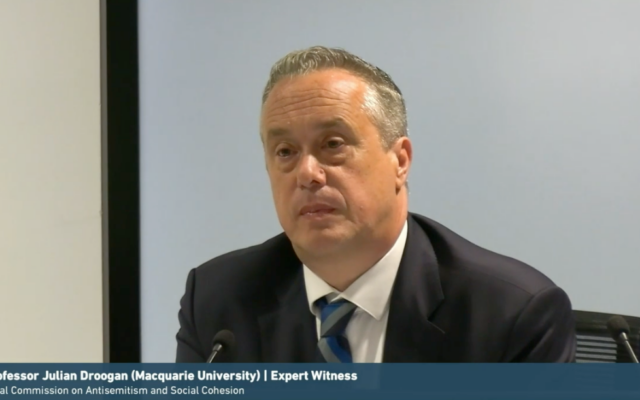
Macquarie University professor Julian Droogan, told the Royal Commission on Antisemitism and Social Cohesion today that far-right extremists regard Jewish people as non-white, drawing on racial theories with origins in Nazi ideology.
“They have a history of racial theory that again goes back to the Nazis and before, which talks about what is whiteness, and they claim that Semitic peoples, Jewish people, Arabs, Muslims are not white,” Droogan said.
He said far-right groups deliberately aligned their messaging with mainstream social and economic anxieties — including terrorism fears, the COVID-19 pandemic, immigration and cost of living — as both a recruitment and propaganda strategy, despite very few Australians being attracted to neo-Nazism.
“Most Australians are not attracted to neo-Nazism, and I think the evidence shows that once Australians see that racial politics within the extreme far right, most people turn around very quickly,” Droogan said.
Droogan also pointed to the growth of far-right alternative media and online communities, saying radicalisation typically occurred through socialisation, humour and community-building rather than direct political indoctrination.
The Royal Commission on Antisemitism and Social Cohesion has heard expert evidence that antisemitism is not an incidental feature of contemporary far-right extremist ideology but one of its central organising principles.
Macquarie University professor in international security and terrorism studies Julian Droogan told the commission that while the far right is “by definition, prejudiced against many different groups”, its antisemitism functions differently from its other hatreds.
“Their antisemitism is not just another prejudice with all the rest; it’s an organising principle,” Droogan said.
He explained that far-right narratives frame a range of grievances, including economic deprivation, immigration, multiculturalism and cultural liberalisation, under a single conspiratorial umbrella.
“They will organise all of those grievances under an umbrella, which is antisemitism, by saying that the Jewish elites or cabals or shadowy groups are responsible for immigration by creating immigration policies in Western nations, are responsible for cultural liberalisation through the entertainment industry, are responsible for economic privatisation or deprivation through economic levers of the economy,” he said.
“It’s a macro conspiracy theory. It’s a conspiracy theory that is unfounded. It goes back to not just pre-internet times, but it goes back to the 19th century.”
Droogan said this framework gave the far right “a target” and “one particular group that they can focus on”, operating within a broader nostalgia for Nazism and drawing directly from mid-century Nazi movements.
He told the commission this ideology had been directly linked to terrorist violence. The manifesto produced by Brenton Tarrant, the Australian perpetrator of the 2019 Christchurch mosque attack, was framed around the great replacement theory, which held that white people were being replaced in Western nations by immigrants as a strategy by Jewish groups.
“Although he attacked Muslims in his act of terror, he saw the real enemy or the greater enemy, perhaps, as what he would have put it in his conspiratorial way, the puppet masters behind immigration,” Droogan said.
He said a series of copycat lone-actor attacks that followed also targeted different groups but made clear “they see the overarching framework to be one of antisemitism and Jewish control”.
The Royal Commission on Antisemitism and Social Cohesion has heard that formal far-right organisations are no longer the primary driver of extremist radicalisation in Australia, with decentralised online movements and lone actors posing a greater and more complex threat.
Macquarie University professor in international security and terrorism studies Julian Droogan, who has led four major research projects into far-right extremism and is editor-in-chief of the Journal of Policing, Intelligence and Counterterrorism, gave expert evidence on the first day of the commission’s eighth hearing block.
Droogan told the commission that while far-right groups exist and remain important, larger currents now play an equal if not greater role in radicalisation.
“Online is the main locus for these social movements. In fact, I think it’s fair to say that some of these social movements have evolved online as online movements, and they are extremists,” he said.
“These online movements don’t necessarily have leaders. They can be decentralised and self-organised, and it’s through these online subcultures that some people are radicalised into far-right spaces.”
Photo: screenshot
Droogan identified the now-disbanded National Socialist Network as the most significant formal group in Australia, but said it was “a mistake to look at the far right purely through a lens of it being groups that are formal and structured”.
He drew an academic distinction between far-right radicalism, which works within the political system to push towards authoritarianism and white nationalism, and far-right extremism, which advocates for the forceful revolutionary overthrow of government.
Droogan said the Active Club Network, a global phenomenon of gyms promoting neo-Nazi ideology, focused on “bodily health, bodily purity, fraternity between men, strict gender roles between men and women, a training of mind and body, and potential for militarism”.
He told the commission that the designated terrorist entity the Terrorgram Collective continued to operate as “a decentralised, fluid network of sites” despite its designation.
On the shift towards online radicalisation, Droogan said the research remained ambiguous on whether online spaces alone were sufficient to radicalise people to violent extremism, but noted that emerging research “is beginning to move in that direction”, a trend potentially accelerated by the COVID-19 pandemic.
He said other influential researchers were now rejecting the distinction between online and offline entirely, arguing that young people “live in a blended world that is both simultaneously, and trying to distinguish between the two is becoming increasingly artificial”.
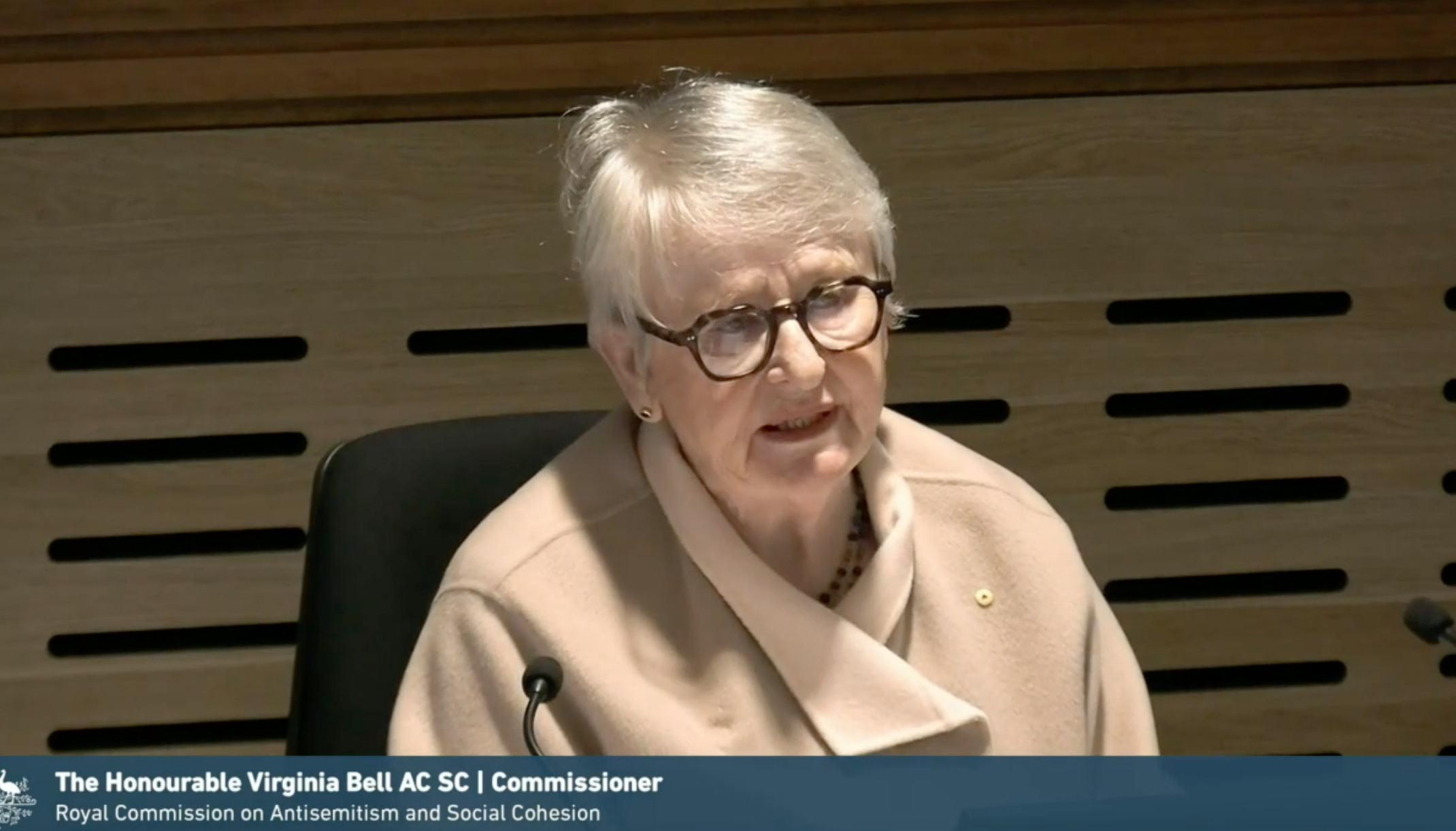
Royal Commission on Antisemitism and Social Cohesion commissioner Virginia Bell has used a preliminary matter to condemn a series of Islamophobic emails directed at a barrister who appeared before the commission during the previous day’s hearing.
Bell told the hearing that the office of the solicitors assisting the commission received correspondence from solicitors for the Australia Palestine Advocacy Network (APAN), attaching a newspaper report of an interview with a prominent member of the Jewish community.
In the interview, the individual expressed the opinion that counsel appearing for APAN and for a Palestine advocacy group had “endeavored to hijack the Royal Commission”, and that counsel had engaged in “clickbait theatrics and gratuitous slurs against Israel”.
Bell said that following publication of the interview, Ragni Mathur SC, who appeared for APAN, received “a series of truly abusive, Islamophobic emails”.
The commissioner made two points in response.
“The first is that Ms Mathur did not hijack this Royal Commission,” Bell said. “Ms Mathur was appearing for an organisation whose interests were substantially and directly affected by the subject matter of yesterday’s hearing, in that trenchant criticism was being made of the representatives of that organisation.”
Bell explained that Mathur’s cross-examination had proceeded based on a limited grant of leave, confined to one paragraph of a witness statement in which the witness expressed opinions about the conduct of the State of Israel in the period immediately following the October 7 attack by Hamas.
“She was granted leave to do that because procedural fairness, a concept familiar to lawyers but perhaps not more widely understood, demanded it,” Bell said.
On the second point, Bell drew a direct parallel between the attacks on counsel and those experienced by Jewish witnesses before the commission.
“Counsel appearing for groups before this Royal Commission should no more be the subject of Islamophobic or other attacks than should members of the Jewish community who’ve come before and given evidence and who have been subjected to vile antisemitic attacks,” she said.
“It doesn’t reflect well on those who make either antisemitic or Islamophobic attacks on the interests that they seek to promote.”
Bell then adjourned briefly to allow media cameras to be removed from the hearing room before the first witness was called.
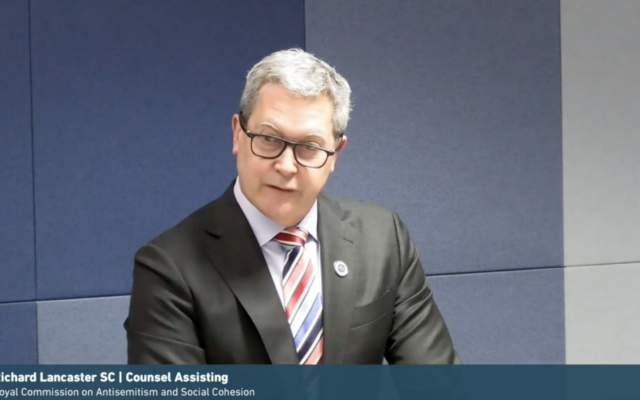
Royal Commission on Antisemitism and Social Cohesion counsel assisting Richard Lancaster SC has opened the commission’s eighth hearing block, outlining the examination of the key drivers of antisemitism and extremism in Australia, including religious, far-right and other ideologically motivated extremism and radicalisation.
Lancaster told the commission that evidence received showed “extremism and radicalisation of various kinds are substantial and ongoing threats to the Australian community”, with young men most often identified as the group most at risk, though not exclusively so.
“They may experience isolation, financial or social grievances, a sense of disconnection, a lack of community, or untreated mental health challenges,” he said. “They have ready access to increasingly radical content online, or they might fall under the influence of individuals and networks of extremists seeking to draw others in.”
Lancaster noted that being vulnerable or susceptible was not the same as being extremist, and that most people with some such vulnerability did not go on to adopt extremist ideas.
He referenced the Director General of Security’s 2026 annual threat assessment, which observed that “hatred of Jews is one thing virtually all violent extremist cohorts have in common”, encompassing neo-Nazis, Islamic extremists and many issue-motivated extremists.
Lancaster outlined four categories of evidence to be heard across the hearing block. The first will come from individuals drawn into extremism who have since disengaged, including a reformed former neo-Nazi group member and a reformed individual who formerly subscribed to an extremist Salafi jihadi ideology.
The second category comprises expert witnesses examining different drivers of antisemitism and extremism. These include Macquarie University professor in international security and terrorism studies Julian Droogan, University of Sydney Arabic and Islamic Studies graduate Dr Rodger Shanahan, and University of Melbourne senior lecturer in international relations Dr Sara Meger.
The third category will examine government prevention, early intervention and disengagement initiatives, including evidence from the Australian Federal Police, New South Wales Police and representatives from state-based programs.
The fourth category will explore the role of community groups, including evidence from Australian National Imams Council president Sheik Shadi Alsuleiman, Shia Muslim Council of Australia director Dr Ali Alsamil and Lebanese Muslim Association secretary Gamel Kheir.
Some sessions will be closed for security and operational reasons.
The AJN is providing rolling coverage on the Royal Commission on Antisemitism and Social Cohesion.



comments