



Australia’s Jewish and Hindu communities have been forging increasingly close bonds in recent years, with relationships strengthening significantly following the October 7, 2023, attacks in Israel.
The solidarity was on full display in January this year when Hindu Council of Australia national president Sai Paravastu stood alongside Jewish leaders, publicly warning that Australia was “incubating religious intolerance” and declaring that those who hate Jewish Australians “hate people of all faiths except their own”.
This powerful show of support came during what Jewish community leaders described as “453 days of nightmares” following antisemitic attacks in Sydney and Melbourne in late 2024.
“Both of us have been attacked,” explains Subramanian Ramamoorthi, national president of the World Hindu Council of Australia (Vishva Hindu Parishad).
“Right from the beginning there has been some sort of animosity with the Hindu community in Australia. We have been suffering right from the beginning.”
“What has happened with the Jewish community after October 7 [2023], we feel that we have a very good understanding, and we are in a common place,” Ramamoorthi told The AJN.
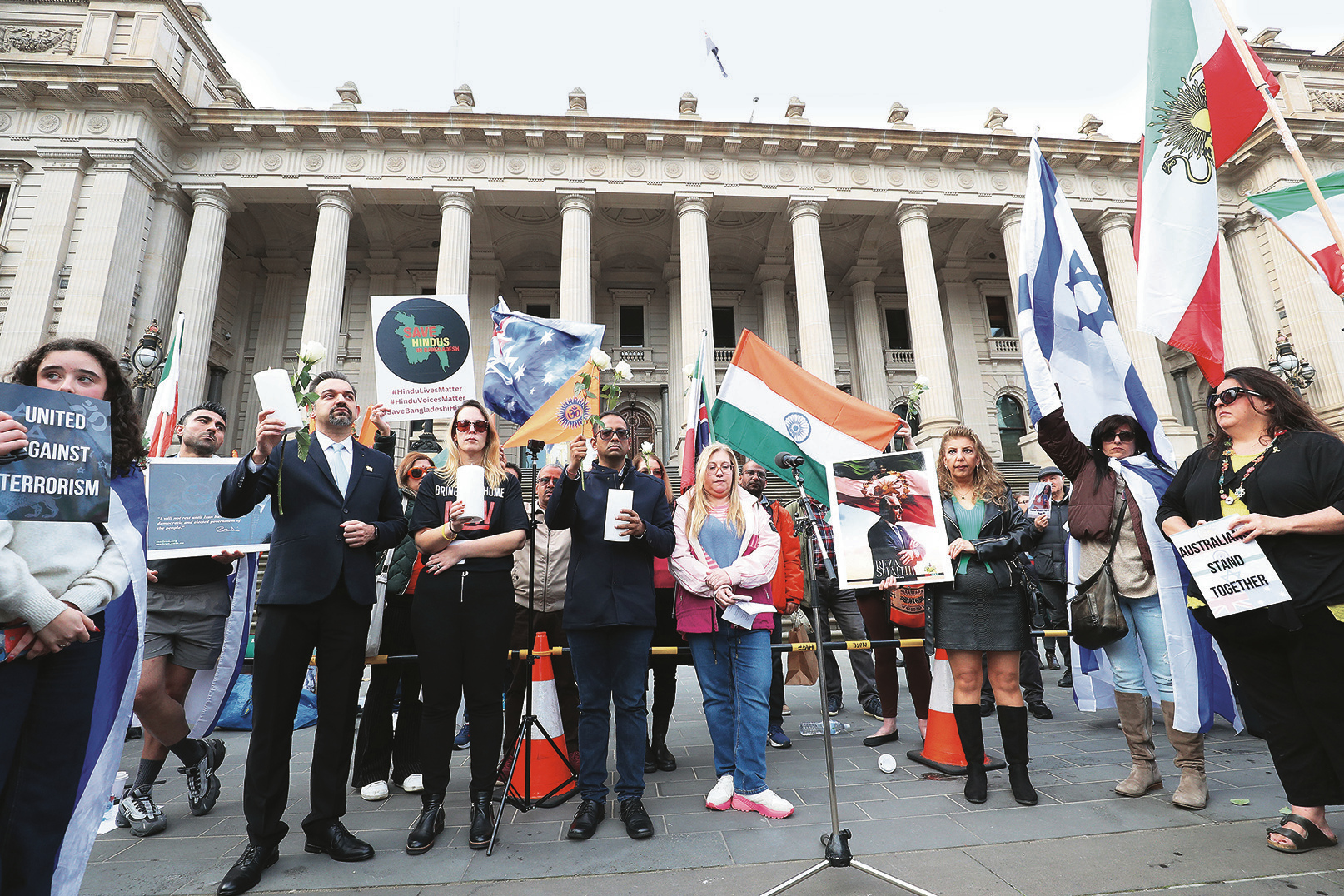
Hindus have been prominent at rallies against terror and in support of Jews and Israel ever since October 7, 2023.
Saurabh, secretary of the Australian Hindu Community spoke at an anti-terror rally organised by J-United outside the Victorian State Parliament in July.
“Both the Hindu community and the Jewish community are the victims of terrorism. We have suffered a lot because of terrorism, and our people have been displaced multiple times because of [terrorism] and we share the same grief,” he said.
The 2021 census figures highlight the minority status of both communities in Australia, with 683,995 Hindus representing 2.7 per cent of the population, while 116,967 Jews make up just 0.46 per cent.

Historical connections celebrated
One of the most significant events bringing the communities together has been the commemoration of Haifa Day, which marks the liberation of the Israeli city from Ottoman control by Indian cavalry regiments in 1918.
In 2024, over 150 leaders and volunteers from both communities gathered in Melbourne for a Haifa Day dinner, jointly hosted by the Indian Australian Diaspora Foundation, the Hindu Council of Australia Victoria, Zionism Victoria, and the Jewish Community Council of Victoria.
The historical significance of Haifa Day lies in the bravery of Indian horsemen from elite army units in Jodhpur and Mysore, who liberated the city on September 23, 1918.
Using only swords and horses against machine gun fire, these soldiers captured the fortified town with eight casualties and 60 horses killed, while 28 soldiers and 83 horses were wounded.
This military victory, following the victory at Beersheba in late 1917, contributed to laying foundations for the Balfour Declaration, the British Mandate, and eventually the establishment of the State of Israel.
The 2024 dinner was particularly poignant given missile attacks on Haifa by Hezbollah which had forced the cancellation of commemorations in the city.
Shared festivals and interfaith dialogue
Beyond historical commemorations, the communities have joined together to celebrate their respective religious festivals.
In December 2022, approximately 100 members of the Jewish and Hindu communities gathered in Sydney for a joint interfaith Chanukah/Diwali event organised by the NSW Jewish Board of Deputies and the Hindu Council of Australia.
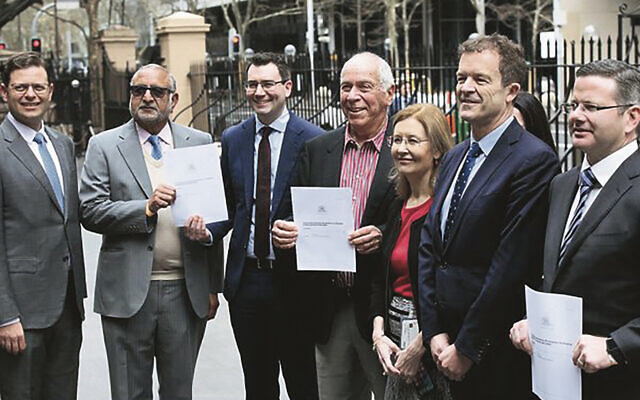
This “Festival of Lights” celebration featured musical performances, traditional foods, the lighting of the menorah, and a video about the cultural links between Jewish and Hindu communities.
Ramamoorthi highlights this common ground. “We both have festivals of light – Hindus have Diwali, while Jews have Chanukah. So it’s all common,” he said.
Victorian Hindu and Jewish leaders have also met to discuss greater collaboration in an initiative by Hindu leader Geeta Devi and Rabbi Ralph Genende representing the Australia/Israel & Jewish Affairs Council (AIJAC) and Jewish Care.
Successful legislative advocacy
One of the most concrete examples of Hindu-Jewish cooperation recently has been their joint advocacy on legislation concerning religious and cultural symbols.
Displaying the Nazi Hakenkreuz (hooked cross) symbol, known popularly as a swastika, has been subjected to legislative crackdowns in Australia recently.
But the Jewish community has been at pains to ensure such bans don’t affect the Hindu swastika, which is an ancient sacred symbol.
This collaboration demonstrates a nuanced understanding of each community’s concerns.
Common experiences and values
Both communities have found common ground in shared experiences of persecution and similar values regarding education, family and community.
“Hindus and Jews are communities that are over-represented in education, income levels and other positive indicators in Australia, while being underrepresented in crime and in prison,” Ramamoorthi notes.
“Both communities have also suffered persecution throughout centuries and have been trying to rebuild from it,” he adds, though he points to a key difference.
“Jews have managed to establish a nation that they can call home, and it serves as a beacon of light in a region where darkness has been perpetual throughout centuries.”
In contrast, Ramamoorthi says, “While the Hindus may be a majority in three nations, we haven’t been able to utilise that to call any one of those nations as a Dharmic nation or Hindu nation, in the same manner that Israel is a Jewish state.”

Navigating religious differences with respect
Despite theological differences, community leaders emphasise that these distinctions have not hindered relationship-building.
“Judaism is a primarily monotheistic faith, whereas Hindu dharma believes that God can appear in many different versions,” Ramamoorthi explains.
“Judaism forbids idol worship, whereas Hindus worship images and idols. Hindu prayers are devoted to many gods and goddesses, where Judaism is only to the One God.”
When asked if these religious differences cause problems, Ramamoorthi is emphatic.
“Absolutely not, because it is the way of worship and belief. Despite this theological difference, there are many other similarities between Hindus and Jews.”
He points to parallels in legal traditions and dietary practices.
“We both have a system of laws. Hindus have Manu Smriti and Astra Shastra, whereas Jews have the Halachah. Both have dietary restrictions. It is forbidden to eat beef in Hindu dharma for sacred reasons, and vegetarianism is encouraged while, in Judaism, pork is forbidden.”
The first Jewish-Hindu Leadership Summit in New Delhi in 2007 saw Hindu and Jewish religious leaders issue a declaration that tackled the question of monotheism and polytheism head on.
It said both “teach that there is One Supreme Being who is the Ultimate Reality, who has created this world in its blessed diversity and who has communicated Divine ways of action for humanity, for different peoples in different times and places”.
Neither seeks to proselytise, nor undermine nor in any way replace the religious identities of other faith communities. They expect other communities to respect their religious identities and commitments, and condemn all activities that go against the sanctity of this mutual respect.
Historical ties in India
The relationship between Hindus and Jews has deep historical roots, particularly in India itself where Jewish communities have existed for centuries without facing the persecution experienced in many other parts of the world.
“Historically, Hindus generally have a positive view of Jews,” says Ramamoorthi.
“This is mainly in comparison with the relationships with the other Abrahamic religions, while Hindus have historically faced persecution as well as genocide under Islamic invasions or even European colonisation.
“Historically, I know we have a very good relationship right from way back,” he adds.
Looking to the future
Looking ahead, Ramamoorthi is optimistic about the potential for even closer ties between the communities.
“There’s plenty of positives and opportunities in this process. Hindus and Jews can work together like they have done in the UK and US, both communities can work together as one against elements hostile to both,” he says.
He believes the key to strengthening this relationship lies in mutual understanding.
“It is for the betterment of both communities that they understand the religious practices of each other and learn more about the important dates and festivities in each other’s calendar.”
With growing interfaith dialogue, collaborative advocacy efforts, and expressions of solidarity during challenging times, the relationship between Australia’s Hindu and Jewish communities appears poised to continue strengthening in the years ahead.
- Features
- Arts and Features
- Hindu community
- World Hindu Council of Australia
- Haifa Day
- India
- International
- Australia
- Community
- J-United
- Jewish Community Council of Victoria (JCCV)
- Indian Australian Diaspora Foundation
- Hindu Council of Australia Victoria
- Zionism Victoria
- NSW Jewish Board of Deputies (JBD)
- Australia/Israel and Jewish Affairs Council (AIJAC)
- Jewish Care
- Jewish-Hindu Leadership Summit
comments