



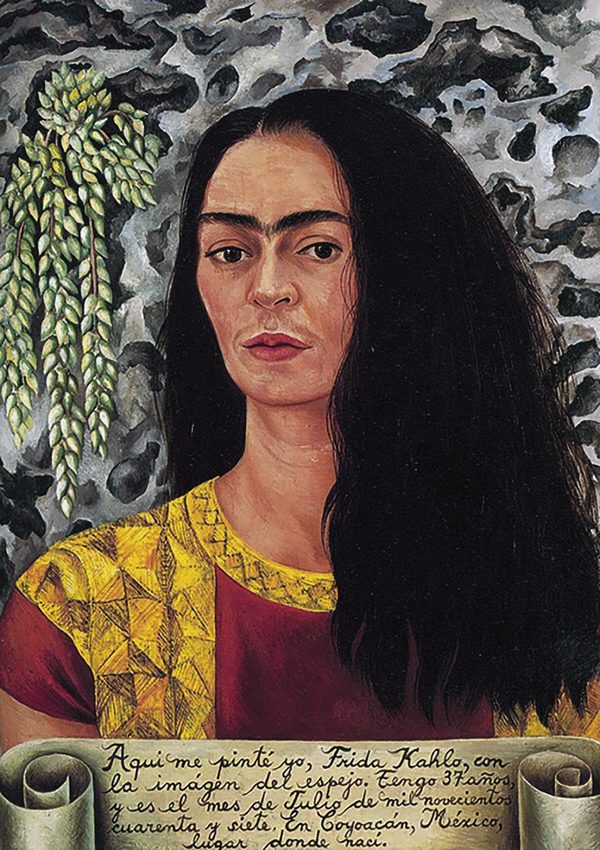
She is the world’s most recognisable female artist, her face adorning more than 100,000 pieces of merchandise worldwide. But behind the iconic unibrow and the vibrant Mexican folklore, Frida Kahlo harboured a far less well-known obsession.
A deep, lifelong entanglement with Jewish people, Jewish culture and Jewish identity.
For decades, Kahlo maintained that her father, Wilhelm Kahlo, was a German-born Jew of Hungarian descent whose parents came from the city of Arad. She said it so often and so convincingly that New York’s Jewish Museum staged an exhibition exploring her Jewish identity, and Amsterdam Jewish Museum curator Rabbi Edward van Voolen chose one of her paintings for the cover of his book on Jewish art and culture.
Then, in 2006, a pair of German historians upended the story. Tracing Kahlo’s lineage to the 16th century, they found Wilhelm came from a long line of German Lutheran Protestants. He had arrived in Mexico in 1891 and changed his name to Guillermo Kahlo. But there was certainly no Jewish ancestry in the family tree.
Israeli art historian and Kahlo scholar Gannit Ankori discovered that Kahlo began emphasising her father’s supposed Jewish background most frequently from 1936 onwards, as the Nazis consolidated power. As a fervent communist, Kahlo may have invented a Hungarian-Jewish heritage to distance herself from Nazi Germany at a time when being German would have been a source of deep shame.
The timing was certainly pointed.
She surrounded herself with Jewish lovers, friends, doctors, dealers and collectors. She kept Jewish books on her shelves and Jewish suffering in her art. She stood up against antisemitism when she encountered it, and she claimed a Jewish identity at a moment in history when doing so carried real danger.
In 1936, just a year after the Nazis banned interracial marriage under the Nuremberg laws, Kahlo painted My Grandparents, My Parents and I, a family tree celebrating her own mixed heritage. Ankori’s research showed that the painting’s composition deliberately echoed the genealogical tables the Nazis used to classify racial purity. Perhaps the artwork was a quiet act of defiance.
But there is another, more compelling explanation. The people who Kahlo surrounded herself with.
Her most significant Jewish relationship was with Hungarian-born photographer Nickolas Muray, born Miklós Mandl in the city of Szeged in 1892. Muray emigrated to the United States in 1913 fleeing the antisemitism that plagued his youth, and met Kahlo in Mexico City in 1931. Their decade-long affair produced the vivid colour portraits in traditional Mexican dress that came to define Kahlo’s public image. According to Muray’s daughter, Mimi Muray-Levitt, when Kahlo divorced Diego Rivera in 1939, Muray believed she would marry him. Instead, she remarried Rivera in 1940.
Kahlo also had a brief but famous affair with Leon Trotsky, who had been given refuge at La Casa Azul, the Blue House in Mexico City that Kahlo shared with Rivera. She painted a self-portrait dedicated to the exiled revolutionary, inscribed with the words “with all my love”.
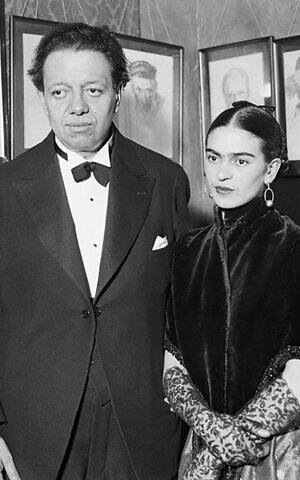
The Jewish figures in Kahlo’s orbit extended well beyond her romantic life. Her first and only solo exhibition in New York was held at the gallery of Jewish art dealer Julien Levy in 1938. She also exhibited at Peggy Guggenheim’s gallery and counted among her collectors Hollywood star Edward G. Robinson, cosmetics magnate Helena Rubinstein and Russian-born Jewish film producer Jacques Gelman.
Her most trusted physician was Dr Leo Eloesser, a Jewish doctor in San Francisco who became a lifelong confidant and persuaded Rivera and Kahlo to remarry after their divorce. Among her closest photographer friends were two Jewish women – Swiss-born Lucienne Bloch, who accompanied Kahlo through her devastating miscarriage in Detroit, and German-born Gisèle Freund, who had fled wartime Europe and spent two years living with Kahlo and Rivera in Mexico.
And then there was Detroit. When Kahlo and Rivera lived in the Motor City in the early 1930s, the artist was outspoken about the antisemitism she witnessed. At a hotel that barred Jewish guests, Kahlo and Rivera threatened to leave, declaring they had Jewish blood themselves. Rivera, descended from conversos – Jewish people in Spain and Portugal who converted to Catholicism to escape persecution or expulsion – on his mother’s side, had stated in 1935 that his Jewishness was the dominant element in his life. The hotel changed its policy.
Back at the Blue House, further clues to Kahlo’s Jewish affinities lingered. Among her possessions were a book of Yiddish poems by Isaac Berliner, whose celebrations of the natural world found their way onto her canvases, a volume of poetry by medieval Jewish poet Yehuda Halevi, and several publications by El Libro Libre, a press established by German-Jewish immigrants in Mexico during the Second World War. Some of her darker self-portraits were reportedly inspired by a book detailing how Jews in Mexico were tortured during the Inquisition.
She surrounded herself with Jewish lovers, friends, doctors, dealers and collectors. She kept Jewish books on her shelves and Jewish suffering in her art. She stood up against antisemitism when she encountered it, and she claimed a Jewish identity at a moment in history when doing so carried real danger.
Whether or not Frida Kahlo was Jewish by blood, the evidence of her life tells a story that runs deeper than genealogy.
comments