



If you wandered into the Ballarat International Foto Biennale this year expecting traditional darkrooms and film canisters, you might have instead found algorithms and prompts.
The Prompted Peculiar International AI Prize, one of the most talked-about exhibitions at the Biennale, saw Melbourne-based musician and visual experimenter Hanna Silver take home the top award, while fellow creative Adrian Elton was named a finalist for the second year in a row.
Launched by the Biennale to explore how artificial intelligence is reshaping photography, the Prompted Peculiar Prize encourages artists to test the boundaries of human–machine creativity.
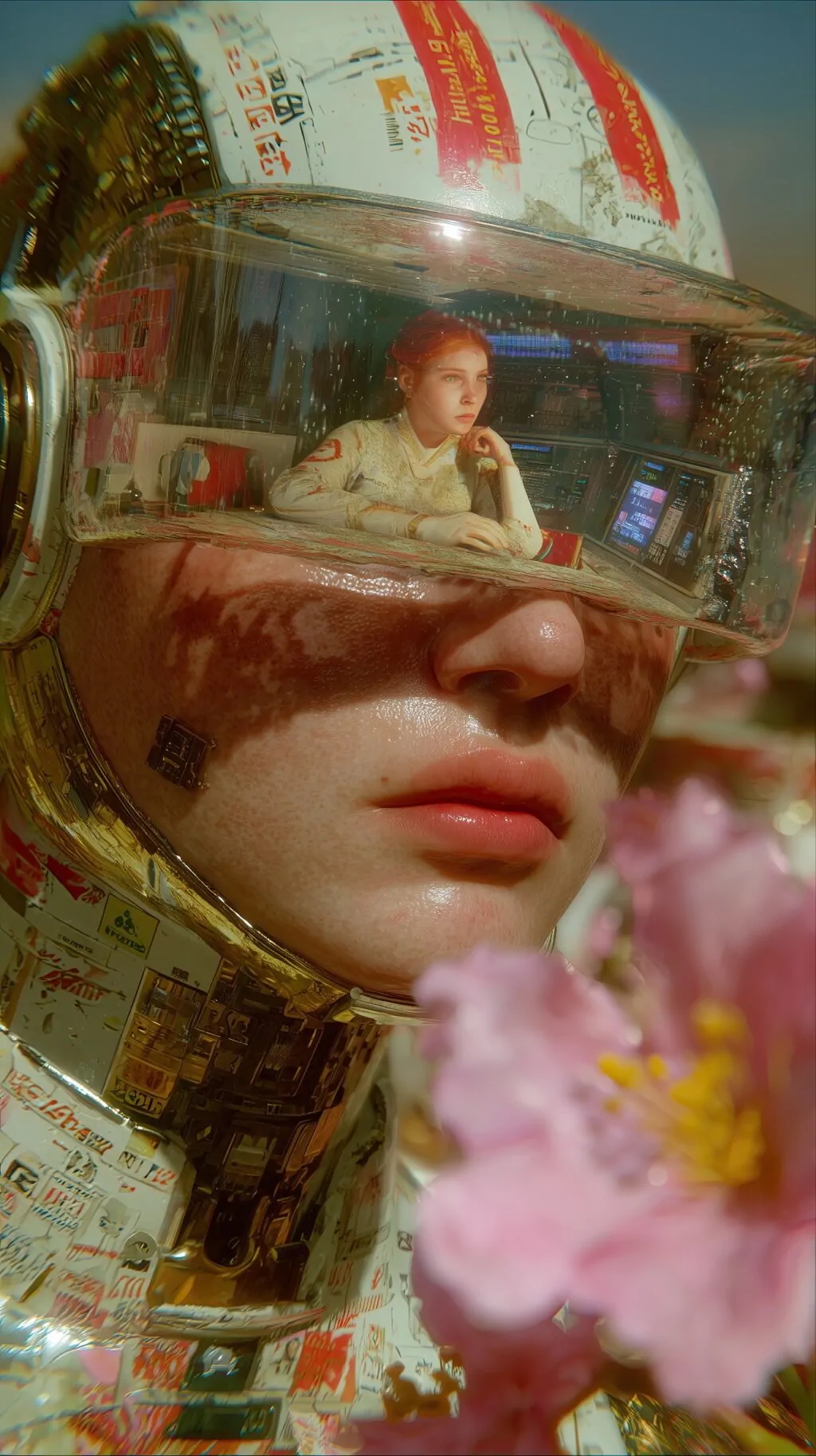
This year’s entries ranged from whimsical dreamscapes to deeply personal visual narratives, and the judges chose Silver’s evocative AI work ‘I’m the only one in here’, as the standout.
Silver didn’t come to AI through the art world but through music.
“I became interested in it in 2022 with the release of DALL-E 2,” she told The AJN. “I was fascinated both by the ease with which one could now create an image, and also the challenge of prompting an AI to get the result you were after.”
While best known as a musician (she’s a member of Lazr Bees), AI offered her a new way to express what words and melody couldn’t quite reach.
Silver insists AI isn’t about replacing creativity, but expanding it.
“It doesn’t improve it, it’s just a new tool. Kind of like if someone invented a new musical instrument. It’s a new way to create,” she said, explaining that despite its speed, it’s not instant artistry. “Spending time prompting to get what you are looking for can sometimes take many tries, and is definitely part of the fun and creativity.”
Her winning image was intensely personal. She described it as a visual mantra for navigating anxiety.
“My image was designed to help me deal with my anxiety on a daily basis. Remind me that I am the only one responsible for my emotions and thoughts. I’m glad the judges got it, what I was aiming for. And grateful that Midjourney generates such beautiful images,” she said.
It’s not Silver’s first appearance at the Biennale.
Last year she won the People’s Choice Award, and this year she walked away with the main prize, a leap she calls “surreal”.
“It took quite a while to sink in. But I’m glad I successfully communicated and expressed via this medium.”
While Silver took top honours, Adrian Elton was also a crowd favourite, and a returning one at that, named as a finalist for this work, ‘Meta Inversion 02’.
“Being a finalist in 2023 was electrifying as AI was still so new. The feeling in 2025 has been more about enjoying the reassuring sense of confirmation that has come from producing work that has been deemed worthy of being selected a second time,” he told The AJN.
Elton, a designer and art director, came to AI from a practical frustration.
“Before AI emerged, if budgets didn’t allow for custom photoshoots we had to cobble disparate stock shots together,” he recalled. “So as the first glimmers of what AI might make possible came into focus in mid 2022, I was smitten and dove in headfirst.”
For him, this technology isn’t replacing artists, it’s expanding possibilities.
“Generative AI is part of an expanded arsenal of tools. But it’s a mega-power-tool on steroids,” he said, explaining though that he’s also clear-eyed about its risks. “There are some extremely valid reasons to be wary of AI; and from a creative perspective, it really is a double-edged sword.”

The ability to generate images without photographers, stylists or assistants, he warns, could mean “some of those team members may invisibly vanish from workflows, projects and the industry.”
Still, Elton sees opportunity in the shift, especially for those who lead rather than follow.
“Those most likely to thrive in this ‘brave new world’ will be those who are at the forefront of creative initiatives, as opposed to those who are downstream and who may never get the call or opportunity to participate.”
So what does all this mean for art, for creatives, or for anyone still trying to figure out if AI is genius or gimmick? Silver, ever the optimist, thinks AI is extremely exciting.
“It will define the coming age and we’re all hoping that those creating AIs are able to keep AI aligned with humanity’s interests,” she said.
But she offers people a warning.
“It’s very important that people know that AI images and video are at the place where they can easily fool us into thinking they are real images. You must be careful not to instantly believe every image and video you see on the internet. Be ready to doubt.”
Between existential fears and beautifully rendered dreamscapes, the Prompted Peculiar Prize reveals something uniquely modern, that art is no longer just about brush to canvas, or even camera to subject. It’s now about the human to machine connection. It’s about how to make poetry out of prompts. And it’s about diving head first into something entirely new.
At the end of the day, as Silver and Elton show, creativity can come from everywhere and anywhere, whether its paint or prompts.
comments