



A Society at Sea
A pre viewing of the Archibald Prize became a confronting reflection on how Jewish identity is positioned in Australia today.
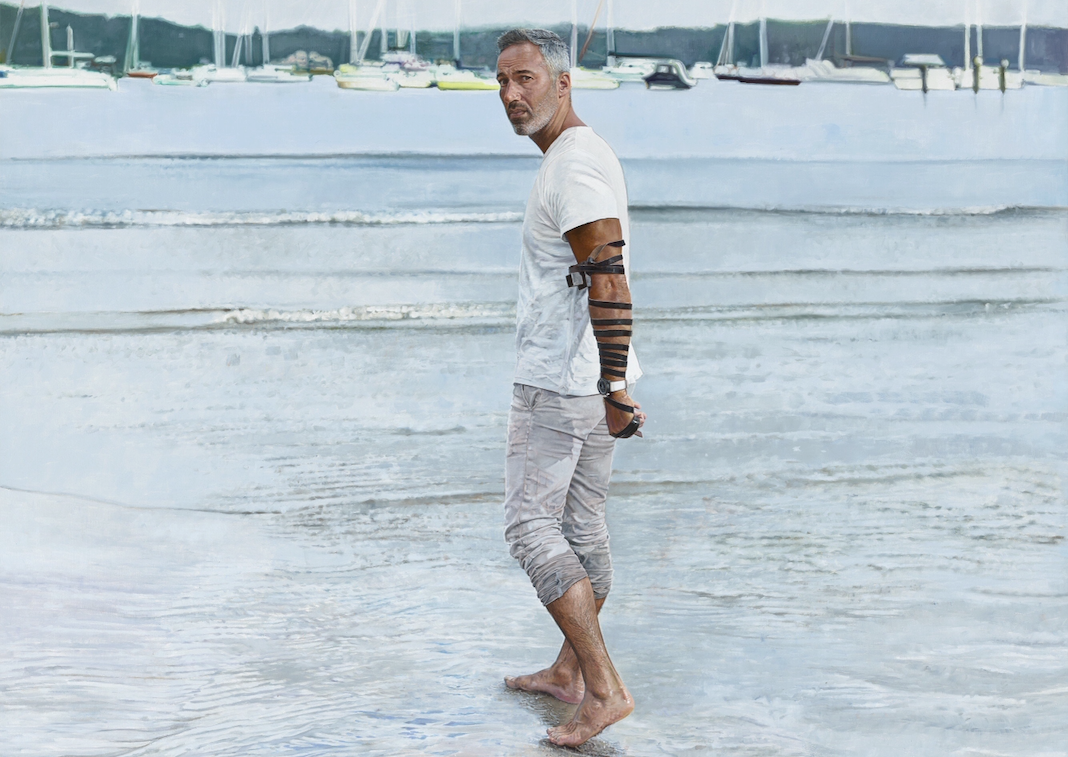
This week I had the privilege of going to a pre-viewing of the Archibald finalists. I was so excited. It had been a tough day listening to testimonies from the Royal Commission on Antisemitism and Social Cohesion and also listening to bigots in court try justify why “globalising the intifada” and supporting Hamas’ charter were not racist, so when offered the opportunity at the last minute to help out a friend while experiencing a pre-viewing of the prestigious Archibald with the curator, I was feeling hopeful for a reset and safe space to end the day.
As the curator took us through the gallery she picked certain works to talk about and it was very interesting understanding the stories behind the artwork. In her introduction the curator mentioned that the finalist collection this year included a number of activists which I thought was an interesting point of hers to make. I see myself as an activist of sorts so I thought I was in for an uplifting evening. Also this year I was particularly looking forward to seeing the portrait of Alex Ryvchin by Michael Zavros, especially since Johannes Leak’s portrait of Alex was for many surprisingly not picked as a finalist in 2025.
One of the first portraits that the curator introduced us to I really loved. It was a painting by Sarah Satha of restaurant owner and charity founder Shaun Christie-David who provides employment to asylum seekers and provides meals to those in need. I loved the backstory and I loved the portrait. Then when the curator spoke about an abstract work being about the need for more generosity of spirit in our society, a lady I didn’t know whispered to me “that is so true, we really need that in these times”. I whispered back that I agreed with her and that I knew that was needed from personal experience. So far I was having fun.
As we continued to walk through the gallery on our guided tour, I was obviously keeping an eye out for the portrait of Alex. This turned out to be a good idea because it’s very likely that I would have missed it otherwise. As we entered each section of the gallery I immediately scanned all the walls for the portrait, of which I had already seen a photo so I knew what to look out for. As we entered section 2 or 3 (I can’t remember which one it was), the curator started speaking about a portrait in the centre of the section and while she spoke I scanned the other walls. I then saw the portrait of Alex on the wall to the left of the entrance when entering that section with a large deep void space next to it between the portrait and the start of the paintings on the perpendicular wall. The painter uses very light colours, mainly white, pale blue and greys and thus blends into the white wall background making the spot chosen to display it in its best light, so to speak, really important. This was not it! A very small portrait was placed next to Alex which seemed really out of place (perhaps there was significance to it but I didn’t get a chance to look at that work). I went up to Alex’s portrait, took a photo and read the artist’s explanation of his work. A couple of people must have noticed that my friend and I had broken away from the rest of the group and came to have a look too. After discussing some paintings in that section, the curator walked past Michael’s artwork and flippantly said something like “Oh and that’s Alex Ryvchin” and moved into the next section. In my opinion she only mentioned it at all because my friend and I spent a lot of time looking at it and taking photos which drew a couple of others to show some interest (or perhaps she saw our Magen Davids?) and I think it would have been awkward for her if she ignored it completely. My enthusiasm for the exhibition was a little dampened but I didn’t yet appreciate how it would soon be crushed.
1. In the last section was the largest most prominent portrait of all, a massive impressive portrait of Daniel Johns which the curator had mentioned in her introduction. The curator spoke about the portraits on either side of the piece. The work on the right of it she explained needed to be placed in just the right spot to be viewed at its best (not her exact words) and it was decided that it should go next to this centre piece. She then went on to talk in detail about the painting on the left of the centre piece, a portrait by Desiree Crossing of Dr Mohammed Mustafa (Dr Mo) called “An ordinary man”. To those not in-tune to how the narrative today in Australia is shaped, this may seem like a perfectly reasonable way for someone to describe themselves or to describe someone else. However Dr Mo knows he is not an ordinary man, and the painter knows that he is not an ordinary man. He, and I assume the painter, knows that he is shaping a narrative in Australia. To be considered an “ordinary man” in Australia you need to prioritise Palestinian suffering in Gaza over all other suffering. To be a “humanitarian” you have to continually talk about the “children of Gaza” as if they are the only children who experience tragedy and need critical medical care. To be an “ordinary man” in Australia you need to be an antizionist, who like Dr Mo supports the eradication of Israel, uses libels and language that demonises Israel and participates in marches in the streets of Perth, Sydney or Melbourne where slogans and death chants against Jews are normalised and where participants don symbols of extremists and terrorists. To be an “ordinary” Australian you have to associate yourself with antisemites like Jeremy Corbyn. The juxtaposition of this painting in terms of artist narrative, text narrative and text tone, and the artwork’s positioning in the gallery was so stark to me. The painting of a proud physically large man with a symbol of his tradition together with the iconic symbol of Australia, our water (“our home is girt by sea”), which to me was also a reference to Bondi Beach, is hidden in a corner. The painting of a supposedly “ordinary” physically large man slumped in a chair as if defeated, perhaps even a victim (to me the image did not portray the idea of humility at all as the painter said she intended), is placed next to the most prominently sized painting in the gallery. For me this tells the story of Australia today. Jews are not “ordinary”, “ordinary” Australians protest against Jews. “Ordinary” Australians get the spotlight and get their voices and presence amplified, Jews (Zionist Jews as they like to differentiate) are not “ordinary”. As Michael Zavros wrote “…symbols are so important in contemporary culture. All too often, when marking identity, they are used to harm people.”
comments