



Live updatesPublic hearings
Academics and faith leaders address social cohesion
Hearing Block continues continues today focusing on strengthening social cohesion, including how it is understood and measured.
Laureate Professor Dr Marcia Langton has told the Royal Commission on Antisemitism and Social Cohesion that Jewish Australians and Aboriginal people share a deep historical bond forged through their common experience of racist ideology and genocide.
Langton, a Yiman and Bidjara woman and Melbourne Laureate Professor, gave evidence about the role of eugenics in underpinning violence and discrimination against both communities.
“When you look at a specific form of racism in one country, like Australia, you look to its antecedents. Where did this racism come from?” Langton said. She traced it to European ideas about inferior races, formalised in the 1800s and deployed to justify imperial expansion, conquest and genocide.
She described how the University of Melbourne’s anatomy department, beginning in the 1880s, collected and dissected Aboriginal human remains in an attempt to prove Aboriginal people were an inferior race, a practice that continued for decades.
“At one time, the University of Melbourne had the largest collection of human remains in Australia, possibly the world,” Langton said. She noted it was not until 2016, through changes to the Victorian Aboriginal Cultural Heritage Act, that holding such collections became illegal.
Commissioner Virginia Bell drew attention to the role Jewish lawyers have played in advancing Aboriginal rights, asking whether members of the Jewish community had been at the forefront of that struggle.
“Oh yes, that’s entirely the case,” Langton replied, citing Ron Castan, Bryan Keon-Cohen and others involved in the landmark Mabo Number Two High Court case, and Ron Merkel SC in the case to repatriate stolen Aboriginal remains from the University of Melbourne.
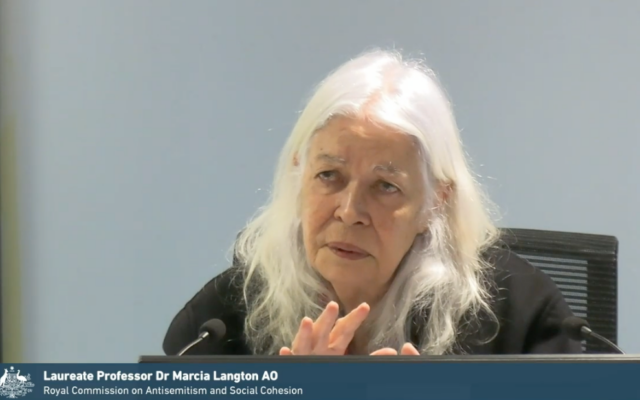
Bell observed there was “an alliance, of a sort” between Jewish and Aboriginal Australians.
Langton agreed, pointing to William Cooper’s protest march to the German consulate in Melbourne following Kristallnacht in 1938 as a foundational moment. Cooper, an Aboriginal elder from Cummeragunja, led a delegation to protest the Nazi pogrom.
“Still to this day in Melbourne, that protest is acknowledged by some public event, because nowhere else in the world had anybody protested against Kristallnacht,” Langton said. She noted Cooper is now honoured at the Melbourne Holocaust Museum.
Langton said the bond extended through decades of shared advocacy. Jewish Australians who arrived in the country after the Second World War joined Aboriginal advancement leagues and worked alongside Indigenous communities.
“Because they landed in this country and saw a situation very similar to what they had experienced, and I think that binds us together in many ways,” Langton said.
Langton said the history of collaboration between the two communities deserved greater recognition. “I don’t think enough is made of this. And this is really important for curriculum, actually,” she said.
Laureate Professor Dr Marcia Langton has told the Royal Commission she does not know a single First Nations person whose life has not been profoundly impacted by racism and discrimination.
Langton drew on more than 50 years of academic and public advocacy for Aboriginal and Torres Strait Islander rights.
She described growing up in Queensland where segregation was entrenched. At about six or seven years old in the town of Bollon, she realised Aboriginal children had to wait in the local shop until all white customers had been served.
“If white people kept coming into the shop, we just had to wait,” she said, adding she witnessed the same treatment years later when travelling in Cape York with her own daughter.
Langton told the commission she was expelled from high school despite being a prefect and high-performing student after she challenged a teacher who recited a racist poem in class.
“I stood up and said, ‘Mrs McKenna, that’s a very racist poem,’ and she went straight to the principal, and I was expelled,” Langton said.
She detailed her work as director of the Underlying Issues Unit in the Northern Territory for the Royal Commission into Aboriginal Deaths in Custody. Across approximately 12 cases along the Stuart Highway, she identified common factors including alcohol access, underemployment, lack of education and what she described as medical racism.
In one case in Katherine, a man was taken to hospital by police but the nursing sister refused to treat him.
“He was carted out to the nature strip in the middle of the road and dumped. And the police called to take him away. And of course, by morning he was dead in his cell,” Langton said.
She said her advocacy work came at a personal cost. Northern Territory police arrested her, and she believed it was police who kicked in her hotel room door while she was on royal commission business.
“It sounded like an explosion. The door was broken. It was off its hinges,” she said, adding the hotel manager was “obviously frightened” and the matter went no further.
Langton told the commission the removal of Aboriginal children from their families was now occurring at much higher rates than at any previous point in history.
“I put it down to an incompetent system and racism,” she said.
Laureate Professor Dr Marcia Langton has told the Royal Commission that teaching anti-racism directly in schools does not work because people are “utterly resistant to it”, and that integrating Indigenous knowledge systems into the curriculum offers a more effective path.
Langton, who established the National Aboriginal and Torres Strait Islander Curricula Project in 2017, gave evidence about her decades-long effort to reform how Indigenous content is taught in Australian classrooms.
She said many university students arrived in her classes knowing “almost nothing” about Aboriginal and Torres Strait Islander people. Some did not believe Indigenous Australians still spoke their own languages.
To challenge those assumptions, she developed a course called Garma Fieldwork, taking students to the Garma Festival in Arnhem Land, Australia’s largest Indigenous gathering, for a week of cultural immersion over seven years.
“When they heard Yolngu people speaking Yolngu Matha at Garma, they were shocked,” Langton said. “It was actually a very good cultural immersion experience for breaking down a lot of their stereotypes.”
The curricula project, initially funded by the Department of Prime Minister and Cabinet and subsequently by BHP, took a different approach to anti-racism education. Rather than confronting racism head-on, Langton built the curriculum around Indigenous knowledge systems, focusing on three areas: fire, water and sky.
“Once you say to a student there are indigenous knowledge systems, you immediately run up against the racist idea that all indigenous cultures are tabula rasa,” she said.
The project has produced 1000 curriculum resources, all freely available to teachers.
In approximately 2020, University of Melbourne education professor Malita Hogarth took over the project, now known as the Ngarrngga project, to formalise classroom testing. It has been funded twice by BHP.
But Langton said implementation remained a challenge. When teachers were interviewed about why they were not using Aboriginal and Torres Strait Islander curriculum, they said they feared being accused of racism and did not know how to assess available materials.
She said racist parents also created barriers by complaining to school principals, dismissing Indigenous knowledge as “superstition” and opposing the teaching of Indigenous content.
Langton said government funding was essential for sustainability, arguing it was “racially discriminatory” for education departments not to invest in developing Indigenous curriculum and training teachers to deliver it.
Commissioner Virginia Bell asked whether the curriculum incorporated teaching about discrimination itself. Langton said the program had not yet reached that point, noting the challenge of introducing traumatising material to children at appropriate ages.
“We have to be very careful about how we introduce this material into the classroom, at what age, how it is taught, because if there are vulnerable children in the classroom, especially Aboriginal and Torres Strait Islander children, this is a very traumatising topic,” she said.
Professor Marcia Langton has told the Royal Commission into antisemitism and social cohesion that Australia needs a single national agency to combat racism.
Antisemitism, Islamophobia and racism against Aboriginal and Torres Strait Islander people are each founded on “myths and lies”, she said, and must be confronted together.
Giving evidence as a fellow of the Academy of the Social Sciences in Australia, Langton said the academy’s submission to the commission recommended that governments implement the relevant findings and proposals of the Multicultural Framework Review and the Australian Human Rights Commission’s National Anti-Racism Framework “without delay” as a coordinated national response to antisemitism, racism and social division.
A second recommendation would consolidate the functions of the Office of Multicultural Affairs and the government’s social cohesion functions, along with governance roles envisaged by both reviews, into a dedicated national body recognising social cohesion as a whole-of-government, nation-building priority.
Langton said the current approach was fragmented. “At the moment, the approach is split up with all these committees and working groups, and we need to bring it all together and tackle racism and xenophobia in a systematic way, in a coordinated way,” she said.
Australia has a Race Discrimination Commissioner and an Aboriginal and Torres Strait Islander Social Justice Commissioner, she said, but “there is no national body for tackling racism”.
Asked about the submission’s recommended dual framing of anti-racism and antisemitism work, Langton said each ideology had to be understood on its own terms. Antisemitism, she said, came from “a very particular body of ideas in medieval Europe”, while hatred of Aboriginal people originated in Europe but developed in Australia.
If Australia was to survive as a multicultural society, she said, young people needed to be educated “to think critically”, and to be accurately informed about the diversity of cultures, religions, lifestyles and knowledge systems.
Langton said she had been labelled a “Zio” by the pro-Palestine movement in Melbourne. Speakers had withdrawn from panels she was listed to appear on, international figures had been told she was a “Zio”, and her car windows had been smashed.
“They will not allow any debate of the issues by labelling me as a Zio. I’m therefore made voiceless in the debate,” she said.
Langton said that while she was horrified by and opposed to what is happening in Gaza, that could not excuse the treatment of Jewish Australians.
“The foul treatment of Jewish Australians cannot be justified by saying that Israel is doing this in Gaza. They’re Australians. This is our country. This is where we have to treat each other properly,” she said.
“There can be no peace if the pro-Palestine movement make enemies of Jewish people in our country. We have to be united for peace, not dividing our country by ethnicity.”
She described the movement’s use of the word “Zio” as illogical and “another form of xenophobia”.
Invited to expand on the principle of “nothing about us without us”, Langton said decisions affecting First Nations communities were still too often made without consultation or expert advice, despite evidence that community involvement produced decisions that were trusted and services that were used.
“Leaving us out of the picture and focusing solely on other forms of racism and xenophobia is not going to fix it,” she said. A handful of people might be persuaded not to be antisemitic, she added, but they would still hate Aboriginal people, and the problem of racism and eugenics would continue.
Asked by a commissioner whether she supported the National Anti-Racism Framework in general terms, Langton said she did, “very much so”.
An early childhood education model developed at a Jewish-founded centre could be trialled across other cultural communities, after engagement with state and Commonwealth education departments, the Royal Commission on Antisemitism and Social Cohesion has heard.
A witness, who gave evidence under the pseudonym AEA with her image withheld from the live feed, told the commission she had been in discussion with both levels of government about a possible trial.
She said departmental officers had visited the centre and taken part in the weekly challah bake with the children.
“I’m very, very grateful for the engagement that I’ve had,” she said.
The centre was established in 2020 in consultation with her husband, an early childhood educator, and a team of teachers. It enrols both Jewish and non-Jewish children.
The witness estimated that about 70 per cent of those currently enrolled are not Jewish. Staff come from more than 15 backgrounds, including Turkish, Greek, German, Chinese, Japanese, Nepalese, Spanish, Irish, Chilean, Brazilian, First Nations, Israeli, Lebanese, French and South African.
The model teaches Jewish cultural practices as multisensory experiences and links them to values the witness said were held across Australian society. Children receive a portion of dough each Friday, shape it themselves, and take the baked loaf home to share with their families.
On Tu B’Shvat, the Jewish new year of the trees, children are taken into the garden to consider their own roots, what nourishes them and what they might give to others.
The witness told the commission that the approach amounts to a form of primary prevention of antisemitism, because it reaches children while their sense of identity is still forming.
“Identity formation is most actively shaped in those early years, and the first five years of life really represent a significant period of development,” she said, adding that bias towards others emerges at about three years of age and increases, “peaking at seven years of age”.
The opportunity, she said, was to build positive associations and meaningful connections with others “before prejudice has even had the opportunity to take root”.
Counsel assisting noted that the witness did not hold herself out as a child development expert in an academic sense.
The centre’s program was built within Australia’s National Quality Framework and the Early Years Learning Framework, and the witness said it would require no regulatory change to operate elsewhere. She said the same structure could be applied to any community’s traditions: “You take that practice, you make it multisensory, and you link it to shared values.”
She told the commission that early childhood educators should be supported with practical resources and training, and said her understanding was that what she described as the social cohesion education hub would welcome material in the area.
In closing remarks, the witness said her team had spent six years refining the model.
“It’s grounded in strong pedagogical principles, but it’s also quite simple,” she said. “If we want a more connected society, we must start where that connection begins in our society’s earliest years.”
Most non-Jewish parents at a Jewish-founded early learning centre had never knowingly met a Jewish person before enrolling their children, the Royal Commission on Antisemitism and Social Cohesion has heard.
A witness, known to the commission as AEA, gave evidence under a pseudonym with her image withheld from the live feed. She said she had established the centre in 2020 intending it to be inclusive, and had expected an enrolment split of roughly half Jewish and half non-Jewish families. About 70 per cent of children now enrolled are not Jewish.
What surprised her, she said, was how little the families enrolling knew.
“Parents would tell us that they had had very little exposure, if not any, to Jewish life and traditions,” she said. “Most had never knowingly met a Jewish person.”
Those parents had perceived the Jewish community as a closed one, she said, something she attributed to its small size and to the fact that Judaism does not seek converts, rather than to any intention on the community’s part.
The consequence, on her account, was that curiosity went unmet and was satisfied elsewhere.
“They’ll turn on the news or they’ll search online, and that’s where they’ll find their information,” she said. “What it comes down to is really that there is that void there, and I think this is an opportunity.”
The witness said parents welcomed the chance to learn about Jewish culture, and read to the commission feedback from the father of one child at the centre.
“We’re not a Jewish family, but we love learning about it so much,” the father said. “And in fact, our son comes home and teaches us more than we’ve ever known about the cultures. He brings home different art, and he’s so proud of the things he’s created.”
She described what her statement called a multiplier effect, in which contact reaches beyond the enrolled child. Parents speak with educators at drop-off and pick-up, see photographs during the day and receive what children bring home.
Grandparents and other relatives ask to see the photographs. Educators themselves, she said, go through the same process of learning about the cultures and reflecting on their own values.
New parents were unusually receptive, she said, because early parenthood is a period in which people reconsider what they want to pass on.
The witness told the commission that face-to-face encounters were necessary for social cohesion but were not sufficient on their own.
“Tolerance and understanding of others are vital foundations in our society,” she said. “We’ve got to go a step further than just tolerance and understanding. We’ve got to discover those points of connection beneath our differences, and those connection points are the glue.”
She said she had wanted to offer the commission something constructive after weeks of evidence she described as harrowing.
“At times it has been deeply confronting,” she said. “What I hope to offer today is something constructive.”
Global Reconciliation executive director and Monash University professor of medicine Paul Komesaroff has told the Royal Commission into Antisemitism and Social Cohesion that Australia needs a coordinated, whole-of-society response to communal division, drawing on lessons from reconciliation work within the Australian Sri Lankan community.
Komesaroff, who is Jewish, gave evidence to the commission today describing the work of Global Reconciliation, an organisation he has led since its founding in 2004 in the wake of the September 11 attacks.
He said the organisation had operated as a coordinating network, rather than a funder, across more than 50 countries, including reconciliation projects in Bosnia, HIV-related community work in Africa, and initiatives in Myanmar and East Timor.
Komesaroff said reconciliation was distinct from conflict resolution. “In reconciliation, what we seek to do is to promote communication and dialogue across difference,” he said, adding that the aim was to draw on differences “in a productive and creative way” rather than simply identifying what kept people apart.
He pointed to the Australian Sri Lankan community’s response to that country’s civil war, which ran from 1983 to 2009, as a model relevant to other conflicts. He said a formal dialogue process led by the Latrobe Centre for Dialogue in 2007 and 2008 brought together Sinhalese, Tamil and Muslim community members and ultimately produced a memorandum of understanding recognising both political differences and shared values.
He said the reconciliation work in Australia had subsequently been shared back with communities in Sri Lanka itself, including through a 2010 workshop and AFL-run football clinics.
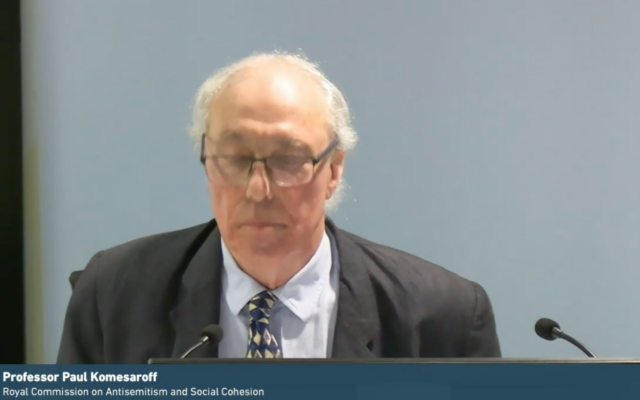
Turning to antisemitism, Komesaroff told the commission it was not a “simple uni-causal” problem. He said the phenomenon carried “the grotesque history of criminality” documented since the Holocaust, but that Jewish people had also historically been made the subject of a “projection of issues that arose in the culture of threats, of vulnerability, of uncertainty”.
He said responding to antisemitism and other forms of racism required addressing psychological, communication, structural and historical dimensions simultaneously, rather than relying on education alone.
Komesaroff backed the National Anti-Racism Framework and proposed a federal office of reconciliation to coordinate what he called the “extraordinary set of capacities” of grassroots reconciliation projects already operating across Australia, many of which he said worked “under the radar” and in isolation from one another.
He said such an office would collect evidence on what worked, but stressed it should not originate projects itself. “It’s important that they come from the community,” he said.
Asked by the commissioner about the incident at Bankstown Hospital with the two nurses and whether he could offer reassurance to the Jewish community about using public hospitals, Komesaroff, an endocrinologist who said he works only in the public system, said such conduct was “completely reprehensible and inappropriate” on any side.
“I’m there to serve my patients, whoever they happen to be, and I would believe that for the overwhelming majority of practitioners, that would be the ethos that they would follow,” he said. Asked whether he would worry for his own safety if admitted to a public hospital, he said no.
The multi-faith officer at the Faith Communities Council of Victoria (FCCV), Sandy Kouroupidis, has told the Royal Commission into Antisemitism and Social Cohesion about the council’s interfaith programs and the current state of interfaith interaction in Victoria.
Kouroupidis gave evidence to the commission describing the FCCV as Victoria’s peak multi-faith body, an umbrella group whose members include the Victorian Council of Churches, the Islamic Council of Victoria, the Jewish Community Council of Victoria, and councils representing Buddhist, Hindu, Sikh, Jain, Bahai and Brahma Kumaris communities.
Kouroupidis said the council’s programs were built around four conditions for social cohesion: a sense of belonging, opportunities to learn about other faiths, opportunities to meet people from other faiths, and opportunities to work together for the common good.
These included a religions and worldviews education pilot developed with Faith Values and auspiced by the FCCV; the Sacred Victoria project, which aims to photograph 100 places of worship and 100 festivals across Victoria with content authored by the communities themselves; and the Victorian Interfaith Festival, now in its 17th year, held annually in a different local government area and designed as a successor to the 2009 World Parliament of Religions.
Kouroupidis said the council also maintained a multi-faith calendar used by schools, government departments and employers to avoid scheduling clashes with religious holy days, and worked with the Sunday Age to publish personal faith-based stories from community members.
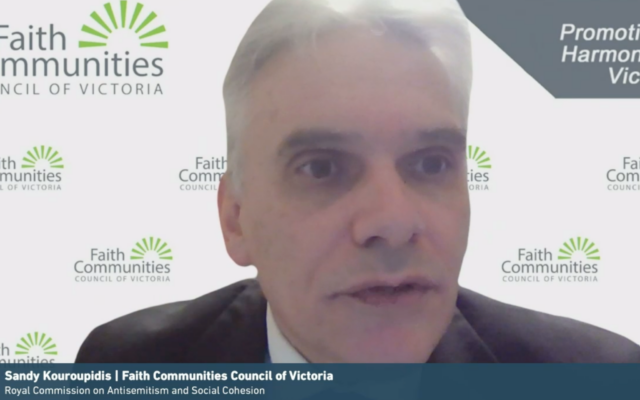
Asked to identify common patterns behind antisemitism, Islamophobia and other forms of religious prejudice, Kouroupidis pointed to misinformation, stereotyping, fear and dehumanisation.
“The only way that we can counteract that misinformation and the stereotypes is to literally… get people to see each other, meet each other in the flesh,” he said.
Asked by the commissioner whether the council was aware of a chill in Jewish-Muslim relations since the October 7 Hamas attack and the subsequent war in Gaza, Kouroupidis said the FCCV’s two vice-chairs — the chairs of the Islamic Council of Victoria and the Jewish Community Council of Victoria — had found it “very, very challenging” to be brought into the same room.
“In the past, before October 7, there used to be wonderful programs where Jewish schools used to go and visit Muslim schools, and Muslim schools used to go and visit Jewish schools and Christian schools,” Kouroupidis said. “Unfortunately, that doesn’t exist anymore. A lot of the Jewish schools simply don’t feel safe.”
Kouroupidis said the Bondi attack had also had “a really huge impact on the Jewish community here in Victoria,” with fewer Jewish community members now attending FCCV interfaith events.
Interfaith educator Abe Schwarz has told the Royal Commission on Antisemitism and Social Cohesion that building familiarity between communities is the key to combating prejudice, describing it as “the antidote” to fear of the other.
Schwarz, a Melbourne-born Jewish man whose family migrated from southeast Ukraine almost a century ago to the day, gave evidence about decades of work bringing together people of different faiths and backgrounds through dialog programs.
Central to his approach, he told the commission, is the Hebrew concept of b’tselem Elohim, meaning “in the image of G-d”. It’s the idea that all of humanity shares a common divine spark.
“The only way forward out of the depths of challenges we’re in right now, I believe, is if we can learn to find a way to see the humanity of the other,” Schwarz said.
“There’s a risk of fear, fear of the other, and the antidote is the familiarity of the other. So I want to build up the antidote, and that’s what all these projects have been about.”
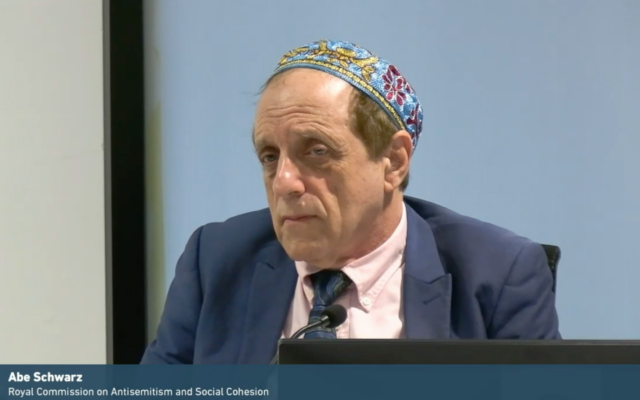
In the early-to-mid 2000s, Schwarz co-founded the Jewish Christian Muslim Association of Australia (JCMA), which sent panels of one Jewish, one Christian and one Muslim representative into Victorian schools.
Drawing from a pool of roughly 30 to 40 volunteers, the panels ran sessions of up to 90 minutes with year eight and nine students, often beginning with a game asking students to guess which panellist belonged to which faith.
“Within half an hour to an hour, so many stereotypes broke, came down,” he said. “They just assumed all Jews and Muslims want to kill each other and hate each other, and we tried to work around that.”
The JCMA did not survive the events of late 2023, but Schwarz told the commission he pivoted to a new model of Jewish-Muslim dialog within weeks of October 7.
For his birthday in mid-December 2023, he brought nine Jews and nine Muslims together at the Initiatives of Change facility in Toorak, adapting the yarning circle format he had previously used with First Nations and non-First Nations Australians.
The sessions have continued at least monthly since, typically on the first Sunday of the month, supplemented by joint concerts and performances. Schwartz said some attendees came directly from pro-Palestine rallies in Melbourne, having spoken from the podium at those events.
“To me, that gave me a lot of hope,” he said.
“I didn’t just want the lefties of the Melbourne Jewish community and the more conciliatory of the Melbourne Muslim community. To cop out and just do it with people that are already getting along well and respectful — that’s not the work.”
Melbourne interfaith educator Abe Schwarz has told the Royal Commission how he spent a decade working to complete two pieces of “unfinished business” left by Yorta Yorta elder William Cooper, who protested against the persecution of Jews in Germany in the wake of Kristallnacht.
Cooper, who lived from 1860 to 1941, is known as an early founder of what became NAIDOC. In the mid-1930s, he gathered 1814 signatures on a petition to King George V calling for Aboriginal representation in parliament, but the petition was blocked by Joe Lyons’ government from being sent to the monarch.
On December 6, 1938, four weeks after Kristallnacht, Cooper led a group of Aboriginal elders on a march through Melbourne to the German Consulate on Collins Street to deliver a letter protesting the persecution of Jews in Germany. Security would not allow them in.
“Most historians agree that there’s no record that it ever got past the security desk,” Schwarz told the commission. “It probably got torn up and thrown out, that same moment.”
Schwarz said he had become close friends with Cooper’s grandson, known as Uncle Boydie, now 98, who had been a 10-year-old boy at the time of the 1938 protest. He formed a committee, initially called Uncle Boydie’s Dream and later renamed William Cooper’s Legacy, to fulfil two goals: getting the petition delivered to the monarch, and securing an apology from Germany.
Both were achieved. The petition was delivered to Queen Elizabeth through an audience with Prince William during a visit to Sydney, with then governor general Peter Cosgrove involved in the handover.
In 2017, Schwarz accompanied Uncle Boydie to Berlin, where they met a representative of then chancellor Angela Merkel. Three years later, during COVID, a video message was sent to Australia on behalf of the German government.
“[They said] we are really sorry to the descendants of William Cooper and all the other Aboriginal people that marched that day,” Schwarz said. “Had we listened to the message, the world history might have been different. We apologise that our previous ambassador didn’t do the right thing and receive you.”
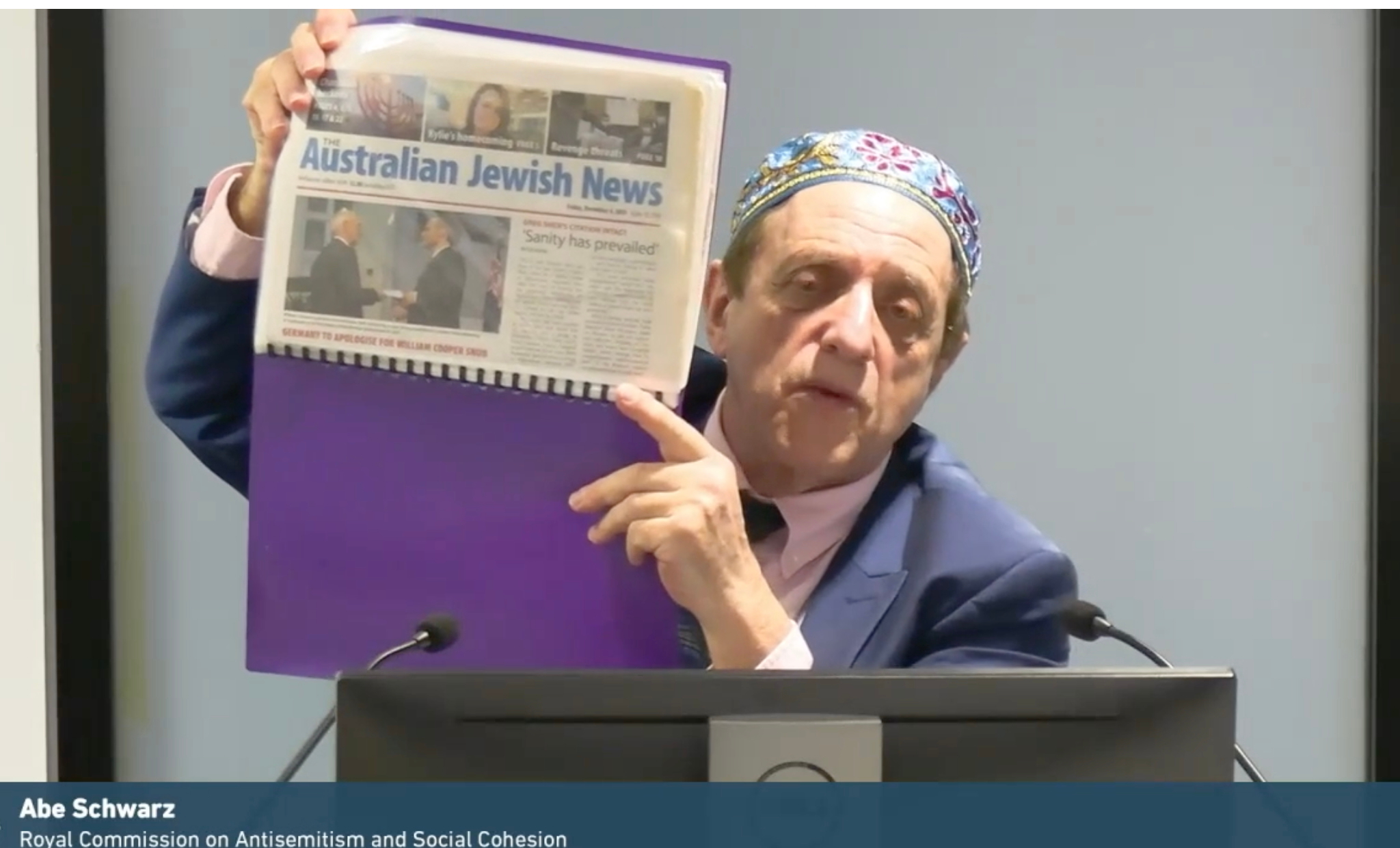
Schwarz said the project was retired about three years ago after both goals were achieved.
He also told the commission that his involvement with Cooper’s legacy grew out of broader work with First Nations communities, which included managing a national project encouraging Indigenous young people who had dropped out of school to return to education, and participating in the 2000 Sydney Harbour Bridge Walk for Reconciliation.
Melbourne-based interfaith educator Abe Schwarz briefly continued giving evidence, offering a candid account of why informal, grassroots interfaith work has proven more resilient than formal governance structures.
Schwarz told the Commission that the collapse of the Jewish Christian Muslim Association of Australia (JCMA) illustrated the fragility of top-down models.
He explained that the peak bodies representing Victoria’s Jewish and Islamic communities, along with the Council of Churches representing the Christian group, formed JCMA’s governance structure.
At least the Jewish and Islamic peak bodies, he said, became unable to communicate with each other after taking offence at comments attributed to one another.
By contrast, he said, relationships between grassroots participants doing the actual dialogue work survived intact.
Schwarz acknowledged the practical costs of remaining unincorporated, noting that grassroots operations cannot access grants or philanthropic funding without deductible gift recipient status, forcing volunteers to “suck it up” and do the work unpaid.
He also stressed the emotional weight of the work itself, describing how meaningful truth-sharing dialogue requires participants to confront significant trauma, grief and pain.
Schwarz recommended that, should the Commissioner consider formal recommendations, government support for trauma-informed counsellors with specialist skills be included, noting he currently has such a professional supporting him.
He said skilled, qualified facilitation is essential to safely guide participants through what he described as very difficult conversations.
Father David Ranson, diocesan administrator of the Catholic Diocese of Broken Bay and parish priest of Chatswood, gave evidence to the Royal Commission this afternoon, detailing years of interfaith engagement across Sydney’s North Shore, Northern Beaches, and Central Coast.
Asked about the origins of his relationship with the local Jewish community, Father Ranson gave a striking account of how the events of 7 October 2023 had immediate personal resonance for his parish.
He told the Commission that a number of his parishioners had just completed a pilgrimage to Israel and were still there when the attacks occurred, leaving the parish “quite concerned at the time for their safety.”
He said the experience was “very real, and very personal,” and it became the catalyst for the parish reaching out to local Jewish leaders within days to express solidarity.
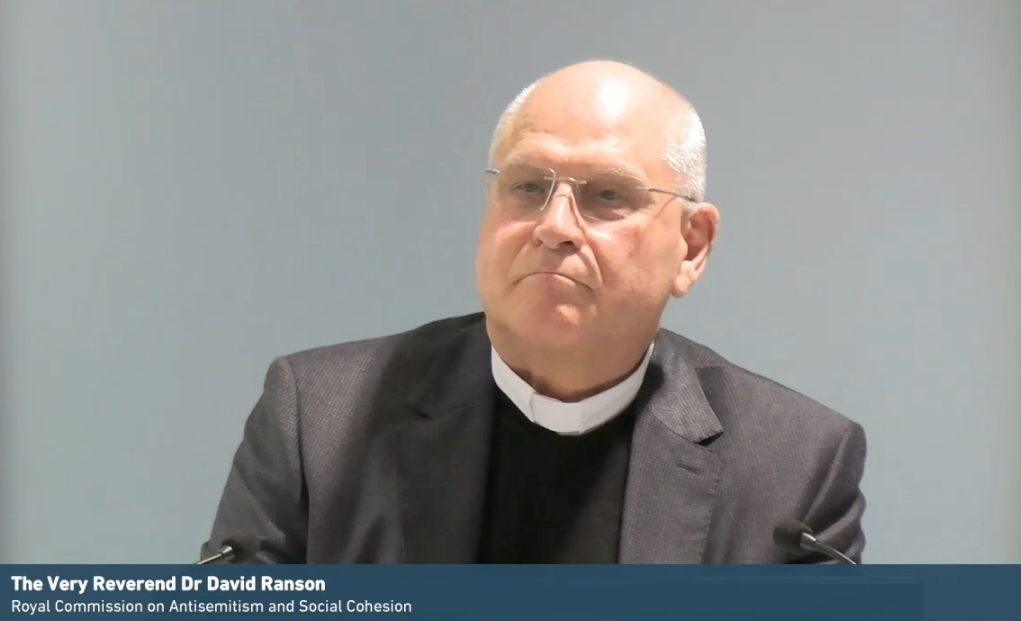
That outreach led to a series of vigils. A prayer vigil for peace held soon after 7 October included Muslim and Buddhist representatives, though the Jewish community was unable to attend due to prior commitments.
A further vigil of memorial followed the attack on 14 December, which Jewish community members did attend, and a larger service on 16 December 2025 drew Jewish attendees from well beyond Chatswood — a turnout Father Ranson said he found personally moving, describing himself as “quite amazed” by how many people travelled to be there despite limited promotion.
The Commission also heard about a joint initiative between the parish and the local synagogue: a series of “podcast evenings” built around the American series This I Believe, in which Catholic and Jewish participants listen together to short, non-doctrinal reflections on human experience before discussing their reactions.
Father Ranson said the initiative had fostered genuine friendships and an “ease of presence” between the two communities.
Counsel Assisting, Jane Taylor, raised plans that had been made for an upcoming joint choral event, and Father Ranson explained that idea had come from a member of the synagogue congregation following the December vigil, who had told him: “the best way to unite, to discover a unity between ourselves, is through music.”
He said the suggestion had prompted the parish and synagogue to begin working towards a joint choral afternoon as a further extension of their partnership.
Father Ranson said his parish — itself heavily multicultural, with large Filipino, Indonesian, Korean and Chinese communities — had responded to these interfaith initiatives “very enthusiastically, very warmly, very hospitably,” with no shortage of parishioners willing to participate, and no objections raised to the growing partnership with the Jewish community.
Bishop Philip Huggins, Episcopal Advisor for Peace Building in the Anglican Diocese of Melbourne, gave evidence to the Royal Commission on Antisemitism and Social Cohesion this afternoon, describing a new role he took up in January this year directly in response to the Bondi Chanukah terror attack.
Bishop Huggins told the Commission he had accompanied Melbourne’s newly arrived Anglican Archbishop to a gathering in Federation Square in solidarity with the Jewish community after the attack, introducing him to interfaith leaders and parliamentarians present.
Out of that experience, the Archbishop suggested Bishop Huggins take on the peacebuilding role to help the Church contribute meaningfully “to this pivotal time of the Royal Commission.”
Bishop Huggins recounted two deeply personal exchanges with members of the Jewish community that he said illustrated why bridge-building work remains urgent.
At a roundtable held after a Shabbat meal at a northern Melbourne synagogue, a congregant described his anguish over whether to send his son to a local state secondary school or a Jewish school requiring armed guards for security.
Separately, Bishop Huggins recalled meeting a friend and descendant of Holocaust survivors at a funeral in early January, who told him: “I am so glad my parents are not here to see this now.”
Bishop Huggins said such stories underscored both the tiredness and trauma many in the community are carrying.

Earlier in his evidence, Bishop Huggins gave a concise account of several peacebuilding initiatives developed through roundtables held since January under the banner “One and Free,” a phrase drawn from the national anthem.
These include the “100 Days of Peace,” a nightly online meditation gathering running from 13 June to the UN International Day of Peace on 21 September, featuring reflections from participants worldwide — including, he noted, a message from the Dalai Lama — and culminating in a roundtable at Federal Parliament on 17 September.
He also described “Voices of Unity,” a walk-and-talk podcast series led by Dr Mujib Abid, an Afghan community advocate, aimed at sharing uplifting stories of ordinary Australians with mainstream media; and “Sacred Spaces for Peacebuilding,” gatherings combining silent multi-faith meditation with dialogue, which Bishop Huggins said fostered listening and trust ahead of difficult conversations.
Asked how faith communities should approach this responsibility, Bishop Huggins said leaders’ willingness to stand alongside one another through crises — citing both the Bondi Chanukah attack and the Christchurch mosque massacres — was a genuine strength of Australia’s multicultural and multi-faith resilience, and one the nation would need as it worked to implement the Commission’s eventual recommendations.
Bishop Huggins became visibly emotional as he relayed advice given to a Romanian Holocaust survivor by Rabbi Ralph Genende — “do what you can while you can” — and spoke of his own resolve, made several years ago, to focus his remaining efforts on benefiting his grandchildren’s generation.
He told the Commission that the roundtables would continue.
The Catholic Archbishop of Melbourne has told the Royal Commission on Antisemitism and Social Cohesion that the surge in antisemitism in Australia was already under way within days of October 7, 2023, before Israel began military action in Gaza.
Archbishop Peter Comensoli, giving evidence on Wednesday, said he released a statement to every parish, school and Catholic organisation in the archdiocese within the first couple of days after the October 7 attacks.
“There was already an explosion of antisemitism that had happened, and this is long before any action that the Israeli state took in Gaza,” he said.
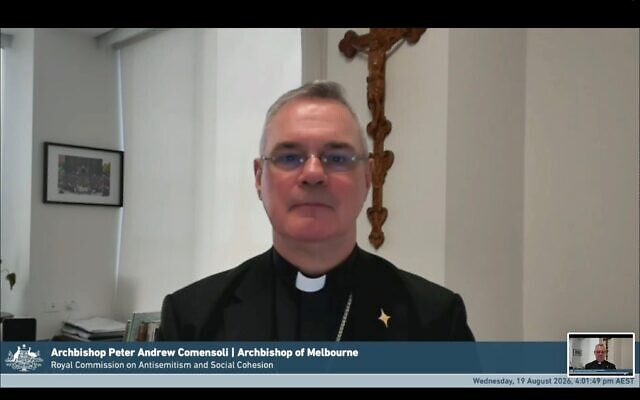
“I’m not making comments on what was happening in Israel, in Gaza. That was what was happening here, and I was seriously disturbed by this explosion of antisemitism that took place, and I felt it absolutely necessary that I challenged that publicly and to extend my solidarity to the Jewish community here in Melbourne and beyond.”
He issued a further statement after the Bondi Beach attack in December, which was distributed the same way and released to the media.
Comensoli, a co-signatory to the Australian Catholic Bishops Conference submission to the commission, said the church’s goal in its relations with the Jewish community was not tolerance.
“Tolerance, in the end, leaves those parties engaged in it, in a sense, remaining within their own camps,” he said. “You tolerate the other rather than encountering with the other, and so a movement from tolerance to dialogue would be the manner in which I would describe the task at hand.”
Asked about the bishops’ acknowledgement of a history of hostility towards Jews, the archbishop pointed to the false teaching of deicide, the charge that the Jews killed God. He said it had been directed at Jews by individual Catholics and Catholic communities from the Renaissance onwards.
Those views were never formal church teaching, he said, and were decisively repudiated in 1965 by the Second Vatican Council declaration Nostra Aetate, which stressed “the importance of avoiding all forms of discrimination, of intimidation, of false presentation of the relationship of the Jews to Christians”.
The bishops released their second social justice statement for the year, Living the Gospel in Times of Social Division, in Brisbane on August 7, ahead of Social Justice Sunday on August 30. It calls for a culture of encounter, a phrase drawn from Pope Francis that Comensoli described as bridge building.
The archdiocese covers close to 200 parishes and about 300 Catholic schools, all covered by interfaith education guidelines published in 2018. Comensoli said the guidelines were aimed at students and staff alike, and were intended to counter “ignorance and forgetfulness” through truth telling.
Melbourne Archdiocese Catholic Schools held a symposium in July attended by close to 1000 teachers, principals and parish priests, at which Together for Humanity ran workshops.
The schools body also took part in an interfaith education seminar organised by the Jewish community at Caulfield Racecourse this month, and further workshops are planned into early 2027. The bishops conference is a participant in the Antisemitism Education Taskforce chaired by David Gonski.
Comensoli is honorary president of the Council of Christians and Jews Victoria, which has run an annual lecture and the journal Gesher since 1985.
Asked for a final observation, he returned to the dignity of the person.
“[We] believe that every human being is made in the image and likeness of God, and that needs to be our starting point.”
A lawyer representing seven Jewish organisations used his time at the Royal Commission on Wednesday not to challenge a witness but to ask him to repeat something he had said.
Leon Zwier, appearing for bodies including the Jewish Community Council of Victoria, put to Archbishop Peter Comensoli an account of the anti-hate taskforce convened by then premier Jacinta Allan on the Wednesday after the Bondi Beach attack.
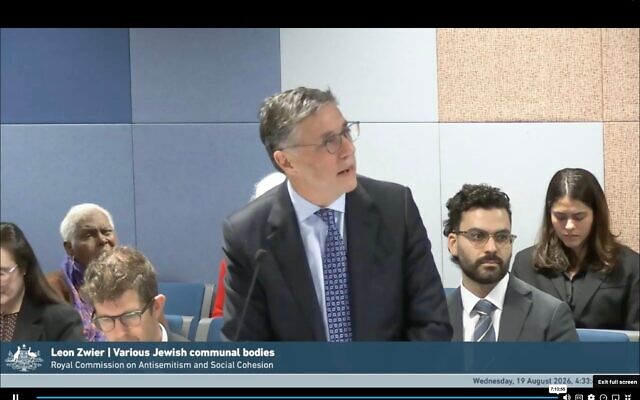
The premier sat between representatives of the Jewish and Muslim communities, Zwier said, and opened the meeting by speaking about hate.
Comensoli was the first person to speak. According to Zwier, the archbishop addressed the rabbi present as his “big brother”, then told the room that what they were dealing with was not hate but something specific.
“You then talked about the fact we were not dealing with hate, we were dealing with something very specific, of antisemitism,” Zwier said.
The archbishop said he could not recall his exact words. “That would have been not something prepared. It would have just come from me at that moment.”
He did recall the address to the rabbi, and explained where it came from.
“It’s part of my belief in our Christian tradition that the Jewish people remain God’s chosen people,” he said, adding that since the papacy of John XXIII the church had spoken of the Jewish people as “our elder brothers and sisters”.
“I said, you are my brother, my older brother, and I wanted to say that. And this is not just about hatred that had been expressed on that day, but something that was built up over the period since 2023. This was not something that had come out of the blue.”
Comensoli said he could not remember which rabbi was in the room.
Zwier told the commission he had been an observer at the meeting rather than a participant. “I was the Forrest Gump at that meeting. I was around the action, but irrelevant to it.”
“It was very powerful. It was very moving. It was plainly unprepared. And you properly described what the Jewish community felt, which was that we were not dealing with hate at large. We were dealing with antisemitism.”
The AJN is providing rolling coverage on the Royal Commission on Antisemitism and Social Cohesion.
For full coverage of the Hearing Blocks, visit the Royal Commission section of The AJN website.
comments