



Aghion addresses ADL summit; Ryvchin gives testimony
ECAJ president Daniel Aghion calling for urgent UN action and co-CEO Alex Ryvchin questioning whether Jewish Australians are truly free to practise their faith
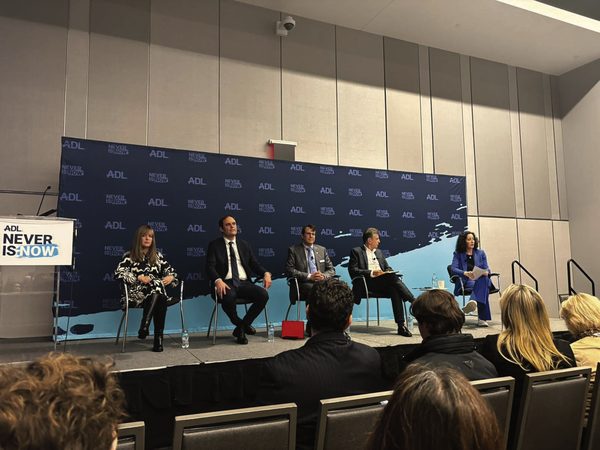
The Executive Council of Australian Jewry (ECAJ) leadership discussed the antisemitism crisis at international forums last week, with president Daniel Aghion calling for urgent UN action and co-CEO Alex Ryvchin questioning whether Jewish Australians are truly free to practise their faith.
Aghion represented Australia at the Anti-Defamation League’s Never Is Now summit in New York, where he joined leaders from the world’s seven largest Jewish Diaspora communities.
“While Australia may have suffered the worst antisemitic attack in the Diaspora since the start of the October 7 war, tragically, it was far from an isolated event,” Aghion said.
“Jewish communities around the world are seeing an unprecedented rise in antisemitism and its normalisation.”
On the sidelines of the conference, Aghion and fellow J7 leaders met with UN permanent representatives from Argentina, Australia, Canada, France, Germany, the United Kingdom and the United States to urge urgent action to address antisemitism.
The J7 issued a joint statement calling on governments and the UN to do more to combat antisemitism and the anti-Israel bias that often legitimises it.
“Our communities are in the midst of a global antisemitism crisis,” the statement said.
“Antisemitism is globalised through copycats, coordinated campaigns and state actors such as Iran, which deliberately internationalises hate, extremism and terrorism, aimed specifically at Jewish communities.”
The J7 met in Australia in early December last year, just prior to the Bondi Beach attack.
Meanwhile, Ryvchin told the US Commission on International Religious Freedom last Tuesday how his parents had “found a haven” in Australia where they were “free to live as Jews”.
“I could never have imagined that I would now be addressing a Commission on Religious Freedom to lament the state of my beloved homeland,” Ryvchin said.
He lamented Jewish children having to attend school under daily police protection and places of worship being regularly defaced and burned.
“When Jewish Australians require complex police operations to safely walk to and from their homes on the Sabbath, do they really have freedom of assembly?” he asked.
“And when gathering in a public park on the first night of Chanukah to light the menorah results in the slaughter of 15 people, are we really free to practise our faith at all?
“When the safety and freedoms of one group of Australians become highly qualified, that is not an inconvenience for that group, it is an indictment of the very character of the country.”
comments