



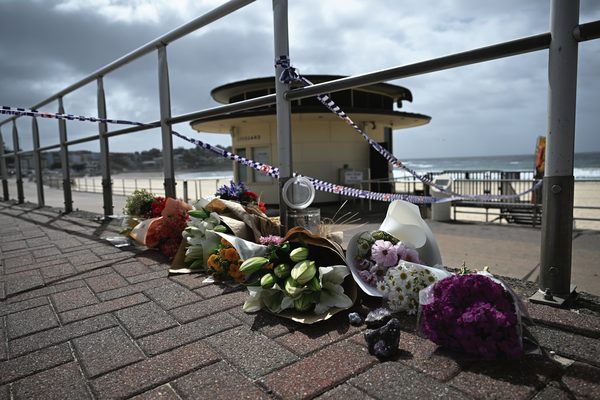
The Online Hate Prevention Institute’s 653-item data collection, gathered between December 15, 2025 and January 11, 2026, reveals how the worst terrorist attack in Australian history triggered what OHPI CEO Dr Andre Oboler describes as “an all-out assault on the Jewish community” online.
515 items of antisemitic content were collected in less than a month – including glorification of the massacre, conspiracy theories blaming Jews for the attack, and AI-generated disinformation claiming the shooting was staged.
The report documents five distinct categories of atrocity-related antisemitism: glorification celebrating the attack, justification rationalising it, minimisation downplaying its significance, denial claiming it was staged, and distortion promoting conspiracy theories blaming Israel, Mossad or the Jewish community for orchestrating the massacre.
“The sheer volume of it, and the nature of some of it – the fact that we had the full suite from glorification to minimisation – I think it was surprising exactly how strong it was, and also the speed and intensity of the campaign to undermine any empathy for the Jewish community,” Oboler told The AJN.
“Unlike our regular monitoring, where the data comes from all over the world but is present and impacting Australia, this sample – because it was about an Australian event – the volume of the content that is Australian is much, much higher.”
Beyond direct responses to the attack, the report found a surge in general antisemitism – traditional antisemitic tropes, Israel-related hatred and Holocaust denial – shared gratuitously in threads discussing the massacre and its aftermath.
“The antisemitism is so normalised and accepted that people are just willing to come out and say it with their full identity shown and with the expectation there will be no consequences for them,” Oboler said.
Glorification: celebrating murder
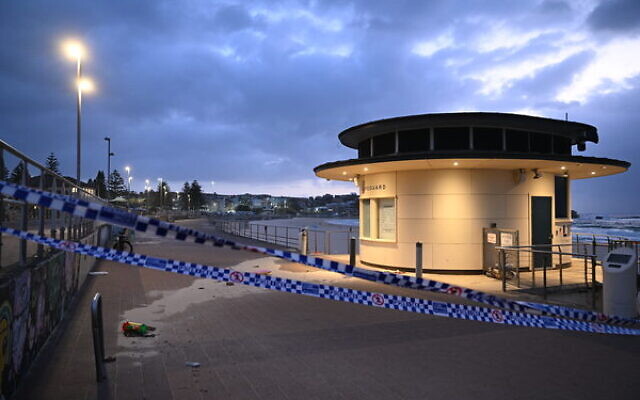
The report documents 17 items of atrocity glorification, with users explicitly endorsing the massacre and arguing the victims deserved to be murdered.
One user reacted to news of the attack by writing “Perfect. Just Deserts!” while another commented “What goes around comes around,” suggesting Australian Jews deserved the killings and holding all Jews collectively responsible for Israeli government actions.
Another described the attack as the “Consequences of genocide”, framing it as justified and deserved.
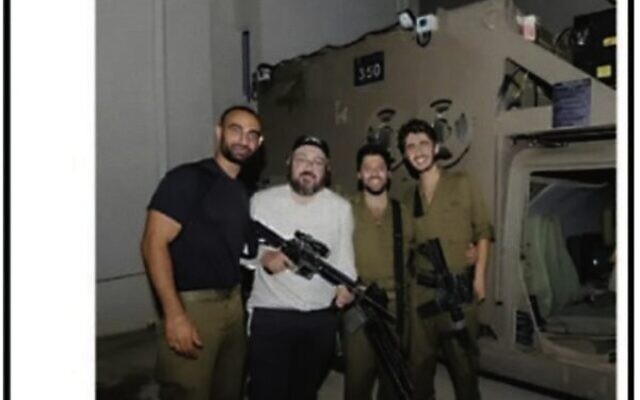
A Facebook user referred to Rabbi Eli Schlanger, who was killed, writing that because he supported the Israeli Defence Force, he was a legitimate target, writing “Live by the sword…” with the unsaid part being “die by the sword”.
One person tweeted that Chabad is a “transnational Zionist terrorist organisation” and described AIJAC’s Arsen Ostrovsky, who survived being shot, as an “Israeli government propagandist”.
Justification: rationalising terror
The report found 75 items of atrocity justification, with 38 claiming the attack was justified because the victims were “Zionists”, 29 blaming Israel, and eight citing other reasons.
A Reddit post justified the terrorist attack because of Israel’s actions in Gaza, while a Facebook user responded to London’s mayor calling the attack “an appalling act of antisemitic hatred” by commenting “it wasn’t anti semitic [sic]. It was anti Israel as a part of the war”.
An Instagram comment described the deaths as “unfortunate, but caused by Israel’s actions”.
The International Jewish Anti-Zionist Network posted that the Bondi attack was the “consequences of Zionist colonisation and genocide”, explicitly justifying the mass slaughter based on Israeli government actions.
A pro-Palestine meme claimed that “Jewish civilians will continue to bear the risk” as long as Israel claims to speak on behalf of world Jewry – in effect justifying targeting Jews worldwide so long as Israel continues to exist.
Minimisation: downplaying the massacre
The report documented 66 cases of atrocity minimisation, with 41 referencing international events like Gaza to suggest the attack wasn’t important, 11 comparing it to other Australian crimes, and 14 taking an “all lives matter” approach opposing focus on the impacted community.
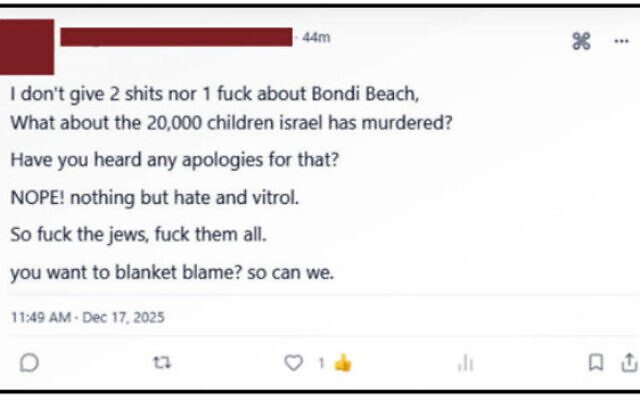
A Gab user minimised the attack by asking “What about the 20,000 children Israel has murdered?”
An X user claimed it was “disgraceful and racist” that “just one privileged group” was being “honoured” during New Year’s Eve celebrations in Sydney, arguing it was “racist privilege” for a menorah to be projected on the Sydney Harbour Bridge.
Denial: crisis actor conspiracy theories
Eighteen cases claimed the attack was staged and not real, promoting conspiracy theories about crisis actors.
One post featured an image of Ostrovsky, claiming he was “performing again for the media” with “fake blood” and “acting”. The post ended “Remember his name and put him on the Nuremberg 2.0 list” – comparing Jewish victims of hate crimes to Nazis.
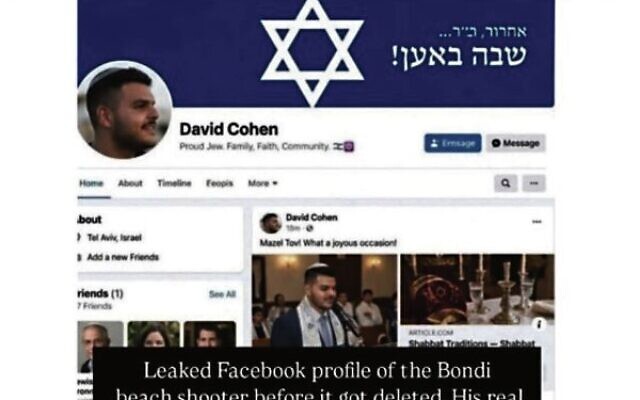
AI was used to generate fake images supporting false flag narratives, including fabricated Facebook profiles.
Distortion: blaming Jews and Israel
The largest category was atrocity distortion, with 122 items blaming someone other than the attackers: 52 blamed Israel, 29 blamed Mossad, 11 blamed Jews, nine blamed Zionists, two blamed Australian authorities, and 29 blamed various other groups.
An Instagram comment claimed “Zionists so hell bent on destroying the fabric of what makes Australia special – it’s willing to commit horrific crimes against its own people to drive its agenda.”
Multiple posts accused Israel of orchestrating a “false flag” attack.
Frequently repeated misinformation claimed gunman Naveed Akram was an ex-IDF soldier, implying the attack was a false flag carried out by Israel.
AI was used to generate a fake Facebook profile depicting Akram as an Israeli Jew named “David Cohen”, designed to advance the narrative that Israel perpetrated the attack as a false flag.
Another comment simply said “Mossad”, implying Israel’s intelligence service carried out the attack.
“There is a problem that is pervading Australia right now … over the last two years, the line of what is acceptable, what is borderline, has just been pushed further and further back that things that were borderline are now fully accepted, and things that were clearly unacceptable are now borderline,” Oboler said.
“And it just keeps moving and pushing Jews further and further back.”

Traditional antisemitism
Beyond atrocity-related content, the report found widespread sharing of traditional antisemitic tropes, with users emboldened to promote centuries-old stereotypes.
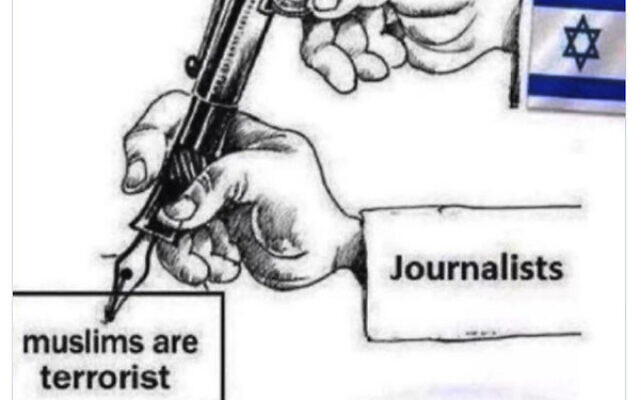
A common theme was claiming Jews control the media, with one X post showing the Israeli flag inserting a coin into a pen held by “Journalists” writing “muslims are terrorist” [sic], suggesting Israel pays media to report on the Islamic extremism that motivated the attack. “This stereotype is antisemitic because it positions Jews as being underhanded and deceitful by co-opting the media for their own selfish goals,” the report states.
Support and empathy from politicians, sporting legends, business leaders and other Australians was presented as signs of a Jewish power conspiracy and “undue foreign influence”. Government efforts to address antisemitism were cast as evidence of Jewish control rather than a legitimate response to rising hate.
“The argument that paying any attention to this, dealing with antisemitism is evidence that Jews control the government, and the Australian government’s under foreign influence, this is such classic antisemitism,” Oboler said.
“The idea [that] the Jews want more empathy and power and control, this is straight out of the Protocols of the Elders of Zion. It’s not just victim blaming. It’s worse than that.
“[And] the idea that people think this is okay, and when they post it online, they’re not getting a torrent of people telling them to take it down, that this is not appropriate, that’s a problem. It says that this is in the realms of what’s normal discourse in Australia at the moment.”
The report also documented Holocaust denial and claims the Holocaust was exaggerated.
Anti-Muslim and compara tive hate
The report also documented a rise in anti-Muslim hate after the religion of the attackers became known, with users demonising the entire Muslim community and blaming them for the attack.
The report notes that the heroic actions of Ahmed al-Ahmed, a Muslim bystander who helped disarm one of the gunmen, “helped to mitigate and slow the spread of this hate”.
The report found almost identical levels of hate targeting the Jewish and Muslim communities on their own posts. But on posts from neutral sources, the level of Islamophobia was a third lower than that of antisemitism.
“What we are seeing is a volumetric attack targeting people that are speaking out on behalf of their community,” Oboler said. “People with a high profile, what they’re experiencing, whether it’s antisemitism or Islamophobia, is much more intense than what the general community is experiencing.”
Oboler said both communities should work together rather than fighting each other to deal with a problem affecting both.
Normalisation and radicalisation
The report argues that normalisation of antisemitism over the past two years contributed to the attack by creating a climate in which those planning to kill Jews could delude themselves into thinking society would see them as heroes.
“The problem we face in Australia is not Israel’s actions, but how some have been allowed to use those actions to excuse their antisemitism and that of others, creating a culture where antisemitism has become normalised and pervasive,” the report states.
The normalisation began on university campuses, fuelled via social media by overseas movements, particularly from the United States, and included incidents like celebrations in Lakemba after October 7 and the “where’s the Jews” and “F**k the Jews” chants at the Sydney Opera House.
“Anti-Jewish hatred has moved from the fringes of society into the mainstream public discourse, becoming more accepted or tolerated,” the report states.
Oboler said the media, particularly the ABC and The Guardian, contributed to the problem by giving space to fringe voices arguing that anti-Zionism is never antisemitism.
“It’s disinformation, which is actually left the Australian public confused. And I don’t think it lives up to the journalism code of ethics, and I think it’s significantly contributed to the problem,” he said.
Fighting hate: what’s needed
Oboler said the first priority is addressing the argument that political speech justifies hate.
“Hate speech is almost always political speech. So if we argue anything that’s political speech should be allowed, you’re essentially arguing there should be no laws about hate speech. And that is not the law in Australia,” he said.
“What we need to do is start by asking the question, is it hate speech? Not is it political? If it isn’t hate speech, then if it’s political, fine. If it is hate speech, whether it’s political or not is irrelevant.”
The report recommends mandatory education and training programs in schools, universities and for public officials to better identify and address antisemitism, consistent enforcement of hate speech laws, and greater accountability for social media companies.
Oboler said Palestinian and Muslim activists must be careful in how they phrase their political activism.
“They can be critical of Israeli policies. They can be critical of the Israeli government. That’s all fine. They just need to do it in a way that is not antisemitic, that is not putting the Australian Jewish community at risk,” he said.
Oboler supports criminal hate speech provisions but believes the government should focus on making existing civil provisions under Section 18C of the Racial Discrimination Act criminal.
“If we were to simply make that criminal, there shouldn’t be any constitutional problems. There shouldn’t be any arguments about scope creep in terms of what’s legal or illegal in Australia, all it’s doing is shifting the prosecution from the individuals, from the Jewish community, to the state, and that’s what we need,” he said.
Oboler concluded that government support for organisations like OHPI is urgently needed.
“This sort of work is absolutely critical. The question is why the government isn’t funding it. It is being discussed. We keep talking about how important it is. Why is the money not on the table?” he said.
The report, involving about 12 people, will be submitted to the Royal Commission on Antisemitism and Social Cohesion, with some who worked on it declining to be named due to safety concerns.
“I think that also says something about the environment we’re in,” Oboler said.
comments