



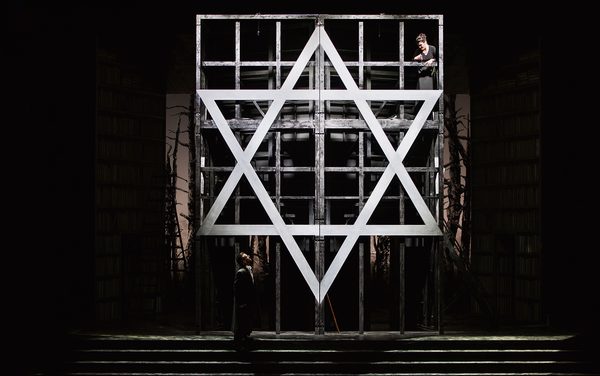
A dangerous love affair, for which punishment is death.
In medieval times, a Jew and a Christian cannot love each other.
So, when word gets out, there are two choices: deny love or deny religion.
Enter the world of La Juive, where the question is asked – can love eliminate hatred?
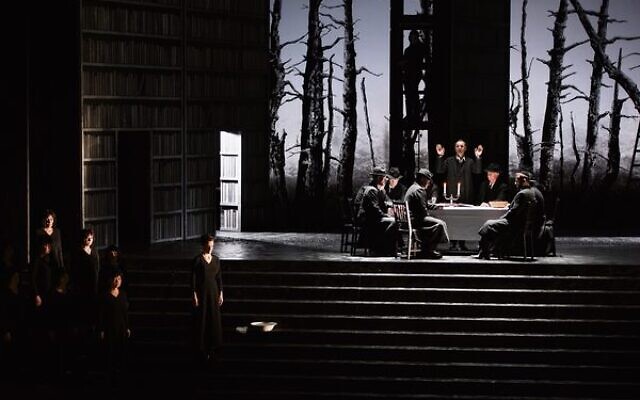
But in revival director Constantine Costi’s version, the audience is transported from medieval Europe, where Jews are being persecuted, to 1930s France as the Holocaust looms.
“It centres around a young Jewish woman [Rachel] and her conservative father,” Costi told The AJN. “She falls in love with an artist who is a Christian, pretending to be Jewish. His identity is uncovered and because relationships between Jews and Christians are forbidden in society, it means death for her and exile for him.”
Costi explains that ancient grudges and ancient histories come to the surface following, leaving Rachel’s father with a difficult choice: sacrificing his daughter or sacrificing his religious integrity.
History comes to life
La Juive was composed by Fromental Halévy, a Jewish composer who began his musical education in Paris at the age of nine or 10. It was La Juive that brought the composer fame and fortune; while other operas were moderate successes, Halévy never had another huge hit. Such was the incredible response to the opera, that it’s a known fact that Wagner overcame his antisemitism (briefly) to hold Halévy’s work with high regard, claiming it as “one of the greatest operas ever created” and using moments from La Juive in his own operas.
What’s beautiful about La Juive, directed by Olivier Py, is that there are huge choral moments contrasted against gorgeous solos, showing that both can create their own version of drama. Add to this the history around the story and it’s a truly expressive production, which according to the Opera Australia website, “offers glimpses of the Holocaust to come, adding a real poignancy to its existing themes of persecution against Jewish people”.
Powerful stories in COVID times
It’s a revival of an extremely powerful story, and Costi says it’s exciting to be bringing such an amazing piece of work to the opera stage.
“It’s dramatically so intense, and so gripping that the opportunity for me to work with mostly Australian cast, for them to find the character themselves, the dynamic and give it a new life for the 2022 staging, is pretty thrilling,” he said.
“At the end of the day, opera is all about feeling”
And when it comes to staging a production during COVID times, Costi says it has required an overwhelming reset of perspective.
“When you’re an artist in the live performing arts industry in recent years, throwing everything that you have at it in terms of your preparation and your work ethic and passion, but for your own wellbeing and sanity, we needed to make peace with the fact that things could get cancelled at any minute,” he explained. “So, you’re operating in a different headspace.”
Feeling the opera
Despite the nature of the story, and the concerning COVID times, Costi says it’s a wonderful feeling to sit in the opera and simply let the emotions rush over you.
“At the end of the day, opera is all about feeling,” he said. “Music operates in a way that yes, the text and characters are important, but there is a kind of incredible, free feeling that can go across the audience. Everybody’s listening to the same music and feeling it.”
Costi explains the music as “grand, sweeping and spectacular”, meaning the audience is taken away on an all-encompassing musical journey, “but then also feel the struggle and turmoil of these incredibly intricate and well-written characters at the same time.”
The feelings are immense.
But as Costi says, “At the end of the day, the beating heart of this story is about the persecuted and the persecutor.”
La Juive is showing at Sydney Opera House March 9-26. Tickets: opera.org.au/productions/la-juive-sydney
comments