



Artist’s strokes of chutzpah
ISRAELI-born artist Arie Levit bills himself as "the greatest artist in the world" with his innovative style of painting.
LEXI LANDSMAN
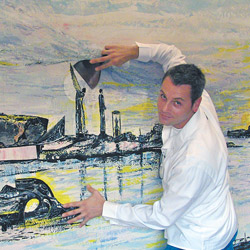
ARTIST Arie Levit is full of chutzpah. “No one can paint like me,” he says without wavering. “I have more skill than any painter who holds a brush. There is nothing like [my art].”
Calling himself “the greatest artist in the world”, the Israeli-born artist speaks in proverbs and frequently quotes his own poetry, regaling viewers with stories of his art as he leads them through his exhibition at the Double Bay Art Gallery.
“I encourage them to feel my art,” he says, tapping a work in his latest exhibition to demonstrate its durability. “If I let people touch my art, my art will touch them. Seeing is believing,” he chants, “touching is understanding.”
Bounding with enthusiasm and energy, Levit uses fresco/stucco paintings made from ground marble that he mixes into a tinted paste and applies to high-quality boards as his canvases.
Instead of paintbrushes, the artist uses only a gyprocker’s trowel as his tool to create “art locked in marble”.
“What I am trying to do is bring common sense back to art,” he says, explaining his belief that art has lost its skill since “anything these days can be called art”.
Levit claims he invented the fresco-painting technique and that his method is so unique that no painter has painted like him before.
Humble he is not, but the 40-year-old differentiates between being arrogant and proud.
“Proud is something you pick up because you have experience and knowledge about what’s going on. Calling myself the greatest artist is just a tool. It’s a funny line, a slogan.”
Since moving from Israel to Sydney’s northern beaches in 2004, Levit has painted using the technique and has launched a tirade of publicity stunts.
He once offered $50,000 cash to whoever could prove that he was not the “greatest artist in the world”. In another, he asked anyone to emulate his style accurately, for which he would award them $1 million. One candidate came forward, but Levit -— being the only judge -— said the artist wasn’t good enough. Instead, he offered her tips on how to improve.
In a thick Israeli accent, Levit speaks frequently in marketing terms, openly admitting that much of what he does is to generate publicity.
“I call myself the greatest artist in the world as a publicity stunt to make me famous,” he reveals.
Yet, more importantly, Levit says his art is a realisation of his desire to be a storyteller -— something he has loved since he was a child, though it took him 35 years to discover art was the best medium to tell his stories.
“When I was a child and I told my father I wanted to be a painter, he slapped my face and told me to be a man,” Levit recalls.
“What drove me to [art] was maybe my grandfather’s art collection, which was embedded in my soul, or maybe it was me wanting to get into my dream world … The day I found fresco, I knew what I was looking for all my life.”
His current exhibition is a culmination of five years’ work, in which time Levit mastered the painting technique. His ultimate goal, he insists, is to make viewers smile from the experience of viewing his art.
“I came from Israel with lots of dreams in my head some six years ago, with two suitcases and $3000, and I hope one day I will be a respectable member of the community,” he says.
“I’m doing it in the hardest occupation — as an artist. It’s a hard journey but I don’t know anybody that is more fit to the job than me.”
Levit’s art is on display at the Double Bay Art Gallery, 475 New South Head Road, Double Bay. For more information: www.thegreatestartistintheworld.com; doublebayartgallery.com.
comments