



Australian Government announces sanctions on Iran
Human rights groups and Jewish community leaders have long called for Australia to adopt tougher sanctions against Iran.
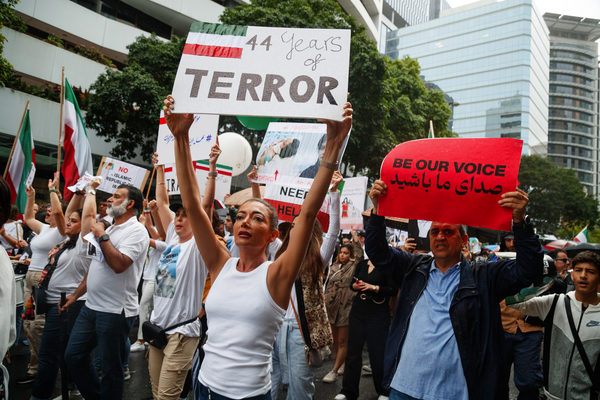
While welcoming the Australian Government’s announcement on Saturday to impose Magnitsky-style sanctions on Iran for human rights abuses, Jewish community leaders argue stronger measures are required.
Australia already has sanctions against Iran’s nuclear program. The new sanctions target Iran’s Morality Police, the Basij Resistance Force and six Iranian individuals involved in the brutal crackdown on protests which were sparked by the death in custody of 22-year-old Mahsa Amini on September 16. The HRANA news agency reports that as of December 3, over 470 Iranian protesters have been killed, including 64 minors.
“The listings demonstrate the Australian Government’s commitment to take clear action to assert our values, and to hold perpetrators of serious human rights violations and abuses to account,” Foreign Minister Penny Wong and Assistant Foreign Minister Tim Watts said in a joint statement.
“In addition to human rights sanctions, Australia is joining partners to announce further targeted financial sanctions on three Iranian individuals and one business involved in the supply of drones to Russia for use against Ukraine.
“The supply of drones to Russia is evidence of the role Iran plays in destabilising global security.”
Human rights groups and Jewish community leaders have long called for Australia to adopt tougher sanctions against Iran.
Executive Council of Australian Jewry (ECAJ) co-CEO Peter Wertheim said while the sanctions are welcome, “The list of Iranian individuals and entities sanctioned by Australia needs to be expanded to include the leadership of the Islamic Revolutionary Guards Corps (IRGC), as well as those at the real centres of power in Iran, the Supreme Leader, President, and key members of the Guardianship Council and Judiciary.
“In addition, the ECAJ has called for Australia to list the IRGC as a terrorist organisation, for the Smartraveller warning against visiting Iran to be made more explicit and realistic, and for Iran to be expelled from the UN Commission on the Status of Women.”
Australia/Israel & Jewish Affairs Council executive director Colin Rubenstein said the sanctions “need to be a first step in a larger program of sanctions against elements of the Iranian regime”.
He said Australia has been “out of step” with its allies on Iran.
“Over the last three months, there have been seven waves of sanctions announced by Canada, five by the US and three by the UK. Our allies have sanctioned 113 individuals and 17 entities linked to human rights abuses in Iran … Australia sanctioned six individuals and two entities.
“Australia therefore still needs to do more to become fully part of the principled consensus among Western democracies on the need to support Iranians fighting for their human rights in the face of gross oppression by a brutal regime.”
Zionist Federation of Australia president Jeremy Leibler called it “entirely appropriate” for Australia to sanction the key institutions brutally repressing Iranian freedoms.
“However, we strongly believe that this should only be the tip of the iceberg. The IRGC is involved in this repression, as is the Guardian Council and key government ministers. We believe these should also have sanctions applied to them,” he said.
Leibler also lauded the late Labor Senator Kimberley Kitching for her instrumental role in the December 2021 legislation that paved the way for the latest sanctions.
“Senator Kitching, who was a close friend of Israel and the Jewish community, would, I’m sure celebrate Magnitsky-style sanctions being applied to these Iranian entities and individuals and, like us, call for their wider application,” he said.
The “Magnitsky” legislation enables the government to sanction foreign individuals who have committed human rights abuses or been involved in significant corruption. It is named after Russian lawyer Sergei Magnitsky, who died in prison in 2009 after exposing corruption in Russia.
The government also announced sanctions on seven Russian individuals involved in the attempted assassination of former opposition leader Alexei Navalny.
comments