



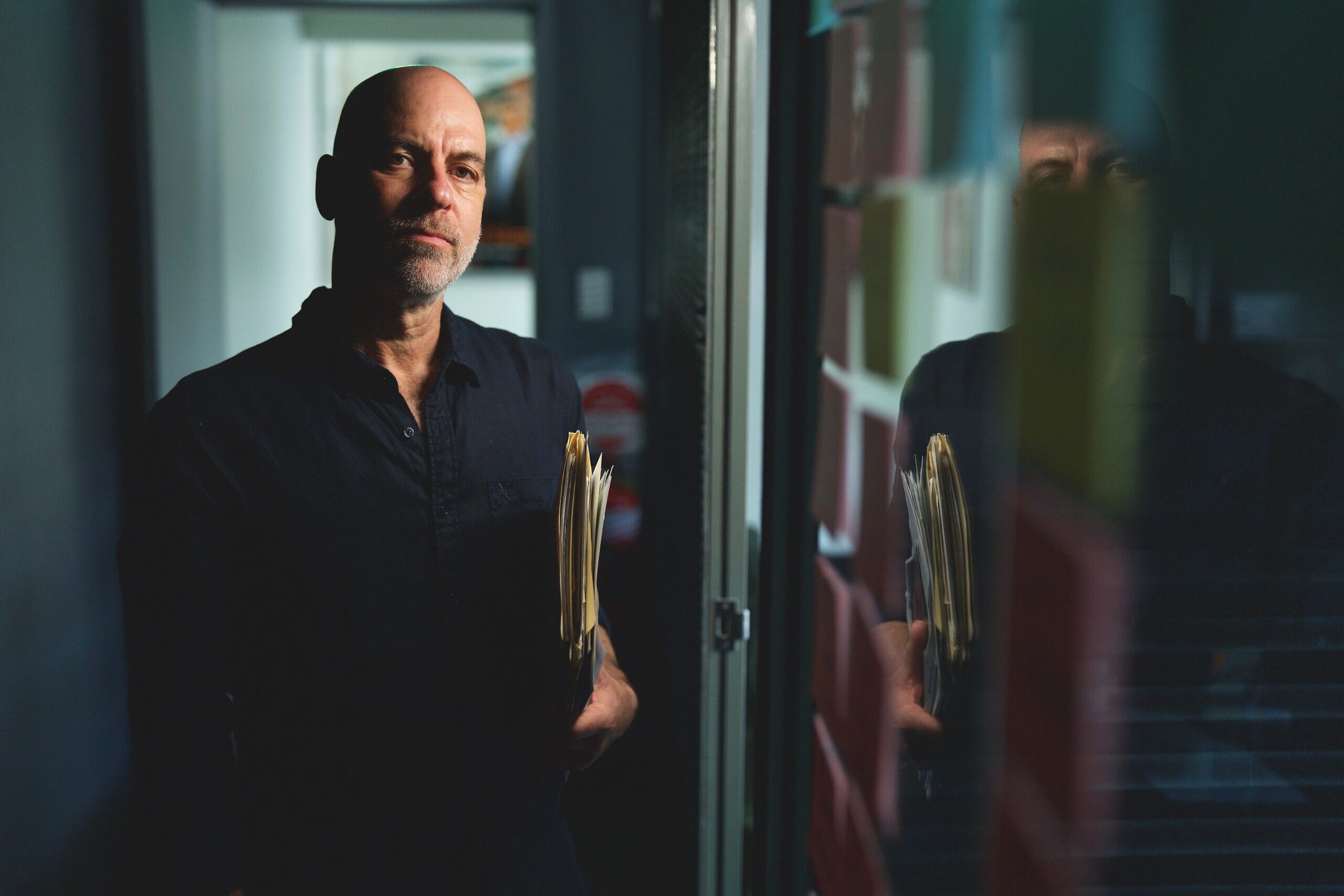
There is a moment, buried in the making of The Hunt for the Last Nazis, when filmmaker Dan Goldberg comes face to face with the sheer scale of what he is trying to uncover.
In Canberra, inside a sprawling archive that stretches “for two soccer pitches”, sits the record of Australia’s pursuit, and failure, to prosecute alleged Nazi war criminals who made their lives here after World War II.
From that, Goldberg has crafted a documentary that is about process and history, a behind-the-scenes excavation of a national scandal that still resonates.
The Hunt for the Last Nazis, commissioned by SBS, centres on three high-profile figures investigated in Australia: Ivan Polyukovich, Karlis Ozols and Konrad Kalejs. All three were accused of involvement in atrocities during the Holocaust, including the “Holocaust by bullets” in Eastern Europe. It’s a chapter of history still misunderstood.
But the story actually begins with a journalist.
Long before the Special Investigations Unit (SIU), there was the work of Mark Aarons, whose investigations exposed the possibility that Nazi war criminals had settled in Australia. His reporting forced the issue into the public, laying the groundwork for everything that followed.
By the 1980s, other countries around the world had begun to reckon with their responsibilities to Holocaust victims, taking steps to identify and pursue perpetrators living within their borders. It was in that context that Australia, under Bob Hawke, established the SIU.
It was a decisive move. But in practice, the results told a different story.
“There were 841 investigations,” Goldberg told The AJN. “Only one went to trial.” There were no convictions.
It’s the gap between intention and outcome that The Hunt for the Last Nazis considers. And it is here that the behind-the-scenes access becomes powerful, including police interviews, exhumation footage, recordings of informants and pieces of evidence that were used.
“The great thing about stories set a generation ago is most people are still alive,” Goldberg said. “So we could actually talk to people who, for five years, worked at the Special Investigations Unit.”
“Trying to prove beyond reasonable doubt that that man pulled the trigger 50 years ago … it was such a high bar. The defence just had to poke a few holes to create doubt.”
The documentary brings back investigators, prosecutors, analysts and historians, in some cases, showing the archival footage of themselves from decades earlier.
That archival material is, by Goldberg’s own admission, the “killer piece” of the documentary. “With some pretty determined researchers and producers, we managed to find previously unseen tapes of interviews… and also audio that had never been heard before of collaborators dobbing in some of these Nazi war criminals,” he said. “When you’ve got archival material that’s never been seen or heard before, you just kind of know that you’re sitting on gold.”
The film does not shy away from the uncomfortable truth that Australia was operating under a “populate or perish” mindset, opening the country’s doors. But, as the documentary makes clear, that openness did not extend equally. Jewish survivors faced barriers, while, in some cases, those with suspected involvement in Nazi crimes were able to enter and settle.
The result, as Goldberg put it, was that having an Australian passport was “a get out of jail card.”
It is a line that encapsulates the film’s central idea: people accused of some of history’s worst crimes were able to live out their lives in relative peace, thousands of kilometres away. And because Australia chose to prosecute them through the judicial system rather than denaturalising and deporting like other countries, it was as if the trials were doomed to fail before they even began.
“That’s where the rub lies, because trying to prove beyond reasonable doubt that that man pulled the trigger 50 years ago … it was such a high bar,” Goldberg said. “The defence just had to poke a few holes to create doubt.”
Witnesses, Goldberg pointed out, were people who didn’t speak English, came from extreme poverty and had witnessed horrific things. “Some people would argue it was destined to fail from the get go,” he said, before pointing out that ultimately, it is the story of a scandal. And in the end, it was the Jews who were let down.
The making of the film reflects that weight. From the “first light bulb” to completion, the project took almost two years. But the actual production window was far shorter. “We made this in record speed. It was made in five months,” Goldberg explained, crediting both extensive pre-planning and the support of the Jewish community, whose financial backing helped close a critical funding gap.
“We shot it in about 20–25 days, and we raced from Sydney to Canberra to Melbourne to Adelaide and back,” he recalled.
That urgency is reflected in the film’s emotional tone.
“When you’ve got archival material that’s never been seen or heard before, you just kind of know that you’re sitting on gold.”
“You have to get beyond the headlines and into the hearts and minds of people. And that is often through emotion,” Goldberg said. At key moments, that emotion is visible in interviews, archival footage, narration and in the filmmaker himself, who is often seen wiping tears from his eyes.
For many viewers, particularly those under 50, this will be their first encounter with a chapter of Australian history that has largely slipped from public awareness. Goldberg acknowledged that many will have little or no memory, and the documentary will leave viewers “shocked and appalled”.
Which is, ultimately, the purpose of The Hunt for the Last Nazis.
To bring the story back into view, to question how it happened, why it was allowed to happen, and what it means when, in the end, justice was never served.
The premiere of The Hunt for the Last Nazis, co-presented by JIFF and The AJN, is on on April 12 at Randwick Ritz in Sydney and April 19 at Classic Cinemas in Melbourne , with a post-film panel featuring Dan Goldberg and others.
comments