



Beat bocher Matisyahu
AMERICAN Orthodox reggae and hip-hop artist Matisyahu is performing in concert in Australia this week and talks about his religious journey and his music.
DALIA SABLE
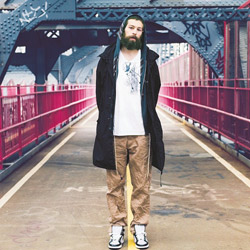
THE facets of singer-songwriter Matisyahu’s identity are difficult to reconcile. He is a lyrical poet who blends verse and Jewish prayer with universal messages for peace and love; a Grammy-nominated reggae artist whose past two albums have “gone gold”; a devout Orthodox Jew with peyot and beard, who now favours jeans and trainers to traditional Chassidic garb.
“I don’t really like to define myself as anything. I take from different aspects of things. I don’t feel like I fully represent any one thing,” Matisyahu says from Brooklyn in a whisper, a far cry from the voice that resounds on stage when he raps to hip-hop beats.
Matisyahu was born Matthew Miller in Westchester, Pennsylvania in 1979. The son of Progressive Jewish parents, he attended regular Hebrew school classes.
It was not until the age of 16 that a study trip to Israel sparked a more profound interest in his Jewish heritage.
“Part of it was I guess a search for identity,” he explains. “I was trying to find a sense of where I come from, what my history is. That being coupled with being on a journey one could call spiritual, or searching for spirituality.”
It was not, however, until a few years later that Matisyahu fully embraced Orthodox Judaism as a way of life. He was initially drawn to New York’s Carlebach Shul, which follows the tradition of the late rabbi, teacher and musician Shlomo Carlebach, who is one Matisyahu’s greatest influences.
Soon after, he found his way to Chabad and he remained largely affiliated with the Chabad-Lubavitch movement for the early part of his career.
His debut album, Shake Off the Dust … Arise, released in 2004, and his 2005 follow-up album Live at Stubbs, recorded at a concert in Texas, are testament to this religious and spiritual journey.
Songs include Aish Tamid (Eternal Flame), with lyrics “Aish tamid eternally, a fire burns continuously. Wondering where you been. Won’t you come on home to me?”
His song Refuge begins in Hebrew and continues with the words “Hashem my God will think about me. My help, my rescuer, you are.”
While to some being a devout, Orthodox Jew and a reggae recording artist is a contradiction in terms, to Matisyahu it is the “balance” of the two that keeps him grounded.
“The rules within Orthodox Judaism help me to stay focused and give me some structure in my life. I guess that is something I chose because I feel it is healthy and helpful. The musician lifestyle lends itself to a certain freedom to be able to do what you want. I think that for me, Judaism is my foundation — it is my place to return to.”
While some critics initially doubted the longevity of Matisyahu’s appeal, his 2006 release, Youth, silenced their scepticism.
Youth debuted at number four on the US billboards top 200, reaching number one of the reggae album charts and ultimately received the golden endorsement of a Grammy Award nomination for best reggae album release. It was not just in the US that Matisyahu’s music went to such heights.
His single King Without a Crown made it onto Triple J’s Hottest 100 compilation and his 2006 Youth tour sold out venues in Sydney and Melbourne.
Matisyahu is now set to reconnect with his Aussie fans as he tours the East Coast next week with his new album Light, his first to be released in four years.
Despite the album’s title, Matisyahu says it is his “darkest” album to date, dealing with issues such as death, madness and escapism. From all aspects, the new album is, in his own words, “a lot more next step”.
“I definitely feel I have grown up quite a bit. From when I started, [to] when Youth came out [and to] now, it has been a real major process for me of coming to terms with lots of different things. Within Judaism, within my career, finding the balance, with Chassidism. I guess this record is the furthering of this, it is taking it to the next level,” he says.
Writing for the album was a two-year process, which took Matisyahu between Brooklyn and Jerusalem and saw collaboration with his friend and teacher Ephraim Rosenstein, who “helped me really work on my ideas for the record and also some of the lyrics as well”.
Matisyahu also travelled to Jamaica for a week to work on two songs with up-and-coming producer Stephen McGregor. Whether it is the collaborations, the personal growth or the inspirations behind the record, Matisyahu’s “sound has evolved” on his new album.
“When I was starting out, I had a period of my life where I had influences by specific artists. Now, it’s more general things. I get influenced by all different types of music and different singers. My music is reflective of that. It incorporates many different styles, [more] than anything I have done so far,” he says.
“That is sort of what it is all about for me. Bringing together different things. Music is all about bringing different styles together, bringing different sounds together.”
Following such a concentrated period writing, recording, producing and perfecting the new record, Matisyahu admits he has not listened to Light for “about a year”.
“When you are working on the record and you are so into it, then you don’t really want to hear it any more. I think when I start to hear it again I will be ready to hear it,” he says.
Despite not listening to his songs, he assures he will be more than ready to perform when he touches down in Australia next week, something he is looking forward to.
And if his last Australian show is anything to go by, music fans from all over -— Jewish and non-Jewish, young and old -— will be waiting with bated breath to see the bocher bounce on stage beating out his best.
Matisyahu will perform in Sydney on Wednesday, August 12 at the Metro Theatre, and will perform in Melbourne on Thursday, August 13 at the Prince of Wales. Tickets: Ticketek 132 849.
comments