



Bibi’s year-end report
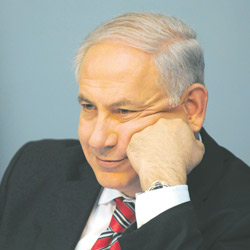
IN recognition of the first anniversary of Israeli Prime Minister Binyamin Netanyahu’s government, AHRON SHAPIRO evaluates its performance on key issues.
GOVERNMENT FORMATION
Binyamin Netanyahu formed Israel’s 32nd government on March 31, 2009, after the forming agreements between the Likud, Yisrael Beitenu, Shas, Labour, Habayit Hayehudi parties. When United Torah Judaism joined the following day, the coalition reached 74 members, a number which is considered to be quite comfortable and stable by Knesset standards.
In particular, Netanyahu should be recognised for his ultimately futile attempt to bring Kadima onboard for a National Unity Government, and his successful effort to recruit Labour which continues to keep his coalition on a more even keel and impressively stable.
However, Netanyahu’s achievement in forming such a wide government must be tempered by the criticism that he gave away a lot of perks in order to achieve it. The current cabinet is the largest in the country’s history, is comprised of 30 ministers and nine deputy ministers.
Coming from a Jewish State – to borrow an American term about wasteful, politically motivated government spending – that sure translates into a lot of pork. Regarding the allocation of portfolios, it is hard to escape the conclusion that several key ministries wound up in the hands of parties ill suited to run them, which reflects on Netanyahu’s judgement.
MARK: B
LEGISLATION
The Prime Minister has been accused of playing it safe politically in the past year and the Knesset’s lacklustre legislative agenda would appear to support that conclusion. The 18th Knesset has not been a particularly proactive group when it comes to lawmaking, and the laws that were passed have not inspired. A landmark piece of legislation, land reform, lacked clarity, while a “Mofaz Law” that made it easier for lawmakers to break away from their parties smacked of political opportunism.
Moreover, the manner that many other bills were put forth and advanced suggested that the Netanyahu was eschewing vision for political expediency. On the other hand, there have also been few glaring screw-ups, and the coalition’s laid-back attitude has kept political drama at the Knesset to a minimum in comparison to previous governments. In a peculiar way, there is some virtue in that.
MARK: B
ECONOMY
Finance has always been Netanyahu’s strong suit and, not surprisingly, his government scores well here. This month, Moody’s Investors Service said the credit outlook for Israeli banks “is stable, reflecting expectations of healthy domestic economic growth in 2010,” adding that Israel’s economy proved “relatively resilient” to the global financial crisis.
What’s more, unemployment is dropping – Last month, the jobless rate declined to 7.4 percent from a revised 7.7 percent in the previous three months, according to Israel’s Central Bureau of Statistics. Lets give credit where credit is due. Netanyahu’s influence on the Israeli economy, which in truth stretches back several years to the time he served as Finance Minister under Ariel Sharon, has kept Israel’s economy in an enviable position in troubled times.
MARK: A
DEFENCE
Had these marks been given two months ago, this category would have earned an unqualified A. Inside Israel, terrorism is at a historic low. Even Sderot has found itself a little peace and quiet. The Israel Defence Forces (IDF) rescue and medical teams even put on a heroic face in Haiti. Defence Minister Ehud Barak, a former Chief of Staff, is well trusted and the confidence has trickled down through the ranks.
A security fence planned for the Egyptian border is probably an idea whose time has come. Every day we learn of more steps the IDF is taking to prepare itself for confronting Iran – an important option to keep on the table. Unfortunately, recently Israel’s reputation on defence took a “hit” – pardon the pun – following what has been assumed to have been a sloppy but successful Mossad operation against a Hamas gun-runner in Dubai, and this has left a mark – a lower mark.
MARK: B
FOREIGN RELATIONS
First, the good news. Prime Minister Netanyahu has outperformed expectations regarding US relations. His careful handling of meetings with US President Barack Obama, his needle-threading Bar Ilan policy speech of last year endorsing a demilitarised Palestinian state, the rhetorical smack-down he delivered to Israel’s critics in his speech at the United Nations and his unilateral temporary settlement freeze were all very savvy strategic moves diplomatically.
However, his best move at all was to use Barak – a trusted favourite of Washington – as his US envoy in dealing with the peace process. So why the low mark? Avigdor Lieberman has been a train wreck of a Foreign Minister, making numerous gaffes and off-message rants, particularly on his personal pessimism regarding peace with the Palestinians. His deputy, Danny Ayalon – who recently caused an international incident over his mistreatment of Turkey’s envoy – has also suffered from “foot in mouth” disease on occasion. Netanyahu gets most of the blame for not keeping Lieberman out of the post, but Tzipi Livni deserves some too, for it was her refusal to accept the role that put him there.
Netanyahu’s response to the Goldstone report has been generally good, although the consensus among analysts is that he should have taken the tough decision to authorise an independent inquiry – which would probably have effectively ended the Goldstone saga – rather than avoiding doing so, mostly to keep his coalition partner Barak happy.
MARK: C-
PEACE PROCESS
On paper, Netanyahu has done nothing to deserve a mediocre grade. In a quantifiable way, the current government has gone much further than the Olmert government that preceded it in terms of making gestures to the Palestinians. For better or worse, the Prime Minister even did so without adhering religiously to the principle of reciprocity that guided his policies during his first stint as prime minister in the 1990s. The moves have been significant: roadblocks have been eliminated; more humanitarian aid is entering Gaza; a settlement freeze was implemented.
Netanyahu even accepted the premise of a two-state solution, something that, for the leader of the Israeli Right, was a magnanimous gesture indeed.
Cynics, however, noted that every gesture came only in response to US pressure. More importantly, though, the concessions were ineffective. Netanyahu failed to parlay his gestures into meaningful dialogue with the Palestinian Authority, and playing the blame game with the Palestinians wasn’t helpful.
To be fair, Netanyahu’s peacemaking challenges were much harder than Olmert’s thanks to the election of US President Barack Obama, whose overtures to the Palestinians increased their resolve to avoid negotiations in hopes the US would extract concessions for them.
However, visionary leaders find a way break through in spite of it all and make progress. The flailing peace process, mired in distrust, has only lent credence to criticism that Netanyahu’s concessions needlessly wasted valuable negotiating capital.
MARK: C
GILAD SHALIT
The efforts to retrieve kidnapped soldier Gilad Shalit from his Hamas captors in Gaza deserve a special evaluation. The Shalit family has indicated that the Netanyahu government has gone further than its predecessor in its efforts to secure his release. While close only counts in the game of horseshoes, this endorsement is good enough for me. A footnote: Nobody gets an A in this category until Shalit is back home.
MARK: B+
OPPOSITION
This mark goes out – not to Netanyahu – but to Tzipi Livni of Kadima. Her determination to take her party’s 28 mandates to the Opposition was a gift to Netanyahu, since it gave Labour the opportunity to join the government instead, and Barak has been far more loyal to Netanyahu than Livni ever could be. However, Livni’s choice hasn’t served the country’s needs quite as well. Kadima, in theory more centrist than Labour, has actually seen many of its MKs concur with the government on too many key issues. This has overpowered the voices of Kadima’s colleagues in the Opposition, which are mostly on Israel’s far Left.
Kadima, itself a party of defectors from Likud and Labour, is far too large of a party to be comfortable to sit in the opposition and is widely expected to split once her rival, Shaul Mofaz, chooses to do so. To her credit, as leader of the Opposition, Livni personally has maintained pressure on the government throughout the year. However her strongest criticism – that Netanyahu is more concerned with consolidating power than governing or making peace – has failed to register with voters and her party’s weakening polls reflect that. At this point, the trend is not in her favour.
MARK: B-
comments