



Bollywood borsht belt
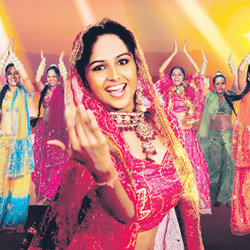
ZEDDY LAWRENCE
WHILE we’re all familiar with the role played by Jewish movie moguls in building the American film industry -—‚ÄÇwith names such as Goldwyn and Meyer synonymous with the early days of western cinema —- less well chronicled is the contribution of Indian Jewry to Tinseltown’s equally successful Asian counterpart. And not just behind the camera, but on the big screen itself.
Stateside, of course, during Hollywood’s golden age, nice Jewish girls such as Theodosia Goodman and Betty Joan Perske were recreating themselves as all-American celluloid stars Theda Bara and Lauren Bacall.
As for the boys, Issur Demsky and Emanuel Goldenberg were reborn as Kirk Douglas and Edward G Robinson. However, it wasn’t just in Los Angeles that obviously Jewish names were being set aside by the acting elite.
During the 1920s and 1930s, the exotically named Sulochana, translated as “the beautiful-eyed one”, raked in the rupees as India’s highest paid movie actress.
But the star of such films as Typist Girl, Balidaan and Wildcat of Bombay, in which she played a staggering eight roles, wasn’t quite the Hindi heroine she was made out to be. Chances are, though, she wouldn’t have found fame among Indian audiences had she gone by her real name, Ruby Myers.
Born in Pune in 1907, the soon-to-be “beautiful-eyed one” worked as a telephone operator before being discovered by one of the head honchos at Kohinoor Films. Myers was initially reluctant to try her hand at acting, regarding it as a dubious profession, but eventually she agreed to give it a go.
It was a wise decision — the actress, whose on-screen romance with Dinshaw Billimoria was as legendary as Bogie and Bacall’s, was so successful that the British Empire had to stand up and take notice.
Alex Hayim, who met a number of Bollywood bigwigs while shooting his acclaimed documentary Shalom Bombay, says: “Sulochana was the leading lady at the time. She really was the queen. The story goes that she was getting paid even more than the governor of Bombay. And that led to a whole debate in parliament because her salary was bigger than his.”
Sulochana’s star began to fade in the 1940s, but by then another Jewish actress had become one of Bollywood’s leading lights. Known as Pramila, Esther Victoria Abraham was born in Calcutta in 1916. Thirty-one years later, she was to become the newly independent country’s first Miss India.
By that time, however, she was already a household name, having appeared in the hugely successful movies Bhikaran and Mother India. The latter ran for an incredible 82 weeks and holds the honour of being the first film from the subcontinent to be screened at Buckingham Palace.
And Pramila wasn’t the only member of the Abraham family to take to the big screen. Her sister Romila and cousin Rose had already carved out careers as Bollywood starlets before Esther got her big break. Indeed, in the 1936 film Habari Betiyan (Our Darling Daughters), Pramila and Rose starred alongside each other.
The success enjoyed by these Jewish actresses mirrored the accomplishments of the wealthy Baghdadi community from which they came. Much of modern-day Mumbai owes its origins to the philanthropic Sassoon family. But Sulochana and Pramila’s achievements owe less to riches than religion.
Hayim says: “At the time, Indian girls weren’t allowed to show their flesh or appear on the stage or screen. It was very much a no-no like in Shakespearean times — it just wasn’t seen as a respectable profession to go into.
“As a result, you had men taking women’s roles. It’s quite amusing, there are pictures of big burly men with moustaches and beards trying to act like beautiful women but, of course, it doesn’t really work. It was more accepted though for Jewish girls or Anglo-Indian girls to be thrust into the industry limelight. And, because they didn’t face much competition from the majority of the population, they could make their mark.”
Not that the involvement of “nice Jewish girls” in the film industry didn’t raise a few eyebrows. Mavis Hyman, author of Jews of the Raj, says: “It was certainly seen as a questionable profession. But I think because there was so much glamour attached to it, people were prepared to overlook the questionable.”
Hyman herself is distantly related to Sulochana. Reflecting on how the telephone girl became a glamour girl, she says: “She didn’t have any professional training. It was achieved through contacts and neighbourliness — at the time there were a handful of Jews involved in the film industry. And Sulochana was also a very great beauty.”
Hayim concurs: “You have to remember that this was the time of the Greta Garbos and Marlene Dietrichs, when beautiful women were always perceived as very light skinned. And the Baghdadis were a lot fairer than their Indian counterparts. So they, in a way, were closer to the image of the light-skinned beauty and could relate to the Hollywood stars of the day as well.”
It’s not just women though who’ve made their mark on Bollywood. On March 14, 1931, the first full-length Indian talkie, Alam Ara, opened in Bombay. Its script was written by a playwright from the Parsi Imperial Theatrical Company, called Joseph David. The film starred Prithviraj Kapoor, father of the late lamented king of Indian cinema, Raj Kapoor.
Interestingly, the actor counted a certain Jewish writer, Bunny Reuben, as one of his closest friends. Reuben himself is the country’s pre-eminent film journalist and historian, and has penned the definitive biographies of both Kapoor and Mehboob Khan, one of India’s most influential directors.
There were also male stars in front of the camera. If you check out the credits for the classic 1964 movie Haqeeqat and the 1965 film Guide, you’ll see that one of the leads in both flicks was an actor by the name of Levy Aaron.
And so to the present day. Among the notable personalities on the Bollywood big-screen is former MTV Asia presenter Sophiya Haque. The actress made her big screen debut in the 2000 black comedy Snip!. With a string of Hindi flicks under her belt, the performer, who describes herself as “half British-Jewish, half Bangladeshi”, has headed West, more recently appearing in Wanted alongside Angelina Jolie and Morgan Freeman, as well as in the long-running UK soap Coronation Street.
For all that, it has to be said it’s unlikely Merchants of Bollywood features any davvening or duchening. But nonetheless, we can rest assured if there was such a thing as the “Bollywood Walk of Fame”, the Jewish stars would shine as brightly as they do in California.
Merchants of Bollywood is showing at the Arts Centre, Melbourne, until February 28 and in Sydney at the State Theatre from March 23-April 11. Enquiries: www.merchantsofbollywood.com.au/aus.
comments