



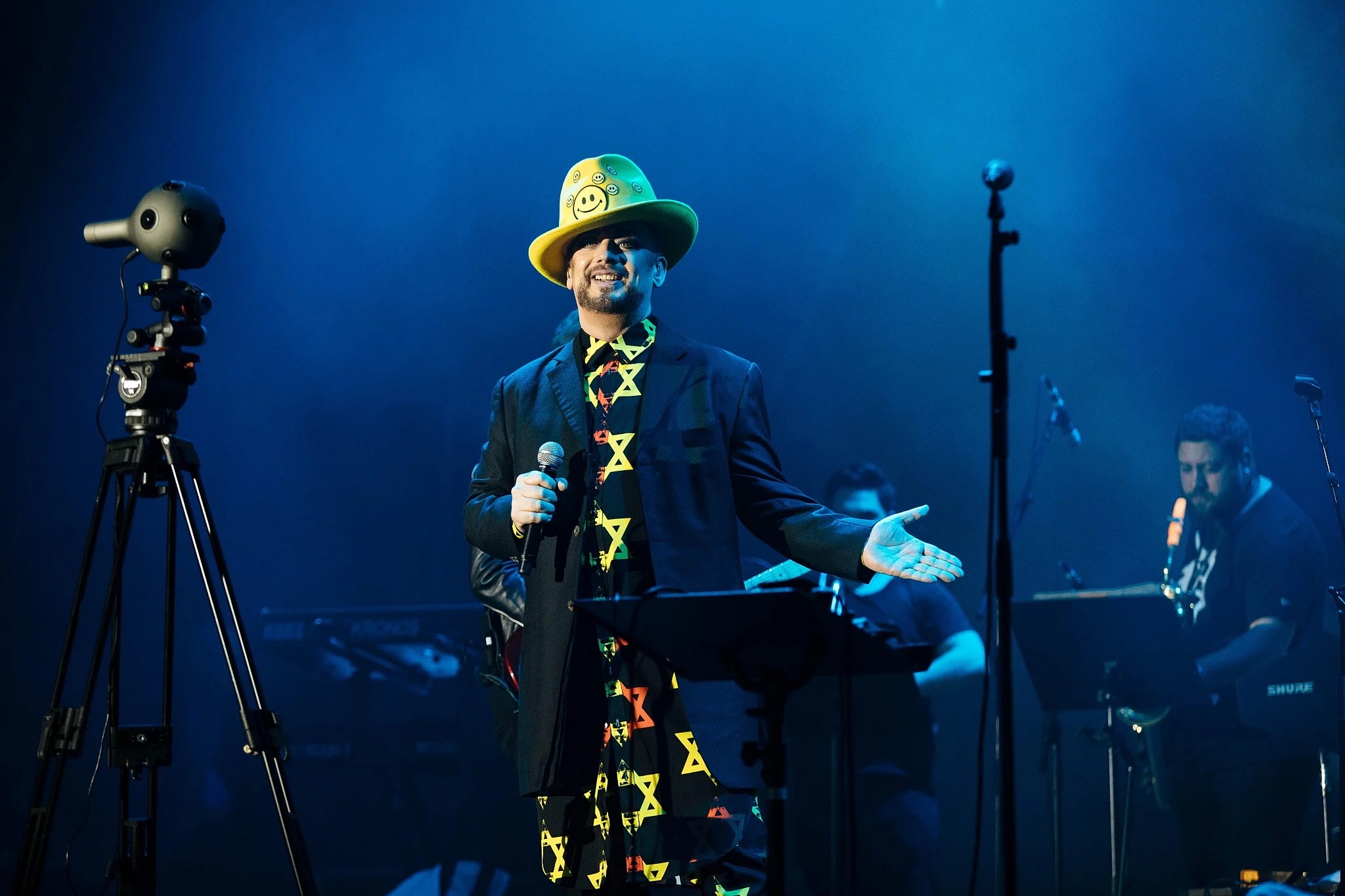
There are plenty of ways a pop star can show solidarity with a cause. A repost. A wristband. A carefully worded Notes App statement. And then there’s the Boy George approach. Write a song that opens with the line “You say genocide, I say war”, set it to a reggae beat, record it with AI-assisted production, skip every streaming platform on the planet and drop it directly to X with the hashtag #Shalom.
That’s exactly what the Culture Club frontman did when he released ‘Od Nirkod (We Will Dance Again)’, a track that is anything but subtle and, depending on where you sit, either bracingly honest or wildly provocative.
Within hours the song had racked up more than 130,000 views (it’s now sitting in the millions). The responses ranged from tearful gratitude to furious condemnation. Which, if you know anything about Boy George, sounds about right.
What the song actually says
The track, which runs just under three minutes, dives straight in. Over a stripped-back reggae groove, Boy George addresses the accusation of genocide head-on, framing Israel’s military campaign in Gaza as a defensive response to the Hamas-led October 7 attack.
He references the Nova music festival massacre, where 378 people were killed and dozens kidnapped, describing the victims as people who were murdered for doing nothing more than dancing. From there, he takes aim at musicians and public figures who have vocally supported the Palestinian cause, accusing them of having selective memory and acting like sheep. He finishes by singing the opening lines in Hebrew.
“I have a lot of Jewish friends and there would never be a situation where I’d turn my back on them…”
The title borrows from the rallying cry adopted by Nova survivors and the broader Israeli public since October 7, a phrase that also lent its name to a 2024 Paramount+ documentary about the festival attack, which won a News and Documentary Emmy the following year.
It is not a song that is trying to please everyone. It is not even trying to be diplomatic. And that, clearly, is the point.
Why it matters that it’s on X, not Spotify
One detail that has attracted almost as much attention as the lyrics is where Boy George chose to release the song. He did not put it on Spotify, Apple Music, or any major streaming platform. He posted it directly to X and Instagram, completely bypassing the usual music industry gatekeepers.
That decision is significant. In the current climate, where cultural boycott campaigns targeting Israel have put pressure on artists, labels and streaming platforms alike, releasing a song this politically charged through traditional channels would almost certainly have triggered a firestorm before anyone had even pressed play. By going direct to social media, Boy George sidestepped all of that.
Israeli media outlet N12/Mako reported the track appears to have been produced with AI assistance, and the Jewish Chronicle described it as “AI-created”. Boy George has not publicly confirmed the production method, though it is worth noting he recently launched a new company called Artist Included, which uses AI to help artists create new versions of earlier songs. Whether or not AI was involved in the production, the lyrics and the sentiment are unmistakably his.
#Shalom pic.twitter.com/0BfHIrThzO
— Boy George (@BoyGeorge) July 26, 2026
A long history of standing with the Jewish community
For anyone who has been paying attention, this song is not exactly a surprise. Boy George has been one of the most visible non-Jewish celebrity supporters of the Jewish community since well before October 7, and his connection runs deeper than most people realise.
Culture Club, the band that made him a global star in the early 1980s, was built on the idea of multiculturalism. The group comprised Boy George, an openly gay Irish-English singer, alongside Mikey Craig, a Black-British bassist, Roy Hay, an English guitarist, and Jon Moss, a Jewish drummer. The band’s name was itself a nod to their diverse backgrounds. In the iconic music video for ‘Do You Really Want to Hurt Me?’, Boy George wore a shirt with Hebrew lettering reading “Tarbut Aguda” (roughly “culture association”), a detail that endeared him to Israeli fans from the very start.
He has performed in Israel several times over the decades, both as a solo artist and with Culture Club. In 2020, he collaborated with Israeli musician Asaf Goren on the song ‘Rainbow in the Dark’, which featured both English and Hebrew lyrics. And in 2024, he was among more than 400 artists and celebrities who signed an open letter supporting Israel’s participation in the Eurovision Song Contest.
That support became even more visible earlier this year when Boy George took the Eurovision stage himself, performing alongside Italian vocalist Senhit as part of San Marino’s entry in Vienna.
It is not a song that is trying to please everyone. It is not even trying to be diplomatic. And that, clearly, is the point.
He had publicly rejected calls to boycott the contest over Israel’s participation, telling interviewers he would never turn his back on his Jewish friends. Though San Marino did not make the final, his presence on the stage, at a contest partially boycotted over Israel’s involvement, spoke volumes.
Then, earlier this year, when two Jewish men were stabbed in an antisemitic attack in the heavily Orthodox London neighbourhood of Golders Green, Boy George happened to be in the area. Speaking about the experience afterwards, he said he could feel the panic in the air and that Jewish people should know “we support them”.
Last month, after being targeted by pro-Palestinian activists for his stance, he said publicly that while he has compassion for Palestinians and does not agree with everything happening in Israel, he will always defend the people he loves.
“I have a lot of Jewish friends and there would never be a situation where I’d turn my back on them,” he said.
The reaction
The response to ‘We Will Dance Again’ has been, predictably, polarised. Pro-Israel voices have embraced it warmly. British Jewish anti-antisemitism campaign Stop the Hate UK called Boy George a champion of “Jewish joy” and publicly thanked him for standing with the community. Perhaps most poignantly, the official Nova Music Festival Instagram account responded to Boy George’s post with a simple comment echoing the song’s title, writing “We will dance again.”
On the other side, critics have been withering. The song has drawn significant backlash online, with detractors accusing him of denying the scale of Palestinian suffering. But Boy George, who has spent a career defying convention and courting controversy, has shown no sign of backing down.
For a community that has often felt abandoned by the entertainment industry since October 7, the sight of a mainstream pop icon putting his name, his voice and his reputation behind such an unambiguous statement of solidarity carries real weight. Whether or not you agree with every lyric, it is hard to deny that Boy George is doing something most artists in his position would never risk.
He is not hedging. He is not being careful. He is being Boy George.
comments