




One day in the 1960s, a lady wandered into Cadrys fine rugs shop in Edgecliff in Sydney’s east, and admired a hall runner hanging in the window display.
The shop’s founder, a Jewish immigrant from Tehran named Jacques Cadry, offered to take it down so that she could see it properly and touch it.
He laid the beautiful, handmade, one of a kind item on the floor.
After a pause, the customer asked him, “Could you please cut me off three yards?”
Jacques son, Bob, still recalls being told that one day when his dad came home from work.
“When the lady made that request, my dad thought, oh my gosh, what am I dealing with here?” adding it captured what Jacques faced in a country that had little idea what a hand-knotted rug even was.
Heading into its 75th year, Cadrys remains the nation’s most enduring name in fine rugs, with showrooms at Edgecliff and in the Melbourne suburb of Prahran.
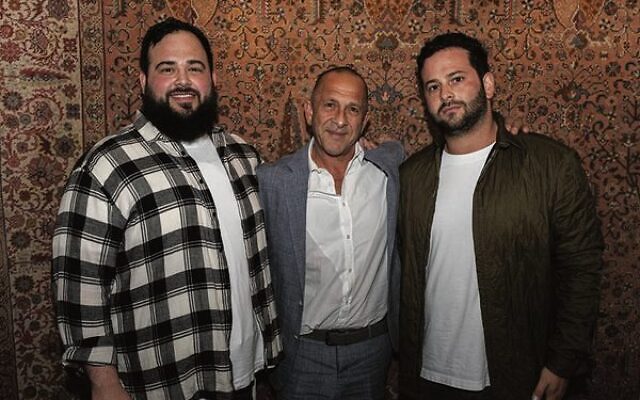
And it remains proudly family-owned, led now by Bob and his sons Jared and Ari.
The past: Jacques’ fresh start
The family’s involvement in rugs stretches back to the 1880s in Tehran.
Jacques’ father, known as Haji Israel, was a leading exporter selling intricately crafted carpets to the London market when Jacques was a young boy, who fondly recalled walking through the bazaars of Tehran, selecting suitable rugs.
Jacques grew up to be a young man of many talents. He completed a university degree in France in industrial pharmacy and, during holidays, worked for the iconic French perfume house Coty, where he learned to develop fragrances, later running his own perfumery in Tehran.
A business trip to Australia changed everything for him. He fell in love with Sydney, and decided he wanted a fresh start in a country that would give his family better opportunities in life than Iran.
Jacques arrived in Sydney in 1951 with his wife Jacqui, son Eddie and daughters Helene and Jeanette – Bob and his twin sister Denise were born seven years later.
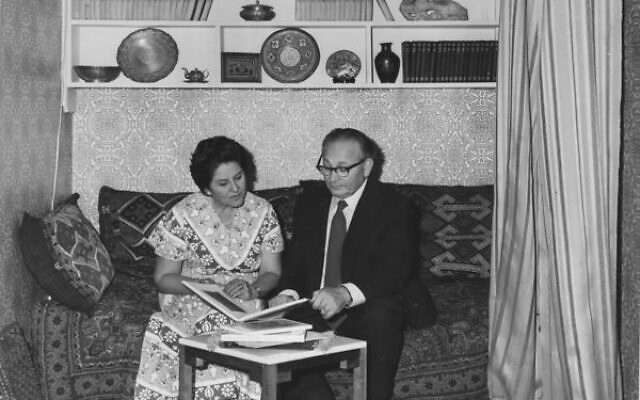
By the end of 1952 – just one year after his arrival – Jacques opened Cadrys in a small shop with a tiny basement in what was a row of terraces where the Edgecliff Centre now stands.
Those early years were hard. “There wasn’t a lot of appreciation for, or knowledge or understanding of, what even a hand-knotted rug was,” Bob said.
“In the beginning, the shop was often empty. Dad had to really cultivate and educate the market here.”
Education became the cornerstone. Jacques worked patiently with interior designers and architects, staged exhibitions promoting Oriental rugs, and sold through department stores including David Jones and Georges in Melbourne.
“He was a man of great patience and wisdom,” Bob said.
“He sowed the seeds of what today is a proud family legacy, and a strong company with great traditions and values, all instilled by his integrity and knowledge.”
In 1962, Jacques moved the business into the landmark sandstone building on the corner of Glenmore and New South Head roads, where Cadrys still trades.
Clients enter by walking past a model camel standing on the footpath outside – a quirky touch that sets the tone before they have even reached the door.
Tea, backgammon and perfume
Anyone who met Jacques – who died in 2003 at the age of 92 – would remember his warm and welcoming nature.
“He treated everyone with respect, and it didn’t matter who they were – he’d open the door, and would listen intently, and give them his time.
“He would have tea with them, and even play backgammon with them,” Bob said, recalling how Jacques also continued to make perfumes, from jasmine and rose he grew in the garden, and give them to customers.
Even now, tea is often served to customers in the Sydney store – including when the interview for this article was done.
Every rug came with a story.
In 1990, when the State Library of NSW featured his personal collection of historically important pictorial rugs, Jacques himself explained why.
“History gleaned from textbooks is often dry and unimaginable. The window that pictorial woven treasures impart gives us the imagery and visual connection that enable these fascinating stories to come alive.”
Bob said his father “was always well ahead of conventional considerations, being able to articulate the importance of that knowledge transfer”.
Children were always welcome in the shop too. When parents fretted about little ones jumping on the stock, Jacques would reply, “Let them jump, let them play – this is a beautiful playground for them.”
And Bob remembers Saturday mornings when the showroom was especially crowded with young families.
“And we’ve got clients coming to us now, saying that they remember coming here with their parents and playing on the rugs!”
Bob, born in 1958, recalled, “As a child, I wanted to be an Aussie boy – I didn’t want to be known as a Persian or a wog or whatever. I just wanted to bleach my hair blond, surf and play footy.”
But that changed at 16, when he travelled with his father to India, Turkey, Afghanistan and southern Russia.
“It was only then that I began to realise the amazing history, and the interest that the business had, on so many levels.”
He embraced his Mizrahi heritage, and began helping out in the shop, usually “shlepping rugs around” and opening up after hours for clients.
Jacques was delighted but did not push, wanting his son to make his own decision.
Bob’s older brother, Eddie, officially joined the business first alongside Jacques, and Bob followed when he reached his mid-20s.
“We both brought with us energy and new ideas.”
The present: a business that is still a family
Today Ari runs the Melbourne shop, and Jared the Sydney one, and they both co-manage operating the broader business under their father’s guidance.
Bob explained that the three have worked together now for about a decade, following an amicable transition when Eddie retired, and Eddie’s son Mark pivoted into property, becoming a leading property buyers’ agent.
“Family cohesion was foremost in that process, which doesn’t always happen in business decisions, but we were lucky,” Bob said. “We’re a very tight-knit family, and that’s been paramount for us.”
Jared recalls no single defining moment when he decided to dedicate himself to the business.
He’d worked summers at Bloch, his mother’s family business, and did work experience at a Double Bay real estate agency.
“But neither gave me quite the same sense of connection or belonging that I felt towards Cadrys,” Jared said.
He’d also gained plenty of inspiration from going on a sourcing trip to India and beyond, with his dad and brother.
“I met distant relatives and cousins who were also involved in the rug trade, so I wasn’t simply travelling to source rugs, but in many ways retracing the footsteps of those before me.
“Joining Cadrys was never simply about fulfilling an expectation. It was a genuine desire to be part of something I felt deeply connected to.”
Bob feels that Jared was “a natural fit”, given his enthusiasm about the family’s rug business going back to his high school years.
“By year 10, Jared was already making posters urging passers-by to buy their next great rug from Cadrys, and sticking them on telegraph poles outside the shop.
“And I’ve kept a couple of them all this time!” he added, smiling.
Ari’s calling emerged on a buying trip to India, when he began to understand and appreciate the elements of weaving, tradition, quality and colour.
“Ari has an incredible eye for detail,” Bob said.
Now Ari oversees finance, accounting and logistics, while Jared handles sales, marketing, design and creative direction.
“I honestly couldn’t love him more for it, because those are probably my worst nightmares!” Jared says of his brother’s role.
They do not always agree on things.
“I might approach something from a creative or commercial opportunity perspective, while Ari will naturally consider the financial and operational implications,” Jared said.
“But I think those differences are healthy.
“And mutual respect was instilled in us from a very young age.”
Heritage and stories in every pile
Cadrys’ story is also very much a part of the contribution of Australia’s Mizrahi Jewish community, and more broadly of Australians of Persian heritage.
Jacques counted Armenians, Islamic scholars, Jesuit priests, rabbis and Buddhists among his friends.
“He was very proud of his Jewish identity, and the contribution that the Jews had made to Iran over many centuries,” Bob said.
That pride bore fruit in 2022, in Cadrys’ 70th anniversary year, with Woven Memory – an exhibition of Jewish-themed rugs from the family collection at the Sydney Jewish Museum.
It included rugs that were handmade by the Bezalel carpet weavers of Jerusalem.
The Powerhouse Museum displayed a rare antique Persian Dorokhsh carpet on loan from Cadrys as part of its own exhibition that year, and there have been exhibitions featuring items from Cadrys at the State Library of NSW.
At the launch of Woven Memory, Bob recalls that the then Woollahra mayor, Susan Wynne, mentioned in her speech that Cadrys is the longest-established family business still trading in the municipality.
“Even we hadn’t realised that,” Bob said. And with that comes the responsibility to continue the legacy, to share the knowledge and contribute to exhibitions,” he said.
He praised, in particular, the SJM, and also the NSW Jewish Board of Deputies (JBD), for their commitments over the last decade to raise awareness about the history, culture, experiences and contributions of Australian Jews of Mizrahi and Sephardic heritage.
It so happens that JBD’s 2026 commemorative event for the Plight of Jewish Refugees from Arab Lands and Iran, scheduled for November 30, will pay particular tribute to three cherished members of the community – including Helene Cadry – who all passed away in the last year.
Bob added, “We’re hoping to have an exhibition of Jewish rugs in Melbourne in the future too.”
Pointing to an Armenian rug hanging in the Edgecliff store, he explained how it was woven in the early 1920s with natural dyes and handspun wool, and how a Turkmen bag displayed beside it was once used by nomads inside their tents to store belongings.
“As Dad used to say, each of the antique rugs is a window onto the world, and people love that each rug has meaning.”
The future: ancient craft, modern tools
If the past was about building trust, the future, Jared said, is about evolving without losing it.
“Our business is evolving at a pace that I don’t think we’ve ever experienced before,” he said, while emphasising how the art of making a rug remains a slow process “that has remained largely unchanged for centuries”.
Yet new technology is transforming design, product development and communication.
“And that’s allowing us to become far more adaptable and creative, without compromising the integrity of the product itself.”
Cadrys now supplies clients across Australia, New Zealand and Fiji – and most recently is branching into the Israeli market – and it undertakes contract and hospitality work, and wholesales to furniture retailers under their own labels.
Increasingly, Jared said, its role extends well beyond simply supplying rugs.
“We’re collaborating with architects, designers and stylists from a project’s earliest stages, and developing bespoke designs for homes, boutique hotels and commercial developments.”
Jared now travels regularly and widely, overseeing sourcing and production processes in India of new rugs that are made based on old traditions, but for the modern market.
He spoke keenly of Cadrys’ newest venture, called C&CO, which offers contemporary collections at more accessible prices, aimed at younger buyers.
“There’s a misconception that handmade craftsmanship must always come with an extraordinary price tag, but that’s simply not the case.”
While looking to the future, there are still plenty of non-negotiables at Cadrys, and a commitment to ethical sourcing is chief among them.
Jacques insisted on fair treatment of young weavers long before it was fashionable.
Indian exporters asked why he would not simply buy as cheaply as possible.
“He’d say, sure, you always want to buy your goods at as cheap a price as possible, but you can’t do this in a way that is going to be unfair to young weavers,” Bob recalled.
A few years after Jacques died, the GoodWeave foundation – an organisation he’d strongly advocated for – came into existence, and Cadrys is now its longest-standing ambassador in Australia. It is an independent nonprofit committed to ethical production, transparent supply chains, and rigorous inspections and standards that prohibit child and forced labour.
Bob, when asked what he most wants his sons to carry forward from Jacques’ legacy, said, “Integrity, respect, knowledge, service, and being true to your word, because it’s the simple things that matter.”
And for the customer? He returned to his father’s advice.
“You buy a particular rug because it should put a smile on your face, and bring a spark of joy. It should also enhance the comfort in your home, and allow you to live on it practically and durably over time, and create memories on it.”
And yes, the kettle at the Edgecliff store is still on.
For more information, visit cadrys.com.au.
comments