



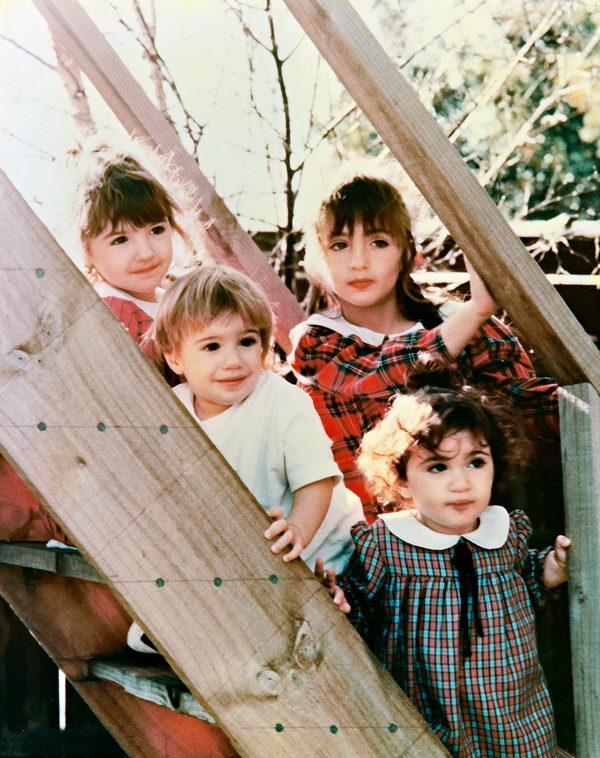
When Ellie Freeman (nee Braitberg) decided to become a surrogate for her twin brother Adam and his husband Omer, it was never simply about carrying a baby.
It was about creating family.
The embryo she carried was created using an egg donated by their eldest sister, Jess, and fertilised with Omer’s sperm, ensuring the child would carry the genetics of both fathers.
Daniel Lantsberg, an Israeli doctor at Melbourne IVF, managed the process with incredible care, keeping Adam and Omer on FaceTime for every appointment. Alongside the legal, psychological and ethical considerations that accompany any surrogacy arrangement, there were also thoughtful decisions about how family connections could be woven throughout the process.
For Ellie, however, the motivation was simple.
“I don’t think I could have done it for anyone other than a sibling,” she says.
When an embryo was successfully implanted, Ellie was already juggling life with three young children of her own; Noa, Maya and Raphael (then aged six, four and two), an energetic dog and a demanding career as a social worker. She was supported throughout by her husband Elliot, who was balancing the pressures of his own medical career as a gastroenterologist.
Ellie is quick to acknowledge the role he played, saying the surrogacy journey would not have been possible without him.
“He has been by my side every step of the way,” she says.
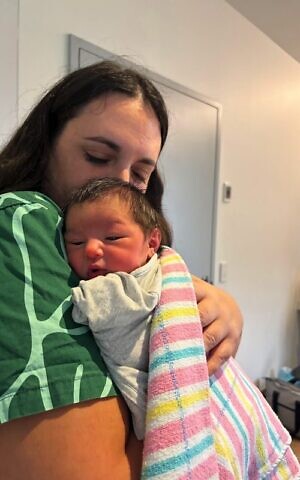
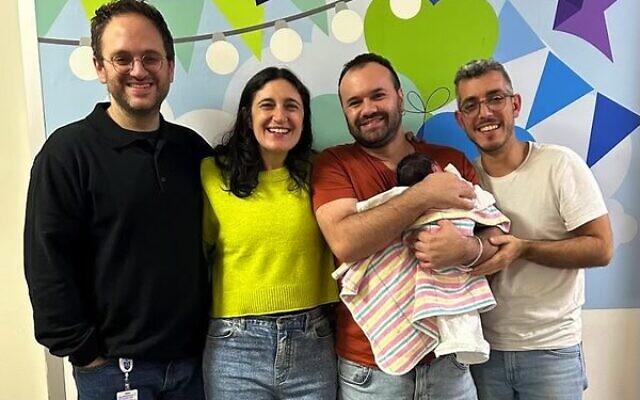
As the due date approached, visa complications, travel restrictions and the threat of escalating conflict with Iran created additional stress. Adam and Omer were living in Israel at the time, and the family anxiously waited for them to arrive safely in Australia before the birth.
The relief was palpable when they finally landed.
What Ellie describes as “the biggest family project yet” culminated in the birth of a healthy baby girl named Gali.
Present in the delivery room were Elliot, long-time obstetrician Lionel Steinberg, and the soon-to-be fathers Adam and Omer. She chose not to breastfeed, wanting to focus on healing and recovery after the birth, but she speaks openly about the emotional realities of the postpartum period and the unique complexities of surrogacy.
When I spoke to Ellie just days after the birth, she was still recovering physically but smiling as she reflected on the experience.
“It went really well,” she says.
It is an extraordinary act of generosity. Yet having known the family for decades now, it feels entirely consistent with who they are.
The Braitbergs are one of those families from school that I still remember more than 20 years after graduating. There were four siblings, all close in age and known for being kind, generous and exceptionally close-knit.
Jess was a year above me. Romy was a year below. Fraternal twins Ellie and Adam were a few years younger again. Their mother, Debbie, was a much-loved teacher at Bialik, known for her warmth and compassion, while their father George, a respected doctor, helped create the sort of bustling family life that, as an only child, always fascinated me.
A few years ago at Kolenu shul, I reconnected with Romy when our daughters unexpectedly became friends. Despite never having met before, they gravitated towards each other immediately and continue to find one another whenever we return for the High Holidays.
As regulars at Spout in Ripponlea, Ellie and I cross paths almost daily, our growing families evolving alongside our dependence on coffee.
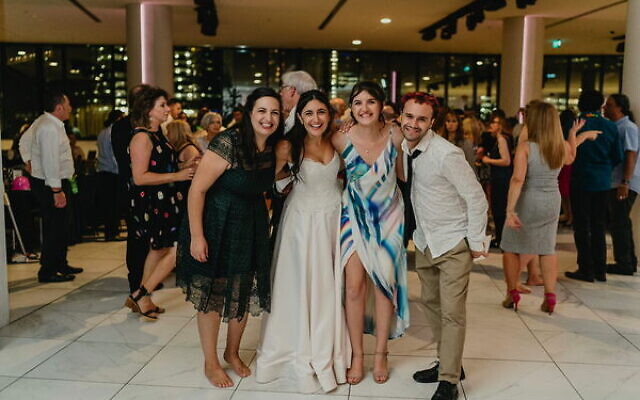
Decades later, they have all built families and lives of their own, but that sense of closeness remains unmistakable.
That closeness is central to how Ellie sees her role in Gali’s life. She is Gali’s aunt both genetically and socially and knows she will remain an important presence as she grows. Besides, as Ellie points out, the family is so close that the cousins already “feel more like siblings anyway.”
Perhaps that sense of family takes on even greater meaning when viewed through the lens of the generations that came before them.
Earlier this year, the family farewelled their beloved Buba, Ester Braitberg. Before her passing, Ellie had spoken on Ester’s behalf at the opening of Anita Lester’s exhibition Portraits of Survivors at the Melbourne Holocaust Museum.
That evening I discovered something remarkable.
After learning that Ester had been liberated from the same camp as my Zaida, I showed her an old photograph of him on my phone and asked if she remembered him. “Of course!” she replied instantly, before laughing and adding that “everyone thought there was going to be something between us.”
In that moment, a connection stretching from a camp in Poland to present-day Melbourne suddenly felt tangible.
Both had emerged from the Holocaust determined to rebuild. Ester carried her mother’s final words, “Don’t let them beat you”, while my Zaida Shmulek embodied a similar optimism, creating a life filled with love, family and hope.
Looking at their legacy and now baby Gali, it is impossible not to think about what those survivors would make of the families that followed.
As Ellie says, “They are the true heroes in this story.”
She adds: “They would be so proud of us, how we love our kids, our families, our Judaism and our Yiddishkeit.”
The birth of Gali is more than a surrogacy story. It is a story about family, continuity and the determination to create new life in the face of what previous generations endured and lost.
After years marked by conflict and grief, with both of our families personally affected by the October 7 attacks, moments like this shine even brighter.
Ellie goes by her married name Freeman now but says that she’ll “always be a Braitberg at heart”. The family have always been known for being kind, generous and exceptionally close-knit.
Baby Gali may be the clearest expression of that yet.
comments