



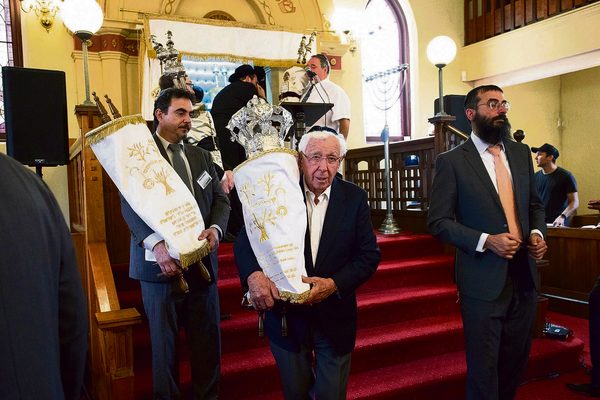
I first learned about Sir Frank Lowy at the Australian Museum in Sydney. Alongside an opalised plesiosaur skeleton and a 19th-century rug made of 75 platypus skins, there was a brief account of a Czech Holocaust survivor who went on to become Australia’s richest man. It was a bizarre way to discover that the origins of the ubiquitous Westfield shopping malls lay in the Levi family from the tiny pre-War Jewish community of Fiľakovo on the Hungarian/Slovakian border.
In 2018, Sir Frank sold the company he ran with his three sons David, Peter and Steven and moved to Israel. At that point, Queen Elizabeth II had already made Lowy a Knight Bachelor and Australia’s Governor-General had appointed him Companion of the Order of Australia (AC), Australia’s highest honour. Then, in 2024, as Lowy was receiving Israel’s highest civilian award, the Israeli Presidential Medal of Honour, a production marketing team was charged with making a short introductory film about him.
Over the next year, that film grew into To Be a Jew: Frank Lowy in his own words, a feature-length documentary by Sarit Asnapi. A film about one of Australia’s most successful businessmen could easily have become an inventory of 50 years of deals. Asnapi, known for My Sister’s Keeper (2023) about the ultra-Orthodox community, though, frames the film using the attacks of October 7 that deeply affected Lowy. Talking to me, he teared up at the thought of his young relatives who were brutally murdered at Kibbutz Be’eri, comparing them to his Slovakian cousins murdered in the Shoah. Asnapi shows what Pinchas “Frantisek” Levi – the boy who lost his father in the Holocaust – carried into Frank Lowy’s later life.
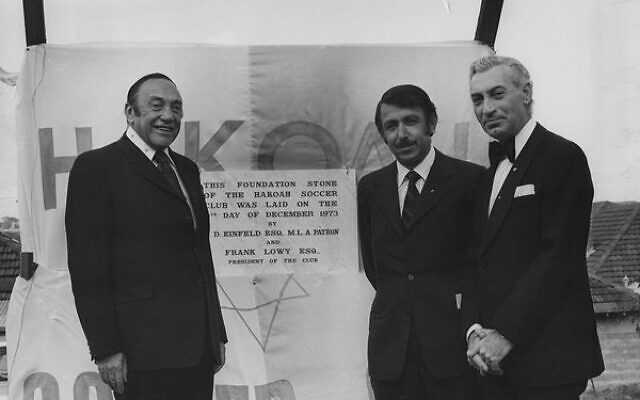
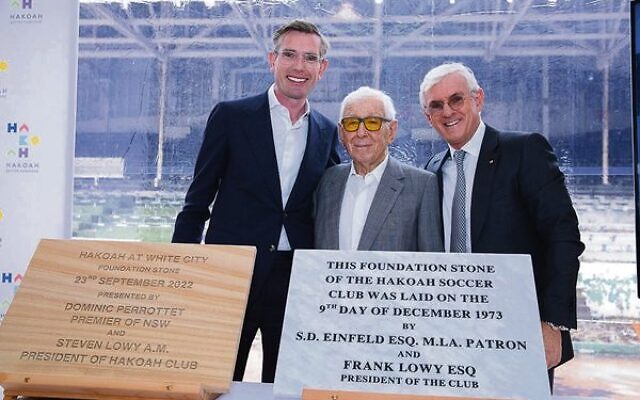
the foundation stone for Hakoah Club in 1973.
When I met him in his New York apartment overlooking Central Park, Lowy told me about an episode during the war that didn’t quite make it to the film. While his older siblings illegally worked around Budapest, he and his mother were relatively safe, though hungry, in the international ghetto. At midnight, his brother sometimes brought food to the building where they were living so that Frank, then a boy, could carry the parcel upstairs to the crowded apartment. His mother would open it, set it out on the table, and invite everyone to eat.
“I protested,” Lowy told me. There were perhaps 30 people in a flat intended for three or four, and he could see how little food they had. What, he wanted to know, would they eat tomorrow?
“Tomorrow, God will provide,” his mother told him.
Lowy, who is now a spry 95, about to turn 96, built and sold Westfield, the shopping centre company whose name is familiar to millions of Americans; helped remake Australian soccer; and founded major synagogues and think tanks in both Australia and Israel. But when he describes the principle behind his philanthropy, he returns to that apartment: “When you have a little, give a little. When you have a lot, give a lot.”
We began, though, with soccer. I’m a Leeds United supporter and his son Peter is now a director of the club. Lowy’s connection to the game goes back much further: to Fiľakovo, where his father took him to watch the local team on Sundays. On a return visit years later, Lowy sought out the spot by the field where his father Hugo, who was murdered in Auschwitz, had sat.
Lowy, his mother and his siblings survived. After the war, he went to Palestine, fought in Israel’s War of Independence and, in 1952, reunited with his family in Australia. He told me that on his first weekend in Sydney, he was back at a soccer ground, watching Hakoah, the Jewish club founded by immigrants on the model of the legendary Austrian team, Hakoah Vienna.
Years after that first Sunday at Hakoah, Lowy, who was president of the club from 1969 to 1988, was asked to help overhaul Australian football. The sport had devoted supporters, but it was a “Volksport” where clubs often carried the national identities and rivalries of immigrant communities. Lowy recalled matches at which hostility in the stands overwhelmed what was happening on the field. He wanted a league that those communities could enjoy together with the rest of Australia.
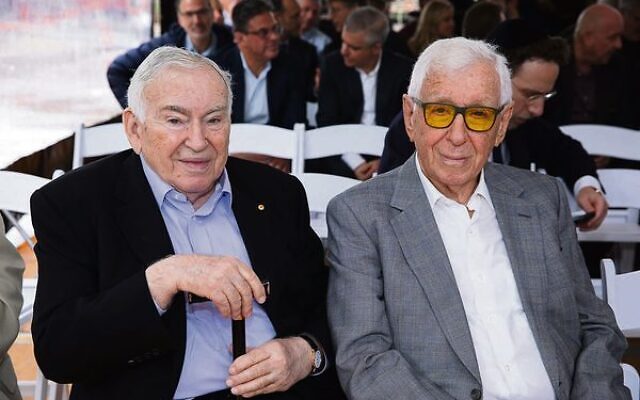
Photo: Giselle Haber
After being approached to transform the sport in the country, Lowy led the national governing body from 2003 to 2015. Under his chairmanship, the A-League began in 2005 with Australian city clubs taking over from the Macedonian, Italian, Croatian, Jewish, and other clubs that had preceded them. As well as refashioning the league, Lowy helped the “Socceroos” national team take on a pan-Australian character. With “the kick that united a nation”, John Aloisi’s successful penalty against Uruguay meant that Australia qualified for the 2006 World Cup, its first appearance in 32 years. It was a moment that transformed soccer’s standing in Australia from a niche sport into a mainstream powerhouse.
Soccer isn’t just a hobby for Lowy. In the wake of December 2025’s Bondi Beach massacre, he wrote to the Royal Commission on Antisemitism and Social Cohesion, suggesting the same principles he used to change the profile of the sport as a potential solution to the blight of rising antisemitism in the country.
He does not pretend that running a league supplies a complete answer to hatred. He does believe that people can change the public life of a country by building institutions, speaking openly and refusing to retreat.
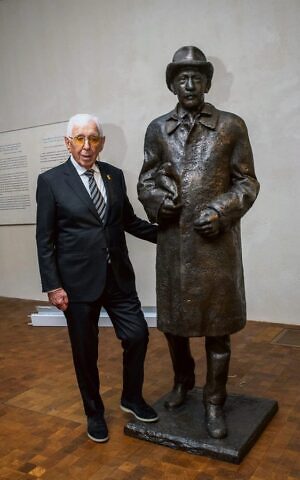
“In soccer, we didn’t try to take people’s ethnic identity away; we worked to stop the expression of ethnic conflict in public. Similarly, it is probably not possible to eradicate a dislike of Jews, but it is possible to help people understand why, in Australian society, the public outpouring of this aversion is not right.”
The persistence of soccer in Lowy’s life fascinated me. So did the contrast between Hakoah, a place where immigrants could keep something of their old lives, and the more broadly Australian game Lowy later helped build. He did not see a contradiction. His early businesses had already taught him what could happen when people from different places found a reason to gather.
After finding factory work on arrival in a burgeoning immigrant Australia, Lowy took a job making sandwiches. Soon, he and fellow immigrant John Saunders opened a delicatessen in the Western Sydney suburb of Blacktown. “The delicatessen was very successful because we were the only ones that were selling continental goods,” he told me, “And the Russians, the Slovaks, and all the people that came were hungry for that. Because in Australia, then, a sandwich meant white bread, a slice of cheese, and white bread on top of it.” So their customers included Europeans from all over, who missed the food they had known before emigrating. The partners bought “Australia’s second espresso machine” and Lowy remembers the Italian workers queuing for coffee on Sunday mornings.
One afternoon, an acquaintance told Lowy he was building shops nearby. Lowy, as he avers is the case throughout his career, was “aware and alert”. How does what I observe affect me? What can I do about it? With whom can I take action? So he went back inside and asked Saunders a question that would recur throughout our conversation: Why don’t we do the same? They began with a few shops in Sydney. In 1959, they opened their first proper shopping centre in Australia, and in 1977, their first shopping centre in America.
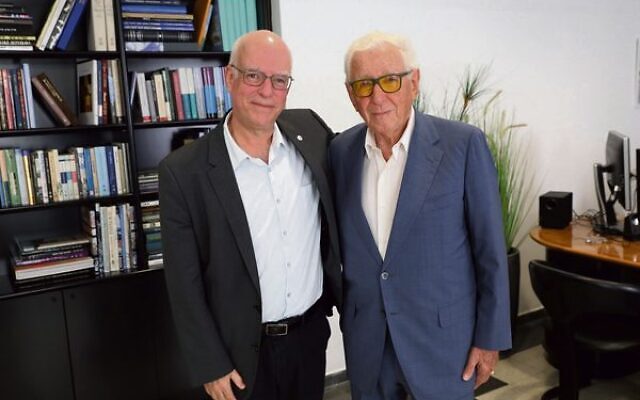
Lowy describes this habit of noticing an opening, then acting on it, as “active optimism”. It is an appealing phrase, though his version has less to do with expecting things to turn out well and more to do with moving into an area and being open to pivot with partners to change goals and maximise success. He spoke of watching for dangers as closely as opportunities, and of the financial crises the company had to survive. He also spoke with unusual ease about the help he received: Saunders, bankers who stood by the business, and colleagues he chose well. “Alone you cannot succeed,” he said.
Lowy told me that he objected when newspapers called him a “Jewish businessman” in stories where another man’s religion would never have appeared. He wanted to be known as a businessman on the same terms as anyone else. At the same time, wanted no one to mistake who he was.
“I carried the Jewish flag,” he told me. Does he still? “All the time.”
For all his talk of building things, Lowy’s memories of Jewish life begin with what his parents did for people who had little power. Before the war, travelling Jews looking for money far from home in Poland or Carpathia would often sleep for free in the synagogue. On Friday nights, the rabbi would see whether any heads of household would take them in for meals. Lowy remembers that his father would bring these travellers home, and even seat them at the head of the family table.
He founded the Lowy Institute, an international policy organisation to combat what he saw as Australian isolation. By providing world class, original “policy-relevant research from an Australian perspective”, it can bring Australia into international conversations. Sometimes, that means bringing world leaders to speak in Sydney, or by convening meetings across the world under an Australian umbrella.
In a similar vein, in 2006, he became chairman of Israel’s Institute for National Security Studies, one of the world’s leading security think tanks. He described his private support for Jewish causes, including Holocaust commemoration, Tel Aviv University and the NSW Jewish Communal Appeal (JCA) as something he learned at home, from those meals and from the coins his mother put into a Jewish National Fund box at their home on Fridays.
The documentary follows Lowy as he reflects on nearly a century of Jewish life and visits communities devastated by the October 7 attacks. Its title sounds definitive, but, when we spoke, Lowy was still working out what he wanted people to take from the film. He hoped some might follow his example in giving to others. He hoped, too, that telling a Jewish story openly might do some good.
Near the end of our conversation, Lowy said he was “a Jew, body and soul, Israeli on top of it”. After his journeys to Budapest, Tel Aviv, Sydney, Trumbull and New York, it was a strikingly simple account of himself. I thought again of the boy carrying food up the stairs, anxious about tomorrow, and of his mother setting a place for everyone anyway.
His mother and his father had both shown young Pinchas how to take pride in sharing food with strangers but it took an adult Frank Lowy to bring diverse people together at a massive scale no matter what their differences: whether it was through food at a deli, politics at a think tank, crowds at soccer games, or shoppers at malls across the world.
This story originally appeared in The Forward (forward.com). To get the Forward’s free email newsletters, go to forward.com/newsletter-signup.
comments