



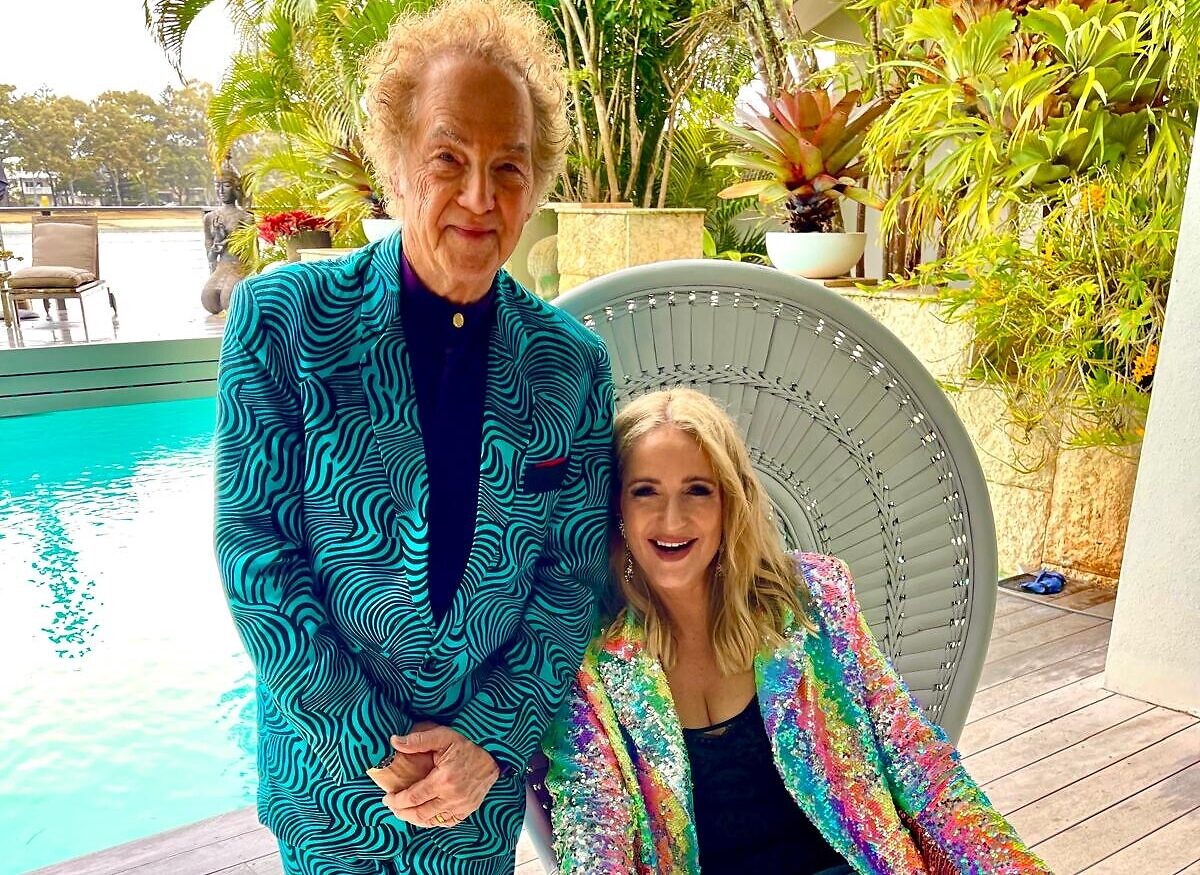
For Bianca Dye, the family business was an inheritance. The radio presenter grew up backstage in her father’s world, learned to perform before she understood she was performing, and built a 30-year career on the same two traits that have kept her father, Issi Dye, on the road for six decades: chutzpah and resilience. At nearly 80, he is still touring. At 52, she is still reinventing.
“People say to me, when are you going to retire? I don’t play golf,” he laughed while chatting to The AJN from a pie shop on his way to Dubbo. “I don’t fish. I’m not a fisherman. I don’t play bowls, but I’m very good at setting up equipment and driving and driving my car around the country and performing, I’m good at that.”
Born Israel Dyzenhaus in Austria in 1946, Dye has spent six decades in showbiz and told The AJN that he has “never had a real job in 60 years”. These days he is what he fondly calls “a musical truck driver, because I do thousands of kilometres”.
“This trip I’m doing 7000 kilometres, driving all over Victoria, New South Wales, and Queensland, performing 20 shows in the next four weeks,” he said.
It started in a Melbourne synagogue, where his father, a doctor and Holocaust survivor, sang as a cantor and a young Issi joined the choir. Then came the Jewish dances and the top-40 covers, where everyone would gush over him.
“I grew up watching someone who was fearless.” Bianca Dye
Issi was, in his daughter’s words, “a huge pioneer of late night TV in the 70s on Channel Nine”. A break on 1960s pop television saw Dye go on to host his own late-night programs and tour as a support act for Roy Orbison, the Beach Boys and the Everly Brothers. His philosophy has not shifted since: “if you love what you do and you enjoy it, go hard on it.”
Bianca spent her childhood roaming the studios where her dad would work.
“My dad used to let me go rogue around … Channel Nine at night. Free-range kids in the 70s; it was great,” she said, recalling running around Bert Newton’s dressing room and annoying him, before being politely escorted out. She also shared a tidbit about a card from Olivia Newton-John, though the show-and-tell photo she took to school left classmates unconvinced. “I had no concept that kids would see me as different,” she said, explaining that she thought it was normal to grow up chatting to superstars.
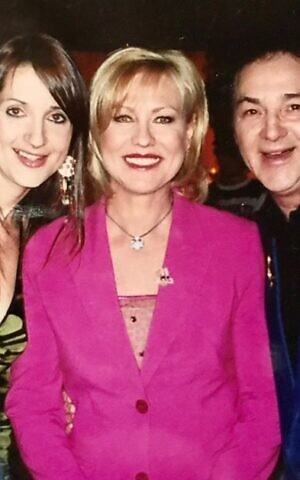
A break on 1960s pop television followed, and Issi went on to host his own late-night programs and tour as a support act for Roy Orbison, the Beach Boys and the Everly Brothers. His philosophy has not shifted since: “if you love what you do and you enjoy it, go hard on it.”
Bianca is the only one of Issi’s three children to follow him into the family trade.
Before radio came a stint as a Marilyn Monroe impersonator and years of spruiking at Gold Coast shopping centres, often covering gigs her father was too busy to take.
“Dad would get overbooked for gigs, and he’d say, oh, I can’t do it, but my daughter can,” she laughed. It’s a tale Issi recalled too. Asked to be ringmaster for the Moscow Circus’s Australian tour, Issi was already committed to his own shows.
“I suggested to him, oh, look, you might like to audition my 18 year old daughter, Bianca,” he recalled. She got the job and toured the country as ringmaster. Soon after, radio came calling through a message on her pager.
For her first job, she was everything at once. “I was the nighttime announcer, I was the promotions manager, I was the PR person, I was the person that drove the station vehicle around,” she recalled, saying she learned the ropes the hard way.
Bianca shared that the hard-won identity made losing it all the more disorienting. When her radio show was axed, Bianca found herself freelancing and asking, “Who am I if I’m not the funny girl on the breakfast show?”
“My Jewish identity has definitely shaped my blood, because obviously Jewish artists are very resilient.” Issi Dye
She was candid about the difficult days that followed, saying her six-week turn on The Golden Bachelor last year became a tonic, until it ended and she hit what she calls “reality show depression”. Still, she kept going, and recently fulfilled a lifelong dream: broadcasting on breakfast radio in her hometown of Melbourne for the first time.
“My dream has been to be on air in my hometown,” she said. The moment meant even more because of who was tuning in. Her father, not a man for compliments, began texting her as he listened in. For Bianca, it meant the world.
If there is one family inheritance, both Issi and Bianca say that it’s chutzpah.
“I’m a little mini him,” Bianca said of her dad. “I do have his chutzpah.” She traces the trait, and a deep resilience, back to her grandparents. Her grandmother, Edith, survived Auschwitz at 15, and Bianca calls her “the most brilliant, captivating storyteller. “I think that’s where I got a lot of what I do from,” she admitted.
She points, too, to her father’s example.
“I grew up watching someone who was fearless,” she said. “He was tough love.” She offers the description with affection, crediting that fearlessness for giving her the nerve to take risks, on stage and on air.
Issi sees the same thread running back to his parents, who rebuilt their lives in Melbourne after the war.
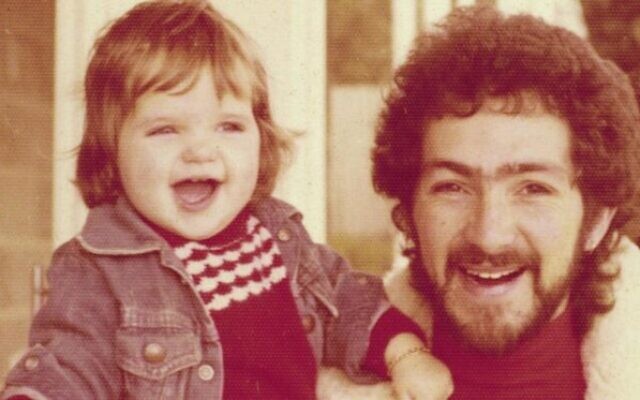
“My father had a lot of resilience and never say die attitude,” he said, explaining that this heritage is inseparable from his craft. “My Jewish identity has definitely shaped my blood, because obviously Jewish artists are very resilient.” He remains proud of where he comes from but admits most of his work is “for the gentiles” now.
Asked what their two careers share, Bianca put it simply: “you need chutzpah in both.” Neither shows any signs of slowing down. As Bianca chatted to The AJN, she was preparing to host the Australian Audio Awards. Her father, for his part, has no plans to leave the road. “All I can do is just keep going as long as I’m able to,” he said.
comments