



Citizen Khaled speaks out
During his recent trip to Australia, Israeli-Arab journalist and authority on Palestinian issues Khaled Abu Toameh answers questions on a range of issues.
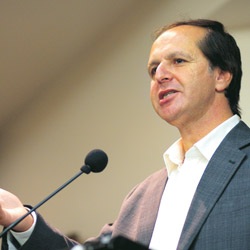
During his recent trip to Australia, Israeli-Arab journalist and authority on Palestinian issues Khaled Abu Toameh answers questions on a range of issues.
How do you feel as an Arab Muslim living in Israel?
You know, I always say that it’s very easy to solve the problem between Jews and Palestinians. Why? Because at the end of the day, there is going to be separation, in one form or another, from the Palestinians.
One day, they will be there and we will be here. But what do we do with the 1.4 million Arabs living inside Israel. What’s their future? I’m very worried about the serious deterioration that has happened with relations between Jews and Arabs inside Israel.
If I were a Jew living in Israel, I would be very worried about the deterioration of relations between Jews and Arabs inside the country. We, the Israeli Arabs, have been extremely loyal to the State of Israel ever since its establishment. We are the Arabs who in 1948 did not challenge Israel’s right to exist. We accepted Israel. We welcomed Israel. We helped build Israel. Israel gave us passports, citizenship, okay. But although the overwhelming majority of us were loyal to the State of Israel, sadly, the State of Israel or the Israeli establishment were not equally loyal towards its Arab minority.
And what am I talking about. I’m talking about employment, services, infrastructure. We continue to suffer from what [former prime minister] Ehud Olmert called a policy of systematic discrimination against the Arab minority.
Now, the good news is that Israel is not an apartheid state. But the bad news is that there is discrimination inside Israel. It’s not just against Arabs — it’s against Russians. It’s against Ethiopians. It’s against the elderly. It’s against the disabled. If this policy continues and the Israeli establishment does not wake up and embark on an emergency plan to improve its relations with its Arab minority, the third intifada will be on the streets of Haifa and Akko, and the Negev and the Galilee.
[However, that said], if you ask me on a personal basis, and I think I represent mainstream Israeli Arabs, we would rather live in Israel under any circumstances. It’s much better than living as a first-class citizen in Cairo, Amman, Gaza or Ramallah.
You say Israel is not an apartheid state. Can you elaborate?
If Israel were an apartheid state, an Arab would not be allowed to live in a Jewish neighbourhood. An Arab would not be able to go to a Jewish school, and so many other things. Or an Arab would not be able to go to the same restaurant as a Jew. You have to look at the apartheid system and study it and see what it was. Compare it to Israel. Are there problems with discrimination? Yes. But I wouldn’t call it apartheid.
Do Israeli Arabs find Hatikvah alienating as the national anthem?
Maybe Hatikvah does not represent what I, as an Arab Muslim, feels — my aspirations and all that — but I have no problem with it. A Jew can sing whatever he wants, and a Muslim will sing whatever he wants. I don’t care about the colours of the flag. I don’t care about Hatikvah. I respect them. I’m not challenging them. I’m just saying, if you want to be a Jewish state and sing whatever you want, do whatever you want, fine. But give me full rights in this Jewish state. You can be a Jewish state for all of your citizens.
So Israel is not trying to impose Hatikvah on me. That’s also good. It shouldn’t be imposing anything on anyone. If Israel wants to be a Jewish state, that’s also fine with us Israeli Arabs. We never thought that it was a problem until Israel raised it. It’s like, why are you chasing me, asking me to accept you as a Jewish state? You are a Jewish state anyway. You are the homeland for the Jews.
But why are you asking me to start saying “yes I accept” or “I don’t accept it”? What does it matter to you? Israel should not be begging or chasing anyone to recognise Israel or accept Israel as a Jewish state. Israel is a fact. It exists. Whether people accept Israel or not, that’s their problem. But Israel should have enough self-confidence and stop raising these issues. There’s no need for it.
What is your opinion of Foreign Minister Avigdor Lieberman’s proposal to make all Arabs swear oaths of loyalty to the State of Israel?
Why is he raising this? We are citizens of Israel. Who is he to come now and ask us to do this? By the way, this is a dangerous idea, because today you will demand it from the Arabs. Tomorrow you will demand it from the Russians. Then you will demand it from the Ethiopians. Israel is a state of law and order and should have more confidence in itself than this man. This man’s message, unfortunately, is very negative, and he is also damaging relations between Jews and Arabs. If Mr Lieberman wants to incite and say these awful things, I say something like this: he who came last, should leave first.
If Mr Lieberman stands up and says “All citizens should be equal and loyal to the state of Israel”, I will say, “yes Mr Lieberman, thank you”. I will even serve in the army. But once you single out one group, that becomes too dangerous. This is not what Israel wants and fortunately, he does not represent the majority of Jews in Israel.
What can you tell us about the recent arrests of two Israeli Arabs [on charges of espionage for Hezbollah] and the response from the [Israeli-Arab] community?
These charges will be tested in court. But what is for sure is that the arrest itself and the allegations that are flying do not contribute to coexistence. They only widen the gap between Arabs and Jews. And if it turns out to be true that these guys are actually guilty of what they are accused of, it just shows that the radicalisation [of Israeli Arabs due to discrimination] is continuing.
How well are your lectures received overseas, in particular at universities?
First of all, you should ask me how they are received by Palestinians [in the Palestinian areas]: very well. I go to Gaza, I’ve been at Palestinian universities in Gaza. I’ve been at Palestinian universities in the West Bank. I go back there every day. I talk, most people tell me what I’m saying makes sense, that these are reasonable things I am saying. So over there I have no problem.
Where do the problems start? As soon as I show my face at a university campus in Canada or in the US, or even here at Monash University, where people — most of them not even Palestinian, not even Arabs — stand up and say to me “how dare you” [and then start throwing around words like] apartheid, war crimes, massacres, death to Israel and death to Zionism.
Their message is hatred and delegitimisation of Israel and demonisation of Jews. I ask [these protesters], “Who are you?” And they say, “We are the pro-Palestinian group”. I tell them, “Excuse me, what’s pro-Palestinian about you? That you are wearing your kaffiyeh? That doesn’t make you pro-Palestinian. You are just Jew-haters and Israel-haters. If you really cared about the Palestinians, why don’t you come to Palestine and teach Palestinian children English, for example? Why don’t you come to Palestine and promote the rights of women under Hamas? Then I will call you pro-Palestinian.
“But sitting over here on a campus in America, and telling me that Israel is bad and to dismantle this Jewish State and to get rid of it, that does not really help me as an Arab Muslim living in Israel. Your message is no different than the message of Hamas. We have enough incitement, thank you. If you have anything good to offer us, please come.”
I passed by some Lebanese girls who were organising Israel Apartheid Week in Canada. I stopped at their information table and I asked them, “Excuse me, which apartheid are you talking about?” They said, “Of course the Jewish State, and apartheid against the Palestinians.” And I asked them if they were from Lebanon. “What about the apartheid in Lebanon against the Palestinians, where in Lebanon there is a law that prevents Palestinians from working in more than 60 professions? By law, it’s written in the law.”
Can you imagine if the Knesset met tonight and passed a law banning Arabs from working in one ­profession?
They said, “You know, you are right, but don’t tell these folks over here. Don’t bring the dirty laundry out, please.” I told them that was hypocrisy. If they want to wage a campaign against apartheid, they need to go against all the apartheid they are talking about.
I don’t like these negative messages. They don’t bring us anything. The same goes for campaigns for divestment and boycotts. Again, I asked how it could help me? Boycott — negative. I told some folks who were calling for boycotts: “Instead of wasting all this energy calling for boycotts of Israel, why don’t you come to that part of the world and bring Jewish and Palestinian professors together, for example? You guys are actually undermining the moderates over there who want peace, through your messages of hatred.”
The battle today against Israel is not in the form of a suicide bomber and a rocket. We have answers to that. Israel has been able to deal with them. You can always strike back at a rocket. You can always fight against suicide bombers. Israel has succeeded at that. I’d be much more worried as a Jew at what’s happening on the university campuses. This is very serious, what we encounter over there.
You are a Jerusalem Arab. Do Jerusalem Arabs want a divided Jerusalem?
I don’t think anyone wants Jerusalem to be divided. I don’t think Jerusalem can be divided. Jerusalem can perhaps be shared. But you cannot really divide Jerusalem. It’s not practical.
This transcript includes answers given by Khaled Abu Toameh during a Q&A in Melbourne. His trip to Australia was sponsored by the Australia/Israel & Jewish Affairs Council, the United Israel Appeal and the NSW Jewish Board of Deputies.
AHRON SHAPIRO
PHOTO: Israeli-Arab journalist Khaled Abu Toameh
comments