



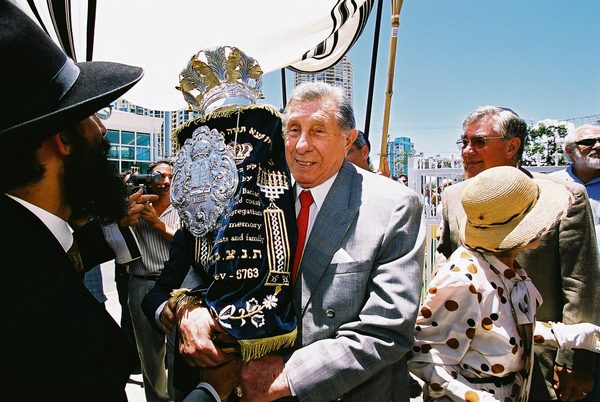
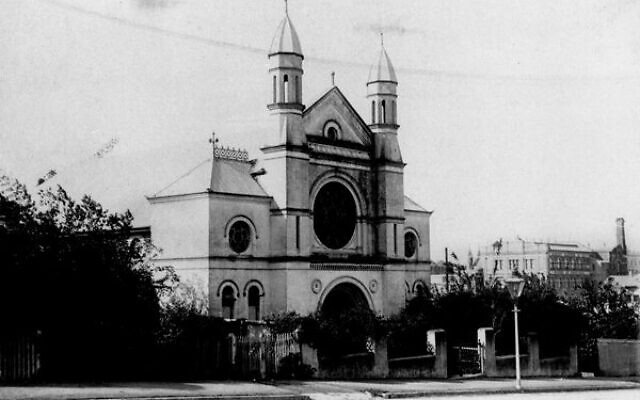
While the first records of Jewish settlement in Queensland coincide with the separation of the colony from New South Wales in 1859, it was in 1865 that several Jewish families came together for the first communal meeting, establishing what became the Brisbane Hebrew Congregation, and later building the historic Margaret Street Synagogue.
160 years later, the Sunshine State boasts a small but thriving Jewish community. Brisbane and the Gold Coast are home to six shules while Chabad of North Queensland services the state’s tropics.
Brisbane-born Pamela Huppert has been part of the community for 90 of those years.
“Growing up in Brisbane from 1935, life was markedly different from what we know today. The population, especially within the Jewish community, was quite small. Everyone knew each other, creating a close-knit, warm, and caring environment that fostered a real sense of togetherness,” she said.
Huppert recalled the reverence shown during holy days. “During the most significant holy days, particularly Kol Nidrei, the men would dress in dinner suits and top hats, while the women always wore hats and gloves. The synagogue was always so crowded, it was often difficult to find a seat, which contributed to a unique and special atmosphere in our beautiful house of worship.”
Life in wartime Brisbane was challenging. “I vividly remember 1939 and the introduction of ration books, every household needed one for each person, including children. Food was scarce, and groceries and many other items could only be purchased with ration coupons. Supermarkets did not exist; instead, parents would phone the local grocer, who would deliver food straight into the kitchen.”
After World War II broke out, Huppert said, fears of a Japanese attack led to the synagogue board proposing that the children in the community be evacuated to Oakey, a country town 155km west of Brisbane.

“It was arranged for approximately 70 children, including myself at age seven, to be evacuated to Oakey for around seven months,” she recalled. Of course, children missed their parents, however I know for certain all had quite a happy life in Oakey attending school and having the friendships of 70 other Jewish friends.”
Recollecting Jewish life during her teens in Brisbane, Huppert said the Judean Sports Club (now Maccabi) played a significant role in forming community bonds.
“At age 15, the Judean Sports Club organised our first Brisbane Sports Carnival. These Maccabi Carnivals brought together Jewish youth from Sydney, Melbourne, Adelaide and Perth, giving them opportunities to meet and form wonderful connections,” Huppert said.
“Every Shabbat, I and most of the youth attended the synagogue. One rabbi, who lived in New Farm, would be walked home by our small group of friends, and afterwards, we would stay together for more time spent in friendship and Jewish education especially as we studied for our bat mitzvah and bar mitzvahs.
She continued, “I remember some of our Jewish festivals, particularly Succot. The Women’s Guild decorated the hall behind the synagogue with hanging fruit. The roof was opened by a pulley, and fruit was hung from the rafters, with each congregant receiving a piece to take home, simple, beautiful memories and a true symbol of unity.”
The community’s infrastructure developed significantly from the 1970s onwards. In 1974, the late Lance Phillips played a vital role in establishing the Jewish Community Centre Queensland, transforming what had been the Burbank Community Centre into a cornerstone of Jewish community life. In 1982, B’nai B’rith established six units to provide housing for seniors.
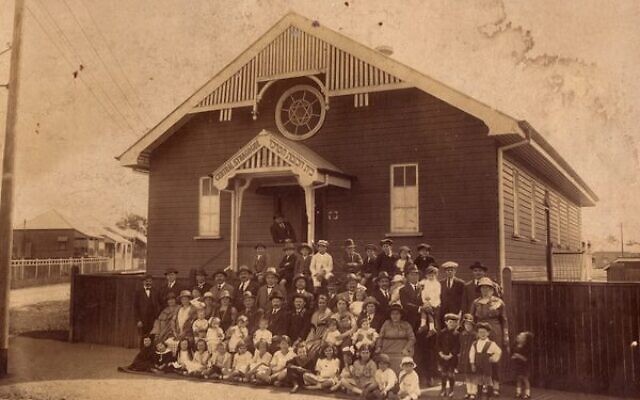
“Today with ongoing development, the JCCQ stands as a comprehensive centre, housing the Jewish retirement centre now with 20 modern units, a shared synagogue and a hall established by the NCJW, Council of Jewish Women Brisbane Section in the early 1980s which has now been renovated to be a wonderful modern function room for weddings, bar mitzvahs and other functions,” Huppert said.
During the 1980s, under Joe Saragossi’s direction, additional land was acquired, leading to the founding of Sinai College, a Jewish primary school that continues to operate today.
Sadly, the community was not spared the impact of the devastating 2011 Queensland floods. While the floodwaters that had been threatening the synagogue on Margaret Street receded before reaching the building, around 20 families were forced to evacuate their homes, returning to significant damage.
At the time, Queensland Jewish Board of Deputies (QJBD) president Jason Steinberg described the extent of the damage as “devastating”.
But he praised the resilience of both the Jewish and wider Queensland communities. “There’s so many people wanting to volunteer to get people back up on their feet and to clear up debris and mud and help, it’s just really amazing to see how people have come together.”
He observed a year later in an interview with The AJN, “The community spirit that was shown was just outstanding and I think the community has grown as a result of that experience.”
Steinberg has long served the state’s Jewish community in a variety of roles. In 2023, he oversaw, as chairman of the Queensland Holocaust Museum and Education Centre (QHMEC), the opening of the collection by then premier Annastacia Palaszczuk.
“Our multifaceted and engaging museum tells the story of the Holocaust in a way that it has never been told – through the voices, stories and artefacts provided by Queensland survivors,” he said at the time.
Commenting today on the contribution of Queensland Jewry on the nation, Steinberg said the small community has made a lasting impact over 160 years.
“In commerce, medicine, law, education, philanthropy, tourism, retail, civic and cultural life of Queensland, Jews have been active in cities and towns across the state from Far North Queensland to Coolangatta and out west to Mt Isa,” he said.
“The importance of marking the community’s 160th anniversary this year is made all the more important given the hate Jewish Queenslanders have been subjected to since the Hamas terrorist attacks on October 7, 2023.
“This milestone is a welcome reminder to celebrate the amazing contribution Jews have made to Queensland. That’s why our tag line for this anniversary is less oy, more joy. This is our moment to celebrate that legacy, joyfully, proudly and together.”
And there are a number of Queensland Jews who have made their mark. Henry Spiro served as mayor of Toowoomba in 1870 and 1873. Miriam Hertzberg co-founded the Lady Lamington Hospital, now Royal Brisbane and Women’s Hospital, in the 1880s. Sir Matthew Nathan served as Queensland governor from 1920 to 1925, while Sir Zelman Cowen was UQ vice-chancellor before becoming governor-general.
Dr Errol Solomon Meyers founded UQ’s medical school. Holocaust survivors Paul Kamsler and Rudi Pekárek made significant contributions as businessman, philanthropist and symphony conductor respectively. Business leaders and philanthropists Reuben Pelerman and Joe Saragossi helped shape the community’s infrastructure. Roy Levy captained Queensland cricket in the 1920s and 1930s, while Ramon Epstein represented Australia in paralympic weightlifting. Miron Bleiberg coached Brisbane Roar and Gold Coast United, and Holocaust survivor Richard Werner left his mark as a painter.
Today, Rabbi Levi Jaffe of Brisbane Hebrew Congregation describes the community as vibrant.
“People are involved and there’s lots of good things happening here. On the whole, it’s a community that’s growing,” he said.
“We’ve got an adult education course called the Kabbalah of Meaning, we’ve got 40 paid participants. And it’s a wide range of people from different ages and backgrounds, and people want to learn. They want to grow.
“The Jewish Communal Centre has been revived over the last few years, which is fantastic. There’s a Jewish retirement village there, they have got their own little shule … it’s actually a beautiful complex, which I think is the envy of some of our larger sister communities. So in some ways, we’re progressing. I think we’re doing a reasonably good job.”
While Queensland along with all states has seen an increase in antisemitism since October 7, Rabbi Jaffe said his personal experience had been a positive one.
“When I walk around the streets, I have had many, many people come over to me, and they’ve said to me, we support the Jews. We support Israel,” he said. “I personally have had not one negative experience, I haven’t even felt negative body language directed towards me since October 7.
“My personal feeling is that the vast, silent majority of society, understand exactly what’s going on, and they’re fully supportive of Israel and the Jewish people.”
Looking ahead, Rabbi Jaffe said the geographic dispersal of the community remains a challenge.
“Brisbane has always had the challenge of not having a concentrated Jewish community,” he said.
But he added, “We’re moving in the right direction. There are more families moving to Queensland and to Brisbane.
“And please God, the next 160 years will be even more exciting and more productive and we’ll be able to grow materially and spiritually.”
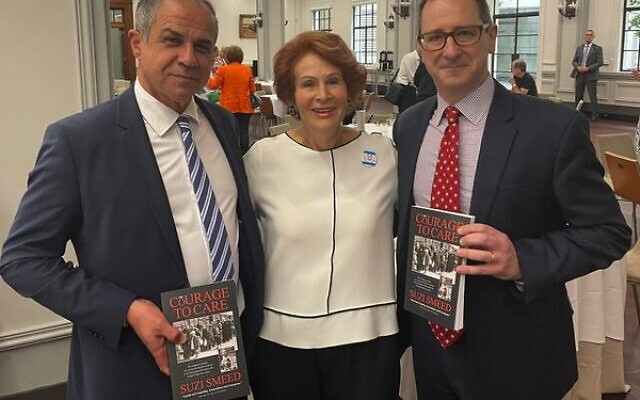
Said Huppert, “From our humble beginnings in the 1800s to today, our community has endured and, if I may say, flourished. So let us continue to work together to make our Brisbane Jewish community once again happy, strong and proud of its wonderful heritage.”
A communal event to mark the milestone was held on November 2 at which Executive Council of Australian Jewry president Daniel Aghion observed something distinctive about Queensland’s Jewish experience. “Your 160 years has worked a miracle of integration, and is a model that I have not seen elsewhere in Australia,” said Aghion.
“Be proud of that. Be proud of who you are. Queensland Jews. 160 years strong.”
As part of the celebrations, a landmark book was recently released, They Found Paradise: Retracing the Jewish History of Australia’s Gold Coast by historian Shaina Rother, covering the history of Jewish life there.
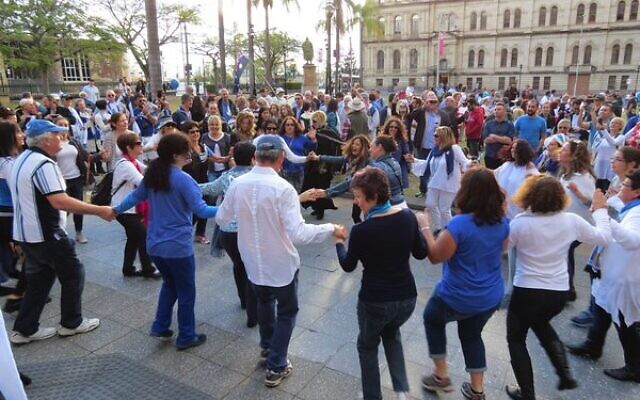
On Sunday, November 16, JFEST, a public celebration of Jewish food, music and culture at Brisbane’s RNA Showgrounds will open the festivities to the broader community.
“It’s a good opportunity for everyone to celebrate the community,” Rabbi Jaffe said. “Please God, this will be an opportunity for people to express their pride in being Jewish.”
comments