



Countries recognising Palestine ignore refugee issue
The countries that recognised the State of Palestine last week pitched the move as a step toward a two-state solution to the Israeli-Palestinian conflict, mentioning issues such as the violence and suffering in Gaza, the Israeli hostages, Palestinian democracy, embassies, Hamas and an elusive ceasefire.
One issue was absent from the announcements, though — Palestinian refugees, a core obstacle in the conflict.
The Palestinians have long demanded the “right of return,” meaning that all of those who lost their homes in what is now Israel in the 1948 war, and all of their descendants, be able to return as part of a peace agreement.
All Israeli governments have consistently rejected the demand, holding that, if implemented, it would end Israel’s existence as a Jewish state by overturning its Jewish majority. The impasse has been a sticking point in the conflict for generations.
Palestinian Authority President Mahmoud Abbas has issued contradictory statements on the right of return. In a 2014 speech, for example, he said, “You want to return? You will return.” In 2018, he said he does not support a solution to the refugee issue that would “destroy Israel.” Earlier this year, he said the right of return was a “steady and inalienable” right. In his video speech to the UN this week, Abbas wore a key on his lapel, a symbol of the right of return.
Hamas, which avowedly seeks Israel’s destruction, has said the right of return is central to its ideology.
Polls have shown that the right of return is the No. 2 issue for the Palestinian public, after ending the occupation.
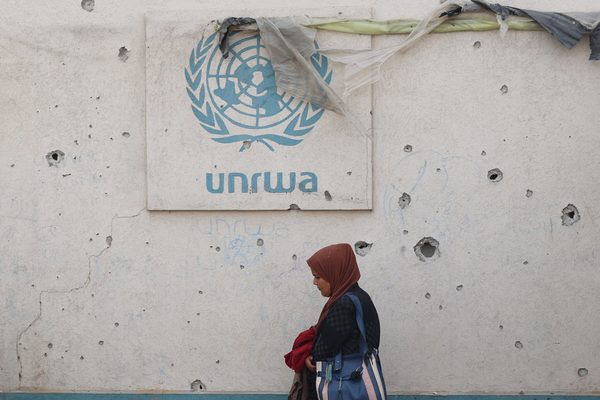
France, the UK, Australia, Canada and Portugal all fund UNRWA. Critics argue UNRWA perpetuates the Israeli-Palestinian conflict by upholding the Palestinian right of return and by its expansive guidelines on who it considers a refugee.
Palestinian refugee status is automatically granted to the descendants of those who fled the 1948 war, as well as to refugees who are granted citizenship elsewhere, creating an ever-expanding refugee population.
UNRWA counts around 5.9 million Palestinian refugees, including 1.59 million in Gaza and more than 912,000 in the West Bank. The remaining refugee population lives in other countries, including Jordan, Syria and Lebanon.
The 1948 UN General Assembly Resolution 194 says Palestinians wishing to return to their homes “should be permitted to do so at the earliest practicable date.” UNRWA says its role is to “provide assistance pending the implementation of that resolution.”
UNRWA says it does not have the authority to resettle Palestinians, unlike the UN High Commission for Refugees, the UN agency that supports all other refugee groups.
The statehood recognitions present a contradiction, in that the states recognising Palestine are funding programs for Palestinian refugees in the State of Palestine. International agreements state that refugees must be outside of their home country.
The UN’s 1951 Convention and Protocol Relating to the Status of Refugees defines a refugee as someone who “is outside the country of his nationality” and is unable or unwilling to return due to fears of persecution.
Those who are forced to flee their homes but remain in their own country are defined by the UN as internally displaced persons. Internally displaced persons are their country’s responsibility, according to the UN Human Rights Council.
“It is just illogical in the most basic sense — how can there be people born in a country, be fifth-generation refugees from that country?” said Einat Wilf, a former Knesset member and prominent critic of UNRWA.
A spokesperson for the Australian Department of Foreign Affairs and Trade said that statehood recognition “does not change our long-standing support for UNRWA.”
“UNRWA’s work will remain vital until there is a just and sustainable solution to the refugee situation,” the spokesperson said.
“This is all insane — these countries prejudice one issue that was to be negotiated — a state of Palestine — but then take a passive tone on this core issue” of the refugees, Wilf told The Times of Israel.
Wilf’s 2018 book, “The War of Return,” co-authored by journalist Adi Schwartz, accused the international community of perpetuating the conflict by supporting UNRWA and the right of return, granting the agency and the idea an international stamp of approval.
Additionally, some UNRWA staffers participated in the October 7, 2023, atrocities against Israelis, and a Hamas data centre in Gaza was located beneath UNRWA’s headquarters in the enclave. UNRWA’s textbooks have also been accused of radicalising children.
Luke Tress is The Times of Israel’s New York correspondent.
comments