



Doctor of the Outback
Dr Howard Goldenberg has spent close to two decades working as a relief doctor in remote Aboriginal Communities in Outback Australia. In his recently released book, Raft, he recounts his many unnerving experiences.
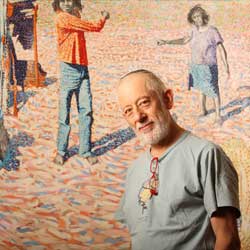
Dr Howard Goldenberg has spent close to two decades working as a relief doctor in remote Aboriginal Communities in Outback Australia. He spoke to Lexi Landsman about his book Raft, which recounts his experiences.
IN the Australian Outback, temperatures can soar to more than 40 degrees, the Earth is red and the sun unkind. It is in those expansive landscapes that Dr Howard Goldenberg feels the most spiritually and religiously awakened.
“Wherever you walk on the surface of the earth, where human beings haven’t trod too heavily, you have a sense of the glory of creation,” the Melbourne-based doctor says passionately when we meet in Sydney.¬† “It’s an every day epiphany in the Outback, so I feel that isolation from a Jewish community gives a freshness and an intensity of living my Jewishness. It’s delightful and profound.”
Dr Goldenberg is no stranger to the paradoxes of the Outback. He talks of being enamoured by its beauty and yet, it is the misfortune of the landscape’s inhabitants that has brought him to such vast locations. For the past 18 years, he has made more than 50 working visits as a relief doctor in remote Aboriginal communities and inside an Outback prison. In some cases, he has been the only doctor within 600 kilometres. It’s those experiences that the doctor and author has chronicled in his book Raft, which will be launched at the Melbourne Writers Festival (MWF) on August 23.
The book follows in detail his many experiences in the earth’s “Red Centre”, or as he calls it in the opening chapter of the book — “the bleeding heart of Oz”. Throughout the interview, he speaks as he writes, as a doctor explaining things in a clear and concise manner, and as a writer adding poetic ruminations and reflections.
Raft is both his story and the stories of so many indigenous Australians who, as he writes in the book, are the “all-drinking, all-smoking living lost, the people who are dying on the raft, or who have jumped from the raft into this former inland sea”.
The metaphor of the raft is key to the stories he is retelling. It was apt then that it became the title of the book. “In a way, the title chose me,” he says, explaining that it was a painting by Rod Moss showing life and wreckage on Australian shores that he purchased at an art show, which captured his imagination 15 years ago and has maintained it since.
“The raft is the industry that keeps afloat the sick and their healers, with such grotesque results,” he writes in the book about his interpretation of the painting, which shows indigenous figures in a scene of loss. “As I attend to my patients here in Alice [Springs], I realise that I am one of those whose task it is to help to steady the raft.”
A lover of art, culture and tradition, Dr Goldenberg has always had a passion for writing. “I think the act of writing helps me work through an experience and to work out what it means to me.
Certainly, [in the Outback, they were] disturbing experiences, profound and sometimes moving, but always significant and strange.”
Many of the patients he treated left an indelible mark on him. One in particular was Sylvia, a victim of domestic violence, who came to him with a lacerated face. There are many others, such as a woman carrying unborn twins, who came to him haemorrhaging, and Zachariah, whose infected elbow hadn’t healed for five years. Coming from a practice in Melbourne, it was an entirely new experience working as a physician in remote communities in Outback Australia.
“I think [through writing Raft], I was communicating my own pain initially and then moral disorientation, and then the experience of trying to work through that and not imagine myself as some sort of passive individual, or some sort of collateral victim, but to try define some useful role, some sense of redemption,” he says.
So was writing Raft a form of catharsis? “I think so, probably a writer has only one story deep down, and it’s the story of what they’ve lived or seen, or dreamed or feared. Those things are all in this book and the writer,” he says, referring to himself in third person, “has adopted a means of expressing, rather than repressing those things, which operate painfully or constructively in every human being”.
THE ancestors of Dr Goldenberg came to Australia in 1840. He was raised in the small town of Leeton, NSW, in an Orthodox household with his three siblings before moving to Melbourne at the age of nine. “I grew up in a family, like Jewish families are, full of books and stories. I grew up as the son of an inspiring doctor, so those things all play themselves out in my life.”
His first book, My Father’s Compass, was a biography of his father’s long and extraordinary life. It was also a journey through half-a-century of Jewish history, tradition and culture. What is evident in Raft is the centrality of his Judaism to every aspect of his life.
Over his 18 years working for different lengths of time as a relief doctor, he says he was astounded at the many times his Jewishness kept “tripping him up” as he worked and wrote. “I don’t expect it, but in so many ways Aboriginal lives and ideas, and values correspond or intersect with Jewish ones — attachment to land, experience of humiliation or dispossession, even massacre, attachment to a culture [and] the overweening power of family and community.”
But he also asserts that although he is proudly and gratefully Australian, he sees the country’s “taints of racism” and is always “conscious that [his] immense good fortune comes at the cost of the dispossession of previous owners”.
So apart from being a memoir, the book sheds light on the reality for so many indigenous Australians living in poor circumstances. Ultimately, Dr Goldenberg hopes readers will take away “the very clear message that there isn’t any simple solution”.
“I hope some will take away the talmudic message that ours is not to complete the task, but we are not free to desist from starting it.”
Raft will be launched on August 23, at 11.30am at the Festival Club, Australian Centre for the Moving Image. Enquiries: (03) 9504 3462. Bookings essential.
comments