



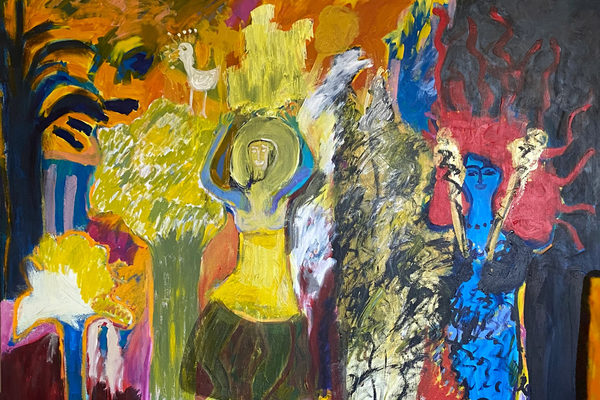
My memory is of our family’s ducks flying overhead. On the odd occasion I heard a quack and wet sludge fell from the sky. My family, which consisted of my mother, father, sister and me, lived in Orchard Road, Cheltondale, Johannesburg.
These were not really our family’s ducks, but my father’s. It was not particularly respectable to keep ducks in a suburban backyard in Johannesburg around 1963, when my father Abraham (Abe) had an enclosure and a pond built. I was mortified. So was my mother. When the neighbours complained, the ducks moved out. My father, his siblings, his many cousins and his mother Ethel all spoke Yiddish to one another. The ducks spoke Yiddish too, always at the top of their voices.
My father never explained the ducks. He never said why a man who lived in a Johannesburg suburb in 1963 needed a small waddling flock in his small backyard, and I never expected an answer. It was only recently that I understood he may have been trying to manifest some of “the old country.” Were the ducks keepers of memory from Ponodel, where his family, the Krikst family, had owned a farmhouse? Was he told about duck-feathered pillows, of how his grandmother made shmaltz from duck fat? Ponodel, now Pandėlys, sat within the Pale of Settlement in the old Russian Empire, where Jews were confined by law from 1791 to 1917, restricted in trade and banned from owning agricultural land. I marvel that my family held onto a farmhouse in that environment, which they eventually sold in 1922 to fund the passage to South Africa of those who were left in Ponodel.
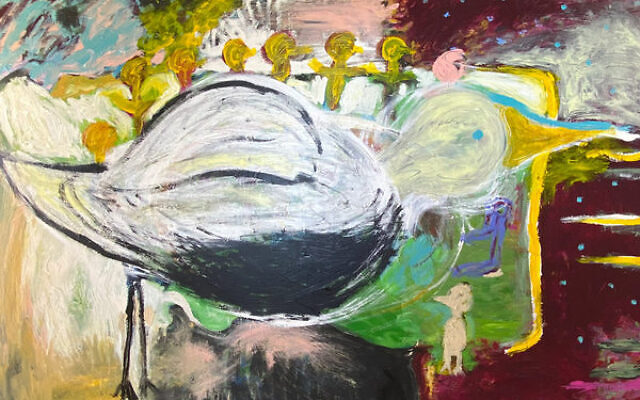
Painting these works, I found myself returning again and again to two people: my father and my Bubba Ethel. Both passed away many years ago. I was very close to my dad, working for him at the races for many years, knowing he was a complicated figure. He told me often that I saw the world through rose-coloured glasses. This was a charge he levelled at me for years, in conversations on which I still mull. I don’t try to resolve these tensions I had with him in my work. I believe it’s possible to hold my father’s view that I saw life too brightly, and my own thoughts that it was okay to disagree. And still I try to understand what he might have been searching for.
I work from my imagination by taking family folklore half-remembered, half-invented, passed down in fragments and turning it into paintings that function as stories in their own way. Painting my self-portrait, ‘Wendy, Slightly Shattered’, was meditative and cathartic and funny and sad, all within the same, sometimes wild, brushstroke. The work is spread across five separate canvases that come together as one image. Light emanates from my fingertips, a woman in pieces, and whole.
This exhibition arrives after several years in which my work has been about violence against women, and the story of my great-aunt Sarah Chaya Krikst, raped and murdered in a pogrom in 1918, after whom I was named. That history became the exhibition Women, Pogroms, Love in 2025. My friend Sylvia Hrovatin opened the exhibition and spoke of watching me turn pain into presence, and despair into depth. She spoke about my cousin Barry telling me that my work was “too dark, too full of misery.” This was a comment I took to heart. I then painted love. In January 2026, in the aftermath of the Bondi Beach terror attack, I painted Chanukah #1, which was selected for the Shalom Collective Holding Light exhibition at Bondi Pavilion Art Gallery. In the painting four Chanukiahs float in a sky above the Bondi sand, holding loss and light together.
Di Zun & Katchkes is, in a sense, where the search for that light has led.
There are many ducks in this exhibition, and I felt deeply grounded painting them. I have a real affection for these works. This body of work, all in paint, mixes humour, family history and family lore: ducks, horses, apples, strawberries, fiddle players. There is one painting where I dance with a duck, and where I hold light. The Yiddish on the walls, alongside the story, is deliberate.
The words ask the viewer to imagine the streets, homes, families and villages of the Pale, and to hear my Bubba Ethel calling out to the cousins, “Tants kinderlach, tants”. Dance, children, dance.
What I want most, walking through this exhibition, is for the viewer to engage with the work, and for the paintings to uplift, to hold their own, to be artwork of the highest standard. Regardless of the story behind them. I want the viewer to discover that these paintings are an act of devotion, honouring a lost world, the world of the Yiddish shtetls that were obliterated. And for anyone who has ever been handed a story half-told by a parent or grandparent, perhaps they’ll recognise something of their own family here and find, in the middle of their history, some music and some joy.
Di Zun & Katchkes is not an ending.
In a few weeks I will interview Leonie, my second cousin, daughter of Harry Krikst, who was born in 1896 in the Pale and left in 1907 for South Africa with my great-grandfather Meyer Leib and his brother Samuel. Meyer Leib was unable to afford passage for the rest of the family at that time, leaving daughters, a son and his wife in Lithuania. From research by my son Sam Bookatz into the Krikst/Lessick family history, I know that Harry went on to fight, through a prominent South African union, for a minimum wage and shorter working hours for black workers. This was a legacy of social action I believe was shaped by his own experience of persecution. Harry was also a member of the Dvinsk23 society, a charity that sent packages to the Jewish communities still in Lithuania before the war. He was a wonderful cook, and I remember him making fried fish, not curried, especially for me. Everyone else in the family loved his curried fish. Un azoy. And so, the ducks that once embarrassed me as a young girl in a Johannesburg backyard have found their way, at last, into a gallery. I hope you’ll come and see where they take you.
Di Zun & Katchkes (The Sun and Ducks) runs 3–8 November at Gallery, Randwick, with a Finissage on Sunday 8 November from 11am.For more information, visit wendybookatz.com
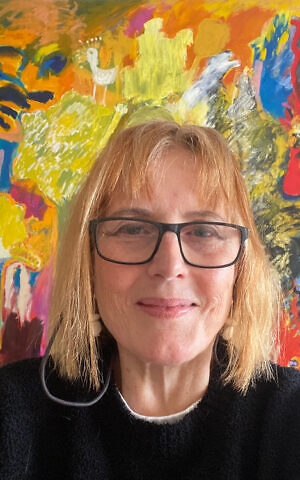
Wendy Lessick Bookatz is an artist who immigrated from South Africa to Australia in 1987. She has won awards at the Waverley Art Prize and the Royal Easter Show, and her recent work has addressed violence against women and the history of her family in Lithuania.
comments