



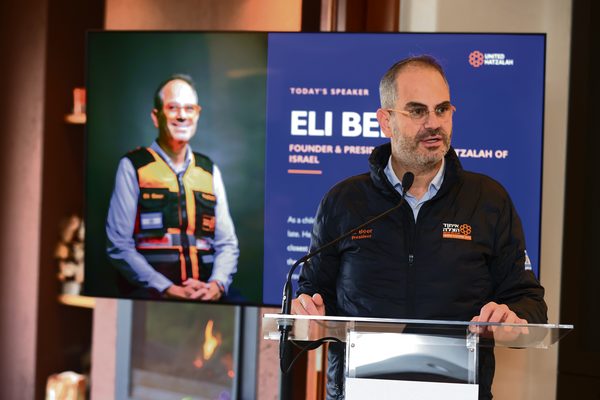
Eli Beer founded United Hatzalah in Jerusalem 36 years ago, building it from 15 volunteers into a national emergency response network of 10,000.
In Australia late last month to deepen ties with local organisations, he spoke to Gareth Narunsky about resilience after December 14, the first hours of October 7, and why he refuses to hide.
What are your impressions of the community so far?
I am unfortunately used to tragedies like the one you had here on December 14. What impressed me most was the resilience of the community. Since October 7, this community, which is so connected to Israel, has been building itself even stronger. I see other communities around the world where people are thinking of leaving. This community is strong. To see organisations that started only a couple of years ago, like CHS [Community Health Support NSW] and CSG, growing the way they are, is unbelievable. As a Jew, as an Israeli and as an American, I’m very proud.
What are you hoping to achieve on this visit?
More cooperation. We already have strong ties with Hatzolah here. I’ve spent time with them, with CHS and CSG, and with philanthropists who are big supporters of Israel. I also had the honour of meeting one of the greatest prime ministers of Australia, John Howard. We spent more than an hour and a half with him, learning from his experience. I asked him where his love for Israel comes from, the same question I’ve asked American leaders. Australia was one of Israel’s best friends for many decades, and we have to rebuild that.
The sense of family Jews around the world share, what do you think holds that together?
There’s a big resemblance between Israelis and Australians. The Australian population has the same chutzpah Israelis have. I saw it in the organisations here. They want to create things, and they do it no matter what. United Hatzalah started with chutzpah. We didn’t get permission, we just did it. I see that here, especially after December 14: people saying we need to protect ourselves, we need to be safe. Jews everywhere are one family. That’s why we’re called United Hatzalah, religious and secular, Reform, Conservative, Orthodox. No matter who we are, we should respect and understand each other.
Can you describe your cooperation locally over the years?

Photo: Jessica Abelsohn
When Hatzolah started here, Mendy [Litzman] came to Israel and trained with us. One of the things he learned was how to deal with a mass casualty incident. You have to triage, control the chaos, and make sure you don’t get killed yourself. He was in exactly that situation a few months ago, when one of the Hatzolah volunteers here, Yanky [Super], was shot. He was there to help save his life, putting himself in danger. The police were calling him to “go and help the terrorist”, and he remembered what he learned with us: you don’t get close until you know it’s safe, because a terrorist could still be a threat.
We always open our doors to organisations that want to learn from us. Now we want to do more. We have the best technology in the world. We even use AI to predict where the next emergencies are about to happen.
So we want to offer our technology here, we want to offer our training, and most importantly, after December 14, we sent a group of psychologists and psycho-trauma professionals. All volunteers, they stayed in the community for almost 10 days. They had interventions with more than 700 people. As someone who started this at 16, to see 700 people receiving emotional support to help prevent PTSD gave me enormous naches. Those teams were trained not only in the method but, unfortunately, through experience, after October 7. They were there for our own people first, and then they came here.
Tell me about United Hatzalah on October 7.
Our volunteers are always ready. They didn’t know they’d be responding to a war, one of the worst we’ve ever seen, probably the worst since the Holocaust. But we make sure every volunteer is ready for anything. When the war broke out, thousands of terrorists came in from around Gaza. Our volunteers heard a police station was attacked and responded immediately, thinking it was one or two terrorists.
My first volunteer, Chaim, was shot by a group of them. He pulled out his gun, shot a terrorist back, and got on the walkie-talkie saying he was hit and needed help. He didn’t realise there were 500 more around the city.
A volunteer named Dolev Yahoud left his house early that morning to save his next-door neighbours. He had all his medical supplies, a bulletproof vest, a helmet and a gun. He found himself in front of terrorists who caught him, murdered him and burned him. We thought he’d been kidnapped, because his walkie-talkie ended up in Gaza. It took nine months to identify his body.
That day, we had 1700 volunteers who went into the Gaza area, went out to save people’s lives, putting their own life in danger. We had three volunteers who were killed and 25 who were injured, and we were able to save many, many people, hundreds of people.
One incident out of thousands was a boy, nine years old, who called about 8 o’clock in the morning and his name was Michael, and he said, “I’m hiding in a closet with my sister, she’s six years old and my mother and father were murdered.” We connected him to one of our psycho-trauma professionals, Tamar Schlezinger, who stayed on the phone with him for 12 hours. She helped him cope, made him the most responsible child in the world. She told him not to cover his mother, so the terrorists wouldn’t realise anyone was in the room. She told him that if anyone said they were the IDF coming to rescue him, not to believe it unless they used his name, because she was in touch with the army and they knew his name. At four o’clock, Hamas came in saying in Hebrew that they were the IDF. He stayed silent. At eight that night the Golani Brigade reached the room and got him and his sister out.
Australia is new to this kind of tragedy. What is your advice for us?
I’m not Australia’s adviser, but I see people moving in the right direction. They’re building organisations, and people should support them. Build the pride. Don’t be scared. A tragedy like this should make you stronger and your community more resilient. And don’t forget Israel. Put it on your bucket list, because Israel needs to be strong and so does this community. Be proud of who you are. Don’t be scared to walk around with a yarmulke. I walked all day today with an Israeli flag on me, downtown, and everyone was nice to me. I’m not scared to be Jewish, and no one should be. I know that in Melbourne they burned down a billboard with my picture on it, and I got some threats. We should take security seriously, of course, but we should not hide. We’re a strong nation. That’s why they target us.
I believe you put your skills to work this week.
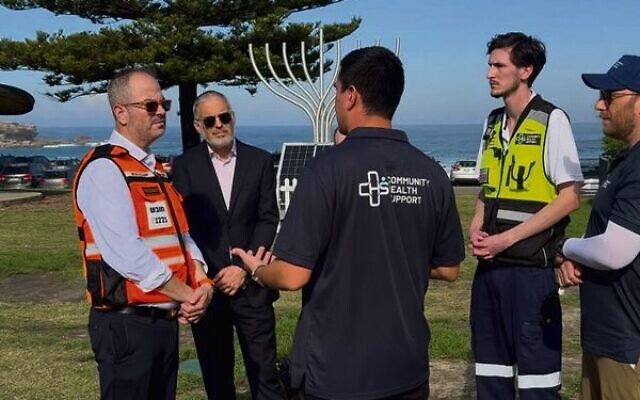
I was having lunch with Mendy when a call came in about a woman who was unconscious and not breathing. Yanky said he was going, and I said I’d come with him; it’s about saving a life. She was gasping, her oxygen level was very low, around 77. We pushed oxygen and treated her, and within three or four minutes she was back up to 96 or 98. The ambulance arrived and everyone worked together well. As I left, I noticed there was no mezuzah, and I asked Mendy if she was Jewish. He said no, she’s Catholic. I said, that’s wonderful. We help everyone. It’s a kiddush Hashem, and we need more and more of that.
How did your volunteers react to the torching of four ambulances in London?
We weren’t shocked. We’ve had incidents like that over the years: stones, Molotov cocktails, shootings at ambulances on October 7, volunteers murdered by terrorists. Hatzalah is one of the most visible organisations in any Jewish community in the world. So I always say we have to be protected. We’ve now put cameras on every ambulance, front and back, running around the clock, with alerts to our command centre when someone approaches. We’re not secret; we’re very proud of who we are. That means we have to be more careful than anyone.
Any final words for our community?
December 14 was the lowest point in the history of Australia’s Jews, but from here you can rebuild to where you were a few years ago, when there was an incredible relationship between the government, the community and Israel. When a government turns against Israel, it causes antisemitism; the two are aligned. You can’t say you’re against Israel but for the Jews. That has to be fixed here. I think the government is waking up now with the Royal Commission. I was very proud to read the reports coming out of it, and proud that Jews are willing to speak openly. Many were threatened. My message is: don’t be scared. Say what you’re going through. Only that will bring the government to understand the relationship has to be repaired.
comments