



Faith in the fairways
Cranbourne and Monash Golf Clubs were established in the 1950s by Jewish golfers who faced discrimination and antisemitism in Melbourne and Sydney, and were determined to do something about it.
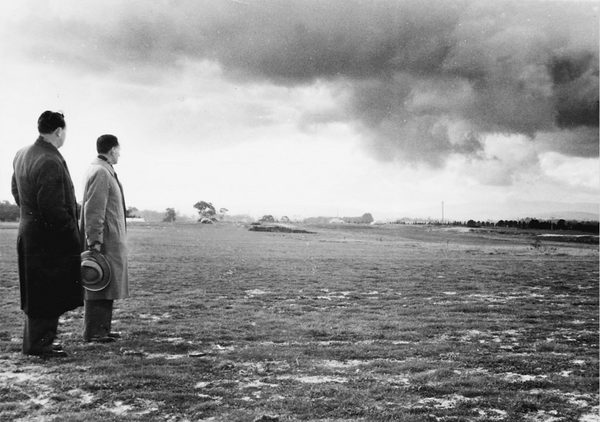
Cranbourne Golf Club
From a humble start of having a makeshift clubhouse in the form of a marquee – that blew down in the wind on its opening day on May 8, 1954 – the Jewish community-funded Cranbourne Golf Club went on to host Australia’s first televised golf event, the Victorian Open, just six years later.
By the 1980s it was regarded as one of Melbourne’s premier Group 1 courses, hosting lucrative Pro-Am events, and back-to-back Victorian Opens in 2000 and 2001, and it remains the home of the Maccabi Victoria Jewish Golf Championships.
And just recently, Golf Australia announced that Cranbourne would host the 2022 Australian Amateur Championships from March 29, featuring more than 150 men’s and women’s players from Australia and overseas.
Golf Australia’s general manager of events, Therese Magdulski, said of Cranbourne, “To be able to showcase the course for our premier amateur championship will be very special.”
But hopefully, the opportunity won’t be lost, to also showcase Cranbourne’s unique history and space in Australia’s sporting landscape – which it shares only with Sydney’s Monash Country Club – of being created as a club for all golfers to join, in the face of widespread discriminatory practices by private golf clubs against Jewish players.
The book What’s Golf? The Story of Cranbourne Golf Club, written in 2004 for the club’s 50th anniversary by its president from 1985 to 1993, Les Kausman, details dozens of incidents of prejudice that occurred to Cranbourne’s founders.
For example, Dr Mossy Hain’s application to join Spring Valley Club noted that he was a medical practitioner and the president of Oakleigh Rotary Club, yet his cheque and application form were promptly returned, with no explanation.
And Manny Goldstone, a keen golfer who was born in England, learned when applying for membership at Melbourne Golf Club of its policy of accepting British, but not European, Jews as members. He withdrew his application in disgust.
A meeting of 20 people was called by Jewish golfer Syd Kaufman on June 14, 1951, and a committee formed with him as chair, which decided to form a golf club that would place no membership entry restrictions on Jewish players, nor on anyone else, apart from being of good golfing character.
The 300-hectare site for the Cranbourne course was found and purchased for 20,000 pounds, and Harry Cohen came up with a brilliant, but very ambitious, fundraising strategy.
A door-knocking campaign would try to convince 250 Melbourne Jews within a couple of months – who may not even have heard of golf – to pay 200 pounds each to become life members of Cranbourne Country Club.
That 100 per cent Jewish-owned entity would then fund the purchase and building of the course, and permanently lease it to Cranbourne Golf Club, which would always have a Jewish president.
Remarkably, that plan proved to be highly effective, and as one of the door-knocking campaigners, Henry Nathan, recalls in Kausman’s book, “Many people did not care for golf themselves, but they did care that if a Jew wanted to play golf, it should not be denied him.”
Kausman told The AJN, “The club is there as a sort of beacon for fairness and equality, and although there’s anti-discrimination protections enshrined in law today, and generally Jews can get membership with any golf club now, you can’t change the hearts and minds of some people.
“And that’s why discrimination still exists, and there have been isolated incidents at golf clubs around Melbourne, even recently, where antisemitism has reared its head.”
Pointing out, “We close on Rosh Hashanah and Yom Kippur in addition to Christmas Day and Good Friday – and there’s no ham or shellfish served in the clubhouse,” Kausman added, “so there are trappings of Jewish traditions and history there, and the non-Jewish members don’t seem to mind – they understand it.”
Current Cranbourne Golf Club president Barry Lehrer, who describes his family as “fourth generation Cranbourne” – said it gives him “a great degree of joy and pleasure to be president of a club that has such a richness of history, a key objective in life, and a future that we all hold very dearly to us”.
He said a copy of Kausman’s book and an introduction to the club’s history is still given to every new member, and apart from Cranbourne being an excellent course to play on, the club’s diversity of members, and its open and friendly atmosphere, “is really what we are all about here”.
“You know, just two weeks ago, a mixture of 90 Jewish and non-Jewish members enjoyed a beautiful Festival of Lights dinner for Chanukah together.”
While Lehrer said the club’s total membership has been growing strongly again in recent years, he acknowledged that “driving new Jewish membership, however, is always difficult”.
“I recognise that these days, people want to play [golf] a little closer to home, but at the same time, there are values we provide that no other golf club in Melbourne can.
“We are working with Cranbourne Country Club to encourage younger Jewish people to join our club … because like any asset, once it’s lost, you only then realise what its true value was.”
Maurice Sackville is a founding Cranbourne member in his 90s who still plays golf there three times per week.
He said he feels deeply disappointed about the number of Jewish Cranbourne members who are leaving the club, including for reasons that relate to travel time.
“My father John made me and two of my brothers, Joe and Harold, foundation members of Cranbourne because of antisemitism he was confronted with as a member of another local club, Albert Park,” Sackville said.
“There are clubs in Melbourne today that are still unavailable to Jews – they’ll tell you we don’t think this club is suitable for you – and antisemitism is rising again in society.
“So it plagues me to think that the younger generations of today have lost hold of the reasons for why Cranbourne was established in the first place – and I think that’s what’s lacking today.”
Monash Country Club
While a decline in the proportion of Jewish membership of Monash Country Club in the last two decades shows little sign of reversing, an upcoming event there, on March 3, 2022, would have given its 1950 founding committee members reason to smile.
The traditional home of Jewish golf in Sydney – a superb 18-hole championship course located high on a hill in Ingleside in Sydney’s Northern Beaches, with distant views of the sea – will host (weather permitting) the postponed 2021 Maccabi-run NSW Jewish Open Golf Championships, featuring a full field of more than 100 players.
And if the founders were here today, they would have raised a glass each for Jody Drutman – who was selected as the club’s new ladies’ captain – and for her friend Terry Katz, elected its ladies’ committee president.
It has been many years since Jewish players held those roles at the club, so Drutman – Maccabi NSW Golf ladies’ president since 2016 – said, “It struck me, quite forcibly, that it’s kind of history in the making again.
“Just in terms of honouring the sacrifices our ancestors made for us back then, in order for us to have somewhere to play golf, and not be discriminated against,” she said, adding, “That’s how I see it, and we’ll do our bit.”
Drutman joined the club seven years ago, and said it was during the interview process with former ladies’ club captain (1988-90) and champion (1991) Ros Fischl – whose father Hyman Eizenberg was Monash Country Club’s founding president from 1950 to 1971 – that she was made aware, as new members are, “of exactly how this golf course came to be, and I was absolutely blown away”.
Sadly, it was the push factor of Jewish golfers experiencing decades of prejudice, and exclusion from Sydney’s private golf clubs, that inspired a core group of 22 – including Eizenberg, first captain Barry Chirlian and first patron Dr Joseph Steigrad – to brainstorm a way in the late 1940s to create a Jewish-owned golf course and club, that would be open to people of all faiths and backgrounds.
As the late Colin Tatz’s 2002 book A Course in History points out, there seemed to be a distinct expression of antisemitism within golf club boards whose “basis may well have been a peculiar form of class consciousness”.
According to Tatz, “Only one Group 1 golf course in Sydney admitted Jews between 1908 and 1945”, and his book includes the minutes of a May 14, 1908 Royal Sydney Golf Club meeting in which the committee resolved, “to recognise that the feeling of the club is adverse to the admission of Jews”.
The book cites many examples of discrimination against Jewish golfers, including Jack Levy in the mid-1930s and two decades later to former Monash president Brian Davis, whose nominators for applications to join Bonnie Doon and Pymble Golf Clubs respectively, were instructed to withdraw them.
Les Kausman, who attended the book’s launch in Sydney, noted how the keynote speaker, Barry Cohen – who had been a minister in the Hawke government – revealed, “on the verge of tears, 50 years after it happened”, that he’d sought the help of Manly Golf Club’s manager to join that club, but was told, “Don’t embarrass me – you know why I can’t.”
Ros Fischl – who is in her 63rd consecutive year as a playing member there, and earlier this year won the club’s Enid Berns Trophy – remembers her father telling her, “Jews were allowed to play golf at St Michael’s, but the other clubs wouldn’t accept them even to nominate for membership, and they’d been given restricted times like 6am to hit off, and they got jack of that!”
“Those clubs showed it [discrimination] covertly … on the surface everything was great, but then it would be: ‘don’t apply here’,” she said.
“My father was always adamant that people should not be discriminated against, and so the Jewish players decided to find a piece of land to purchase a golf course, and asked the Jewish community in Sydney to contribute 50 or 100 pounds each as debentures, and that’s how Monash was formed.
“And it’s still such a friendly place to be.”
The club’s internal road is named in honour of her father, as is an annual trophy, plus the Flora Eizenberg Trophy, in honour of her mother.
Her husband, Alex, an 88-year-old Holocaust survivor and former membership committee chair – who still plays there most Mondays – emphasised how there were “around 2000 original shareholders of Monash Holdings”, referring to the Jewish-owned company that bought the course, built it from 1948-1952, and leased it at a peppercorn rate to Monash Country Club ever since.
“The remarkable thing is that out of all those people, there were few who were interested in golf – the rest contributed for the sole reason of supporting the birth of this club, and its cause.”
Notable events at Monash since it opened included replacing its clubhouse after a devastating fire in 1957, achieving Group 1 status by the early ’60s, and hosting the Australian PGA in 1964 and in 1984, when Greg Norman lifted the trophy.
Fischl said Monash’s current total playing membership is 1046, “which is pretty healthy”, but she laments that the current Jewish membership – which over the past 71 years has fluctuated between 10 to 30 per cent – appears to be on the decline again.
“Some Jewish golfers who live in the St Ives area remain members here, but many have moved to the eastern suburbs, and joined clubs there.”
Ilia Vilensky, who was Monash Country Club president from 1996-2004, feels “saddened and concerned” about the fall in Jewish members, and said greater awareness about the club’s roots is needed.
“I was the person who asked Colin [Tatz] to write A Course in History, to make sure people knew the club’s history, so they don’t discriminate on the basis of race, religion, or any other reason,” Vilensky said.
comments