



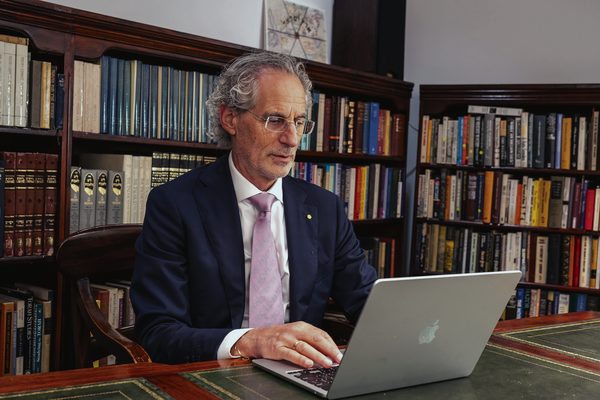
Reflecting on 37 years at Sydney’s Emanuel Synagogue, Rabbi Jeffrey Kamins is characteristically candid about how it all began.
The then final-semester rabbinical student had no intention of taking a job in Australia when he walked into a job interview in Cincinnati in February 1989 wearing a pair of cords and a woollen jumper. But a professor had told him a friend was in town looking for an assistant rabbi at a Sydney shule, and suggested he go along. It was, as Rabbi Kamins put it, “a bit of a lark”.
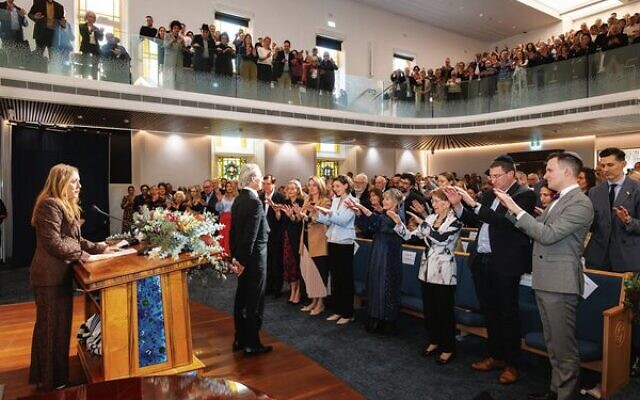
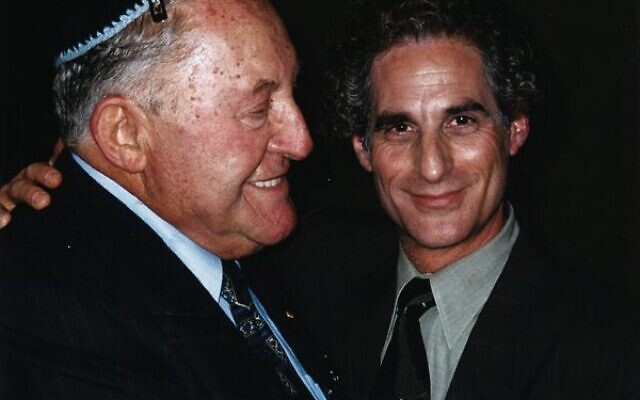
Nearly four decades on, he has just been farewelled as Senior Rabbi at Emanuel Synagogue in a community celebration that brought together generations of congregants whose bar mitzvahs, weddings and funerals he has officiated, children of children he has watched grow up, and colleagues he recruited when they were barely out of university. On July 1, he formally becomes Rabbi Emeritus and the baton will pass to Rabbi Jacqueline Ninio, who has worked alongside him for 28 of those years.
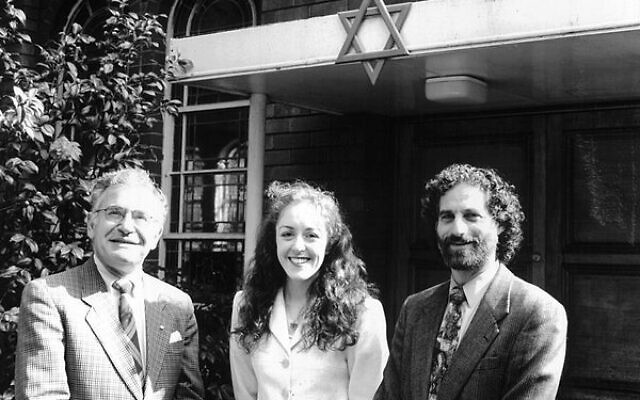
But back to the beginning. Rabbi Kamins recalled that Rabbi Brian Fox z”l and shule president Heinz Gerstl, who “pegged me for being a bit of a California hippie”, put him up in a hotel overlooking Bondi Beach, and spent five days wining and dining him. At that week’s Friday night service, Rabbi Fox welcomed visiting guests, inviting them home to dinner. Kamins told his then-girlfriend Bobette who was from the American South – “and you know southern hospitality” – who he said was seriously impressed.
When the job offer came, he said it was the kicker that “now it’s real”.
“Then it was scary,” he said, “Because it was really far away then. It cost two dollars a minute to call home. We came here in July of ’89 and hit the ground running, but there were a lot of homesick tears at the beginning.”
The tears did not last. Within two years he knew Sydney was home – the climate, the flora and the ocean reminding him of Los Angeles before the city lost its gentleness, he said. By the time he and Bobette – married by this point – became citizens three years in, the question was settled. “Five became 10. And now I’m a lifer.”
Arriving as an assistant, when Rabbi Fox left for Manchester in 1999, Rabbi Kamins became Senior Rabbi. Over the years he diversified the synagogue’s offerings – today it operates across three spaces, runs services from Reform to Masorti to traditional, and describes itself as post-denominational.
“I came from a secular background, and I have to be honest – I never really warmed to the Reform style of prayer,” he said. “What I felt was that I wanted Emanuel to be much more broad in its liturgical offerings. I knew there were people who preferred a traditional service, who preferred to pray in Hebrew, who loved the fact that they could sit next to their partner regardless of gender.
“I didn’t want the style of one service to be the thing that prevented people from coming in and realising that how we teach and practise Judaism is actually very engaging, inspiring and meaningful.”
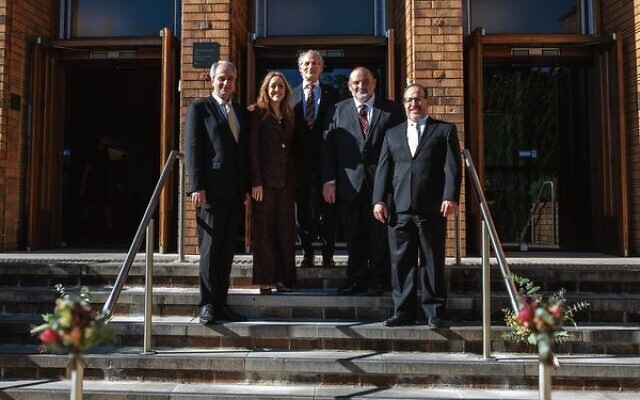
Rabbi Kamins started the Masorti service in the early 1990s with the help of a young George Mordecai, whom he eventually wooed back to Emanuel in 2019 after time spent overseas and who is now a rabbi himself. Rabbi Ninio joined in 1998. Also in the team are Rabbi Rafi Kaiserblueth and Rabbi Sam Zwarenstein.
“I know I’m leaving the synagogue in eight incredible hands, four pairs of two,” Rabbi Kamins said.
“Rabbi Ninio has been an extraordinary sounding board, adviser and incredible support. The whole time I have been Senior Rabbi, she has been working with me.”
The synagogue’s place as a spiritual home for LGBTQ Jews is a particular source of pride. “The more doors you have open, the more people can walk in. And isn’t the synagogue a spiritual centre, a place where you want people to come in?” Rabbi Kamins asked.
Emanuel was the site of Australia’s first religious same-sex wedding, held in the just opened Millie Phillips building in May 2018.
Rabbi Kamins was honest that his own journey to fully embracing same-sex religious ceremonies – he was on board with civil unions – took time in the early 2000s, crediting Rabbi Ninio as having led the charge consistently. The theological framing he eventually arrived at is characteristically Emanuel: rooted in text, open to its ambiguities.
“In the Torah it says each of us is created in the divine image,” he said. “To deny people who are looking for a monogamous, committed, sacred and sanctioned marriage – I don’t see the argument.”
Rabbi Kamins has also spent much of his rabbinate working to dissolve what he regards as 19th-century denominational anachronisms – particularly the historical distance between Emanuel and the Orthodox community. In the early years, the synagogue – then known as Temple Emanuel – barely registered in communal discourse. He recalled a unity service decades ago at which Orthodox rabbis walked out when he rose to recite a psalm.
He did not take it personally then and does not now. “I’ve always had good personal relationships with Orthodox rabbis,” he said. “I understood the institutional constraints. The personal was a different matter.
“I maintained good and friendly relations, and there would be things behind the scenes.”
Those behind-the-scenes relationships, he said, were often with individuals of considerable spiritual depth, men he counts among the most formative influences of his rabbinate. He and one senior Orthodox rabbi worked quietly on a joint conversion procedure that never came to fruition but left him convinced the aspiration remains alive.
A question about religious control over the Western Wall drew him into sharper territory. Rabbi Kamins sees the current Israeli coalition’s push to place the egalitarian prayer space under the sole control of the Orthodox Chief Rabbinate as a symptom of a deeper drift – one he has watched with growing alarm since his first trip to Israel in 1975. He has lived there three times – each time for one year – and vowed in 1980 that if he did not live in Israel, “Israel will live within me.”
“I’ve seen the deterioration of Israel on this issue decade after decade, as the country has become much more enmeshed in a messianic Zionist vision – which is not the only Zionism that was around in the time of [Theodor] Herzl,” he said.
“Yes, he dreamed of Israel, but this is not the Israel of which he dreamed, all one has to do is go back and look at his writings.
“We all say ‘Zionism’ as if it has always been one thing, as if Judaism has always been one thing … since the extraordinary victory of June 1967, Israel has become a much more religious, ethnocentric state, and there are litmus tests of what makes you a real Jew or a true Israeli.
“That’s why the whole draft bill is such a hot, contentious issue, and this is not a side issue of that, this is actually part of the same issue.”
But he conceded, “It’s for them to work out.”
Rabbi Kamins is equally candid about the fractures closer to home that have pained him most in this final chapter of his rabbinate. He describes himself as a lifelong leftist – he traces it to his parents – and the events since October 7, 2023, have placed him in contested ground within his own community.
Following the Bondi Beach terror attack in December 2025, he was invited to an Indigenous healing ceremony at Hyde Park, where a Muslim lawyer from the Imams Council also spoke. “It was totally apolitical. There wasn’t a sign about Israel or Palestine, it was only about Bondi,” he said.
The two embraced. But a photographer whose portfolio featured pro-Palestinian rallies captured the moment.
“Within 24 hours the Jewish community exploded,” Rabbi Kamins said. “The vitriol that came against me for supposedly turning my back on the Jewish community after Bondi was a really hard time. The outpouring of love, concern and warmth from neighbours, from faith leaders, from Palestinian friends – I believe the Jewish community could have been much more embracing of the embrace that was coming from the Australian community. Things eventuated in a different direction, and I’m sad.”
It is a sadness he connects to something larger – a polarisation he sees running through the Jewish community as it does through Western societies generally, accelerated by social media algorithms. He worries about the growing reluctance to engage with difference, even within families.
An example is the severing of relationships over political disagreements about Israel. “We used to not say Kaddish over someone who had intermarried. I wish we weren’t doing that over someone who has a different perspective on the most complicated political situation facing Jews.”
Rabbi Kamins also mourns the fading of environmental issues from public discourse – a passion he traces back decades and one he intends to pursue seriously in his emeritus years. What frustrates him most is not public indifference so much as political abandonment, and he directs particular disappointment at the Greens.
“Bob Brown started that as an environmental activist party,” he said. “Now no one’s talking really about the environment anymore.”
The relentless focus on the Israeli-Palestinian conflict has, in his view, consumed the political oxygen that should be going to climate, urban planning, housing and transport. “These are pressing issues for every Australian and every human, no matter what our faith background is,” he said. “I feel like we’re losing that one.”
His plans for his Rabbi Emeritus years – interfaith work, environmental advocacy, continued engagement with Israeli-Palestinian dialogue – reflect the same instinct that has characterised his tenure: say yes, step toward complexity, don’t mistake unity for uniformity.
He is currently in shloshim, having lost his mother in May aged 98. He will travel to Israel in July, the United States in August and September, and return for Yom Kippur – this time as a congregant.
Asked what nearly four decades at Emanuel has given him, he answered, “I wanted to learn more about Judaism, I wanted to teach Judaism, and I knew I wanted to live a life of goodness, compassion and service.
“I found my calling – to be with human beings. To watch them grow, from the little ones in the preschool to people I’ve now done three generations of life cycle events for.
“To be given the honour and privilege of being with people in crisis and feel what life is and is all about. What people have given me from their openness and generosity and love knows no bounds.”
comments