



If you haven’t yet caught The Pitt, consider this your sign to start. The critically acclaimed medical drama, from the same creative team behind ER, has quietly become one of the most thoughtful explorations of Jewish identity on mainstream television right now.
Set in a fictional Pittsburgh emergency room and starring Noah Wyle as senior attending physician Dr Michael “Robby” Robinavitch, the show has never shied away from its Jewish roots. But in the third episode of season two, it stepped into territory that left many viewers both Jewish and non-Jewish, reaching for the tissues.
When the creative team behind The Pitt began developing the show, they knew they needed to differentiate Wyle’s new character from his beloved ER role. That conversation began with executive producer John Wells asking Wyle a simple question: “Noah, where’s your family from?” Wyle replied that his family was Russian-Jewish. That single exchange sparked the creation of Dr Robinavitch and set the tone for the entire series.
Wyle’s father came from a family of Russian Jewish immigrants, while his mother was Episcopalian. Faith didn’t dominate his upbringing, but both backgrounds were present, particularly through the holidays. “It was like a Chinese menu — one from Column A, one from Column B,” Wyle once recalled.
For Wyle, his character was also an opportunity to explore a different kind of Jewish professional on screen. He could be someone from a blue-collar background who came to medicine for different reasons than the typical Jewish doctor TV trope.
For those who missed season one, the Jewish thread was already woven through the series from the beginning. In one of the season’s most quietly devastating moments, after a particularly difficult shift, Dr Robby sits on the floor of a makeshift morgue clutching a Star of David and reciting the Shema.
In another episode, Robby mentions his Jewishness in passing, telling a colleague that a Biblical quote should be attributed to “Luke, the disciple, who probably heard it from Paul, the apostle, but what do I know? I’m Jewish, it’s not my book.”

Being set in Pittsburgh, starring a Jewish actor as a Jewish emergency medicine doctor, it was always a matter of when, not if, the show would address the October 2018 shooting at the Tree of Life synagogue in the city’s Squirrel Hill neighbourhood — the deadliest antisemitic attack in American history, in which 11 worshippers were murdered and six more wounded. It would be unrealistic for the shooting to have had no personal or professional effect on Dr Robby.
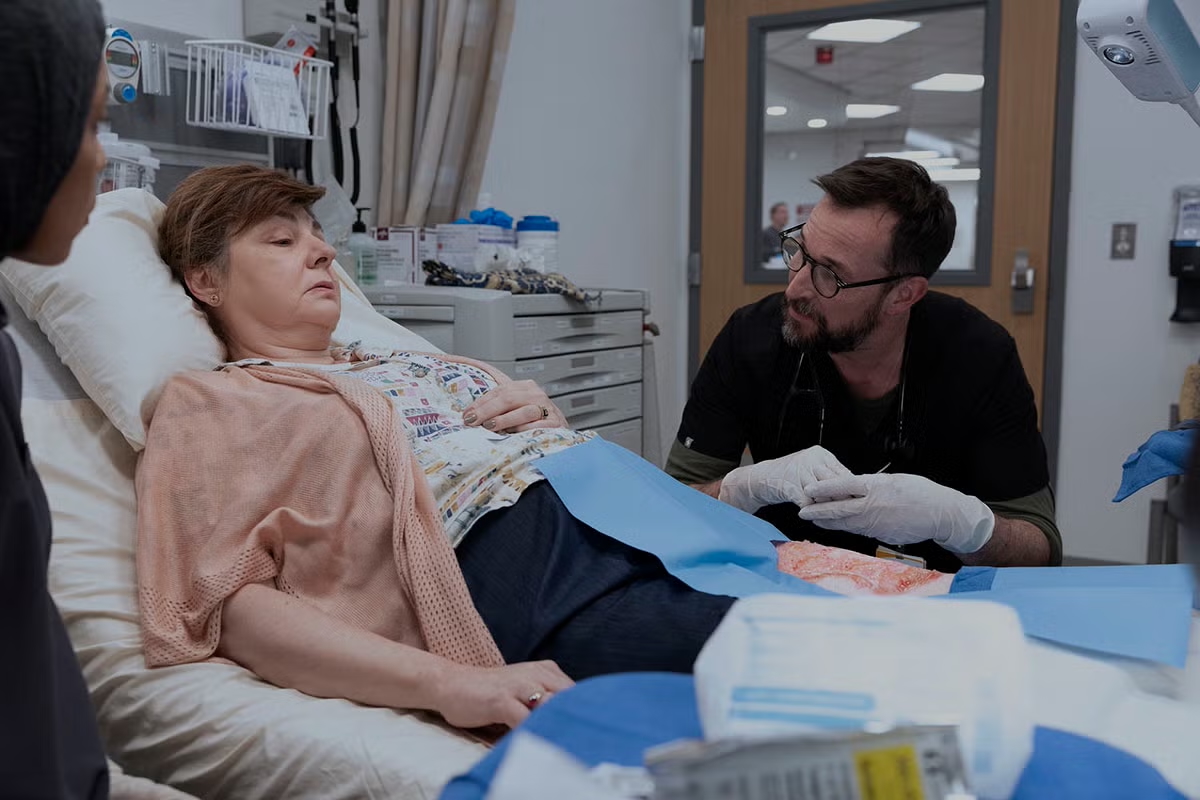
In episode three of season two, co-written by Wyle himself, the reckoning finally comes, through a visit by an elderly Jewish woman, Yana Kovalenko, who arrives in the ER with burns after dropping a samovar on herself. She explains that she was startled by firecrackers. After recognising Dr Robby’s surname as Jewish, the two connect warmly. She pries about his relationship status, asks where he goes to synagogue.
The episode never recreates the shooting itself. Rather, the trauma surfaces the way it often does in real life. It was triggered by a noise, years later, drawing Yana back into her memory.
Yana tells Dr Robby she belongs to Tree of Life.
The restraint with which the show handles this material is striking. As Wyle told Variety, when he began researching the shooting, what moved him most was what came after the shooting. The outcry of the city’s Muslin community.
“It was the most underreported aspect of the story, and perhaps the most hopeful moving forward,” he said.
In a scene that has resonated deeply with audiences, Yana notices that nurse Perlah is wearing a hijab, and quietly thanks her, not for the care she’s receiving that day, but for what the Muslim community did years earlier.
“After the shooting, it was the Muslims that came together for us in support and walked with us,” Yana says. “You raised money. You paid for all the funerals. Thank you.”
This is not fiction. In the week following the shooting, Muslim organisations CelebrateMercy and MPower Change raised nearly $200,000 for victims and their families.
Executive producer R. Scott Gemmill was direct about the responsibility to tell this story, telling Variety, “You can’t do a medical show, set in Pittsburgh, with a Jewish doctor without addressing that. The fact that the Muslim community came together and paid for all the funerals — that’s the kind of information that needed to be out there.”
Real survivors of the Tree of Life attack have responded to the episode with emotion. Carol Black, who was hiding in a basement storage room during the attack (her brother Richard Gottfried was killed) said she was grateful for the wider audience the show reaches. “I don’t want the story of what we experienced to go cold,” she told Forward. “This is a very popular show. People need to know about this.”
In a media landscape where Jewish characters are often either the butt of a joke or a tragic symbol, Dr. Robby is a complicated, warm, flawed, recognisably Jewish man simply trying to do good work in the world.
The fact that Wyle himself is Jewish, and that his own family roots run through Russia to Pittsburgh, gives the show a cultural specificity that can’t easily be faked. It shows in every samovar joke, every High Holiday mention, every moment of weary, sardonic wisdom.
For Australian Jewish audiences especially, watching a mainstream drama treat the Tree of Life shooting, and the Jewish-Muslim solidarity that followed, with such care and intelligence feels significant. At a time when antisemitism is rising globally, The Pitt continues to quietly make the case that our stories deserve to be told with complexity and humanity.
The Pitt season is streaming now on HBO Max.
comments