



Haredim shown watered-down conscription bill
IDF to send out 54,000 draft orders to Haredi men this month, said planning to set up checkpoints to catch evaders.
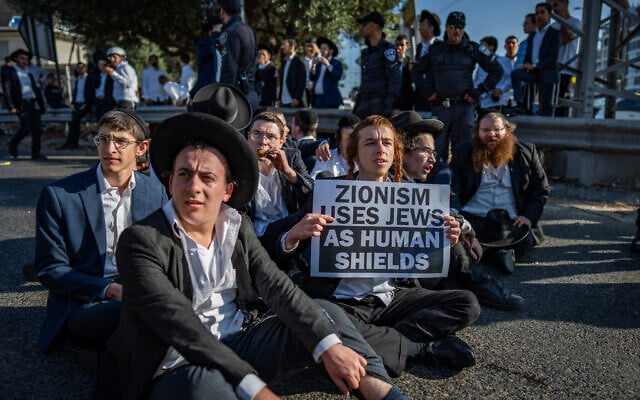
(THE TIMES OF ISRAEL) Likud lawmaker Yuli Edelstein, chair of the Knesset Foreign Affairs and Defence Committee, presented a Haredi representative with a copy of a watered-down compromise bill regulating the conscription of yeshivah students — paving the way for its advancement and prompting bitter criticism from opposition politicians.
At the same time, the IDF announced it would begin issuing 54,000 draft notices this week to members of the ultra-Orthodox community whose exemption from military service as yeshivah students is no longer valid, following the expiration of the previous legal arrangement.
Unprecedentedly, the IDF is reportedly vowing to step up enforcement against draft evaders and deserters across all demographics, with plans to take more rapid measures against potential conscripts who fail to show up — including empowering Border Police to set up checkpoints and carry out arrests.
According to the Ynet news site, the Haredi parties insisted on seeing a copy of Edelstein’s softened legislation ahead of Prime Minister Benjamin Netanyahu’s diplomatic trip to the United States, with Edelstein ultimately meeting former Shas MK Ariel Attias. The process reportedly contributed to a delay in Netanyahu’s departure for Washington, DC.
The version shown to Attias is a draft, while the final version of the softened legislation will be presented to lawmakers within 48 hours, Israel Hayom reported. It said the law’s presentation was delayed due to Edelstein’s insistence on introducing multiple changes to the text.
The decision to show the draft to the Haredim sparked angry responses from opposition lawmakers, who have long pushed to end the decades-long exemption of most ultra-Orthodox males from military service.

“If Yuli Edelstein, under pressure from [Prime Minister Benjamin] Netanyahu, presents the law to the ultra-Orthodox before presenting it to soldiers and reservists, that sums up the whole story of the ‘evasion law,’” Opposition Leader Yair Lapid wrote on X.
“The time has come to put an end to the rule of the evaders. Conscription for all – this is the call of the hour,” declared Yisrael Beytenu chairman Avigdor Liberman, while The Democrats chief Yair Golan insisted Edelstein’s actions were “proof that this law won’t draft a single ultra-Orthodox person.”
The ultra-Orthodox Kikar Hashabbat news website reported that former Sephardi Chief Rabbi Yitzhak Yosef announced the Shas Council of Torah Sages will soon gather to discuss the latest version of the bill.
According to national broadcaster Kan, the legislation will call for conscripting only around 4,800 Haredim in the first year. The report said while the ultra-Orthodox Shas and United Torah Judaism parties will oppose the new legislation, they are not willing “to blow everything up” over the issue.
Contacted by The Times of Israel last week, lawmakers from the Haredi parties said they had yet to see a final draft of the revised bill, although one United Torah Judaism official said his party was concerned about its contents.
The Haredi parties are already boycotting private member bills by coalition MKs over delays in advancing the legislation, and earlier Sunday, ultra-Orthodox political sources indicated they were considering boycotting all plenum votes in the Knesset until presented with the new draft.
Edelstein had long pledged to allow legislation on the matter to pass through his committee only if it included sanctions against ultra-Orthodox men who flout enlistment orders.

An unreleased version of the bill previously worked on by Edelstein’s committee was said to include a raft of harsh sanctions — including the loss of discounts on property taxes and public transport, removal of tax benefits for working women married to draft dodgers, exclusion from the housing lottery, and the cancellation of daycare and academic subsidies.
The bill would also have prevented draft dodgers up to age 29 from obtaining driver’s licences or travelling abroad, and would have opened them up to the risk of arrest.
Reversing course
However, last month Edelstein appeared to back down on some of his demands, as part of a last-ditch effort to prevent the Haredim from voting for a bill to dissolve the Knesset.
Both Shas and UTJ, seeking to preserve longstanding exemptions from mandatory service enjoyed by the Haredi community, had threatened to support the dissolution bill over the enlistment issue — a move that would have left Netanyahu without the majority needed to stay in power. Elections are currently scheduled for October 2026.
After reaching an agreement in principle on Edelstein’s compromise terms to head off that crisis, the ultra-Orthodox parties announced that “understandings have been reached regarding the principles for the law preserving the status of yeshivah students”, adding that “another few days” were needed to “complete the final version” of the legislation.
The following day, however, Israel launched a series of airstrikes against Iran’s nuclear program, setting off a 12-day war and delaying any discussion of the legislation in the Knesset. Both Edelstein and Shas chairman Aryeh Deri were informed of the strikes in advance — knowledge that appears to have contributed to their willingness to compromise.

According to a report last month by the ultra-Orthodox Behadrei Haredim news site, the compromise outline stipulated that the enlistment law would be a temporary measure lasting only six years — or four, if it failed to meet its mobilisation goals.
While sanctions connected to subsidies for academic study, international travel, and driver’s licences would be imposed immediately, others relating to daycare and public transport subsidies would be delayed.
A wave of call-up orders
Around the same time as Edelstein’s meeting with the Haredim on Sunday, the IDF announced it would begin issuing 54,000 draft notices this week to members of the ultra-Orthodox community whose exemption from military service as yeshivah students is no longer valid, following the expiration of the previous legal arrangement.

The summonses will be distributed in phases throughout July, with enlistment appointments scheduled across the 2025 draft year, the military said.
As part of the broader recruitment process, the IDF said it would focus on identifying candidates with high potential for combat and frontline support roles, citing increased operational needs.
In addition, the IDF plans to step up enforcement against draft evaders and deserters across all sectors.
While the IDF did not specify what this may entail, Hebrew media reports said the lengthy process of declaring someone an evader would be considerably shortened — meaning a candidate for service who fails to show up could be declared a draft dodger within as little as two months.
The IDF Military Police will also set up checkpoints where they will be authorised to arrest draft dodgers in the West Bank and within Israel, according to Behadrei Haredim.
Lapid welcomed the IDF’s move, saying it is “the people’s army, not a half-people’s army.”
The IDF declined to comment beyond its initial statement.
Channel 13 quoted a senior ultra-Orthodox politician warning: “If a single yeshivah student is arrested, the government collapses.”
Stav Levaton contributed to this report.
comments