



Historical aspects of the Tisha b’Av liturgy
However much we wish the day would disappear, our practices on Tisha b’Av are deeply endowed with meaning.
Get The AJN Newsletter by email and never miss our top stories Free Sign Up
This coming Motzaei Shabbat is Tisha b’Av, the culmination of the Three Weeks and the Nine Days. Keys to the Tisha b’Av tefillot are the reading of Megillat Eichah (the biblical book of Lamentations) at night, the recitation of Kinnot (dirges) mainly in the morning, and insertion into the Mincha amidah of “Nachem”, a paragraph seeking the comforting of Yerushalayim as it is rebuilt.
Of all aspects of our liturgy, whether recited thrice daily or once annually, the Kinnot stand out as the least well known and understood. Unloved and unwanted as the day of Tisha b’Av itself, most published editions of Kinnot are not even in a format that belongs in a library. Tradition has it that as we hope that the messianic advent would soon make them redundant, there is no need to print them except in the cheapest manner; little did it matter if flimsy productions would not last a lifetime. I clearly recall when nearly 70 years ago the late Rabbi Boruch Abaranok who at one time sold sefarim in Glen Eira Road (prior to becoming Rav of Mizrachi) handed me such a flimsy Kinnot book apologising in his humble manner even to a young boy for giving me such a “primitive” gift – and of course explaining why it was so in a lesson that remained with me ever since. (The Lookstein edition with commentary based on the teachings of Rabbi Joseph B Soloveitchik and the Artscroll edition as well as the Rosenfeld Kinnot that preceded them broke with tradition as exceptions to the rule. Educational they are – but hopefully in the future they will serve as repositories of history rather than practical prayer books.)
And beyond that general downplaying of their position amongst our liturgical treasures, is an attitude to their recitation unparalleled elsewhere. Which Orthodox shule would decide on any other day of the year to omit elements of a prescribed liturgy on an ad hoc basis? Strictly speaking the recital should take until midday – yet many have a policy to recite only the first few and a number of others considered key compositions – a decision largely left to the discretion of the rabbi, chazzan or other individuals. And many who do recite all or some have not studied their meaning, format and inbuilt references in a way that all other aspects of our liturgy are studied so that they are fully understood and able to be recited with proper kavannah (intent presupposing understanding).
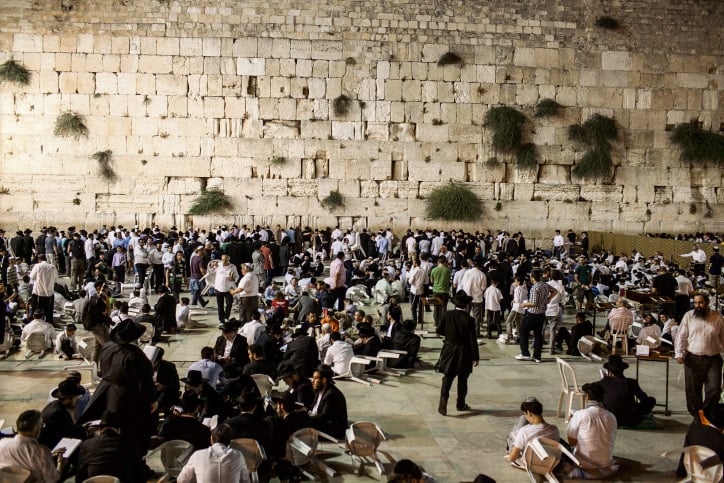
On the other hand I must make reference to Tisha b’Av that I have twice experienced in Beit Knesset HaGra in Bayit Vegan. In that strictly Ashkenazic shule whose minhagim date back to the German ways of its immigrant founders (as well as rulings of the Gaon of Vilna) but were collated and formalised by the late Dayan Yehezkel Abramsky, each Kinnah is read in a specific traditional tune by one participant. Additionally, and even at Shacharit, the service – so much rushed and shortened elsewhere – is followed by rereading Megillat Eichah from a properly written parchment Megillah (although in the morning when that reading is optional rather than prescribed, unlike in the evening, it is read without the blessing “al mikrah megillah”). Incidentally amongst books of the archive of the Melbourne Hebrew Congregation found years ago hidden under the floor of the building was a large format shaliach tzibbur (cantor) prayer book including Kinnot, at the back of which someone had written regarding a date of Tisha b’Av that I think was in the 1870s/80s saying that the service had finished around 11am – that that writer felt was completely out of order as it should have lasted till midday.
What actually are Kinnot? A series of poems of lamentation that originated between the seventh and thirteenth centuries, to which some have now added a few Holocaust-related compositions. Primarily concerned with the loss of the temples and Jerusalem and in many cases replete with biblical references particularly to Megillat Eichah, their style and structure varies considerably. As is the case with the piyyutim (poetic insertions) of the Selichot and other festive services, that variation ranges from simple biblical language to complicated and convoluted expressions, the full meaning of which is often difficult to fathom – at least in the first instance. And as – whether owing to expectation of imminent redemption that will make them redundant, or perhaps pure laziness – one does not see their study worthwhile, they remain for many a largely closed book.
comments