



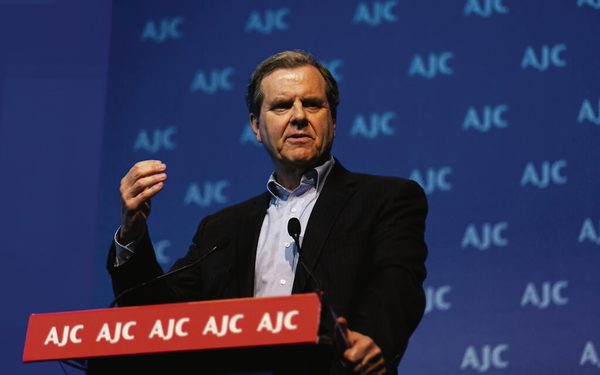
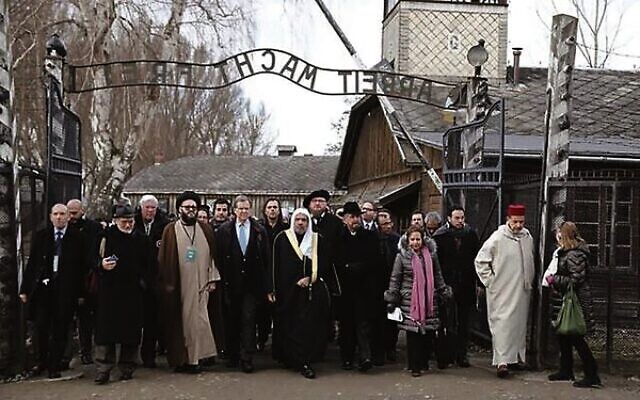
David Harris has dedicated his career towards countering antisemitism and strengthening Jewish identity. Born in New York in 1949 to parents who survived the Holocaust, he led the American Jewish Committee (AJC) for more than three decades, serving as its chief executive from 1990 to 2022.
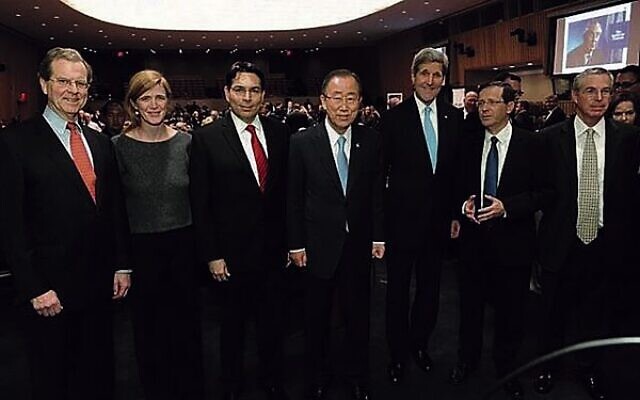
Harris’ leadership is renowned for its campaigns for the freedom of Soviet Jewry, the fight against the United Nation’s “Zionism is Racism” General Assembly 3379 resolution, and his engagement with political and civic leaders around the world including those in the Middle East.
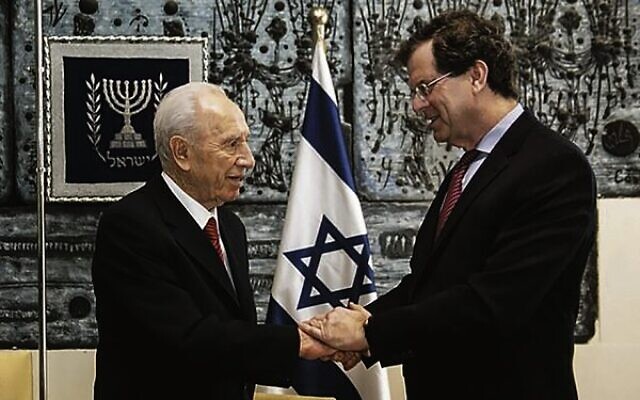
Many consider AJC to have laid the groundwork for the Abraham Accords. The late Israeli president Shimon Peres once described Harris as the “foreign minister of the Jewish people”.
This reporter was fortunate to have witnessed Harris’ impressive leadership firsthand while on secondment at the AJC in New York, where I saw his unique ability to build allies across difficult divides.
Following his tenure at AJC, Harris has taken on the role of executive vice-chair at the Institute for the Study of Global Antisemitism and Policy (ISGAP).
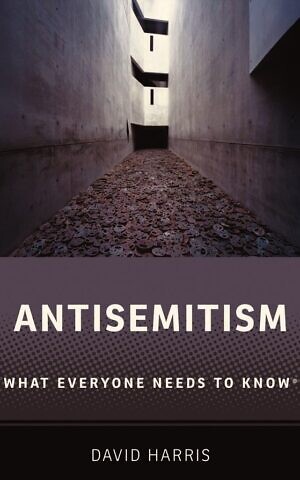
He is the author of Antisemitism: What Everyone Needs to Know (2025), published by Oxford University Press, which provides a clear and accessible guide to examining the history, evolution and contemporary challenges of antisemitism, providing a helpful resource for anyone navigating antisemitism in the post-October 7 world.
In the book’s dedication, he writes, “To my Libyan-born wife, Jou Jou, and to the memory of my Soviet-born mother, Nelly, and Hungarian-born father, Eric, each of whom faced real-world, life-threatening antisemitism and, miraculously, survived.”
Harris will be visiting Australia next week, at a significant time for the nation as it undertakes hearings of the Royal Commission on Antisemitism and Social Cohesion in the aftermath of the Bondi Chanukah massacre that killed 15 people.
The visit is co-hosted by the Australia/Israel & Jewish Affairs Council and The Joint Australia.
Q: You have written an excellent and informative book that provides a thorough guide to understanding antisemitism and how to best counter it with historical and modern examples. What was your motivation for writing this book and what do you hope it achieves?
Truth be told, the book was not my idea. In the fall of 2023, I received a phone call out of the blue from the executive editor of Oxford University Press, asking if I would be interested to write this book. Given rising antisemitism, she said, such a book was needed and, importantly, she stressed, for the widest possible audience. That’s precisely the book I set out to write.
Q: You write that antisemitism often defies logic, is conspiratorial, comes from many directions (including right, left, Islamist, Christian), and that there is no easy cure. From your research, what does work to counter antisemitism?
To answer this central question, we have to ask ourselves what’s actually worked in the past and why. For example, why did so many Danes help save 90 per cent of Danish Jews from the clutches of the occupying Nazis? The best answer I could get from the many Danes I’ve asked is simple and compelling: they were fellow Danes. As simple as that. Why did Jews in Australia, Britain, Canada and the US live so confidently for decades in the postwar era until just a few years ago? Because liberal democracy and its core values succeeded in achieving greater openness, harmony and equality, all of which, alas, are now under threat as political extremism and social fragmentation enter the national bloodstreams.
Q: Australian Jewry has seen a rise in antisemitism, more devastatingly with the Bondi Chanukah massacre that killed 15 people. What is your advice to the Australian government and its citizens on countering antisemitism?
My message to any government is essentially the same: Words are fine, but only if met by concrete and sustained actions. Otherwise, at this stage of the game, they’re meaningless.
And those actions must never underestimate the specificity, durability, lethality, and adaptability of antisemitism. But if antisemitism falls victim to political and electoral considerations, if it is just treated as one among many manifestations of hate or prejudice, or if there are no serious consequences for incitement and violence, it won’t change anything.
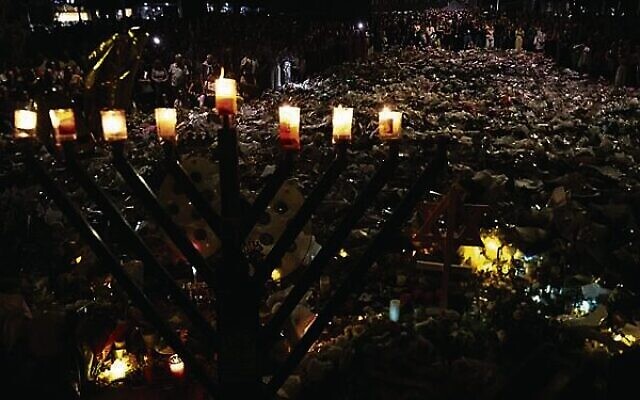
Photo: Facebook
Q: The Australian government appointed Jillian Segal as a special envoy to counter antisemitism prior to the Bondi attack, and there were concerns that her recommendations were not acted upon. In your book, you discuss the importance of such special envoys, who can be used as a ‘fig leaf’ or help drive change. What would be your advice to government envoys responsible for combating antisemitism?
Each case of a special envoy is different. Nonetheless, it comes down to two basic questions. First, is the envoy well-suited for the position, clear-eyed about the challenges, and skilful at operating in a political environment? And second, is the special envoy well plugged in to the decision-making process, or operating on the margins as little more than a prop?
Photos: Times of Israel
Q: You suggest Holocaust education is important but not always effective in countering antisemitism, especially if it is taught without empathy. How can we best teach young people about the Holocaust and countering antisemitism? What are schools and universities getting wrong?
Of course, Holocaust education remains essential. It certainly is for me as the son of European Jews who survived. But we need to recognise at least two relevant factors today. If it was once seen as an inoculation against antisemitism, that is less and less the case. And if it is to be taught going forward, how do we take into account changing circumstances, such as the passage of time, rapidly emerging technologies, how information is sought and processed, and major demographic changes in our societies and reflected, of course, in classrooms.
Q: Having worked as an advocate for the Jewish people for many decades, were you surprised in the aftermath of October 7 about the resurgence of antisemitism and the retreat of former allies? What can be done to rebuild allyship?
I understood long before October 7th that antisemitism may have hibernated, but it never fully vanished, yet I was shell shocked by the speed and virulence of its return, often masquerading as antizionism. And yes, I was stunned by the degree to which it penetrated so many segments of our societies, including higher and even secondary education, political parties, labour unions, cultural spaces, nongovernmental groups, and the media. Are we left with no allies? No, not at all. But we need to recognise now who they are or could be, rather than chasing after those we once thought were our partners but who turned against us in our time of greatest need.
Q: You indicate that Jewish advocacy organisations need to adapt to the post-October 7 climate. How can they best do that?
Frankly, by recognising, first and foremost, that we need an October 8th playbook for an October 8th world. While Israel has battled on seven fronts, there is an eighth front – the global assault on the Jewish and pro-Israel communities, with a clear aim of intimidating and isolating them, while driving a diplomatic wedge between Israel and key countries, including Europe, Australia, and North America. To some extent, it pains me to say, they’ve succeeded. Our new playbook must address both the reality of war and the seismic shifts under way.
Q: You identify social media as a breeding ground for antisemitism – how can this be countered?
Not easily, as we have all learned. Freedom of speech is a hallowed right in liberal democratic societies, so where to draw the line will always be vigorously debated. At the same time, one cannot understand the spread of antisemitism like wildfire without coming to grips with social media as central to its dissemination. Or the fact that for billions of people today social media is, in effect, the public library, the main source for forming views and opinions. Yet how many have the filters to sort through the maze of information, misinformation and disinformation?
These are urgent issues that require the shared consideration of governments, social media platforms, educators and concerned communities, including our own.
Q: What can be done to connect the struggle against antisemitism to the defence of liberal democracies?
To some, the connection couldn’t be more obvious. As has been said many times, antisemitism reveals a deeper danger in society, a threat to the entire system. What begins with Jews never ends with Jews. But we have to do a much better job of explaining the connection in ways that don’t sound simply self-serving but reflect the stark truth of historical experience. For example, Hitler targeted the Jews for the “final solution”. In the end, the war he triggered led to the death of an estimated 60-70 million people and the destruction of entire countries.
Q: Now as executive vice-chair of the Institute for the Study of Global Antisemitism and Policy, what do you see as the biggest challenges and most promising opportunities for global Jewry?
I “retired” in 2022 for about 30 seconds. Even before October 7, I understood the battles were far from over. After October 7th, even more so. I needed to fight on and looked for an organisation that really understood what was going on, didn’t flinch at or soft pedal the threats, and was focused on generating outcomes, not simply output. ISGAP stood out. It was prescient, it was fearless, it drew together scholars of many faiths and backgrounds, and its work was solidly researched and documented.

ISGAP blew the whistle on dangerous foreign funding of Western education emanating principally from Qatar. So, too, on the widespread impact of years of such funding on what our young people are being taught and, yes, who is teaching them. And it has shone a spotlight on the Muslim Brotherhood and its long-term plan to weaken and fragment Western societies, including by fomenting antisemitism. This is no time for a failure of imagination by any of us, nor for trembling knees, nor for sleepwalking through history. ISGAP – and groups that share its outlook – are more urgently needed now than ever.
David Harris will be speaking at public events in Melbourne on May 10 and Sydney on May 14.
To book visit (Melbourne): trybooking.com/DLJTN (Sydney): trybooking.com/DLJUN
“My message to any government is essentially the same: Words are fine, but only if met by concrete and sustained actions. Otherwise, at this stage of the game, they’re meaningless.”
comments