



How Ofra Haza’s Chai became an anthem
Nothing about Ofra Haza's 1983 Eurovision performance was accidental, with Chai still resonating today.
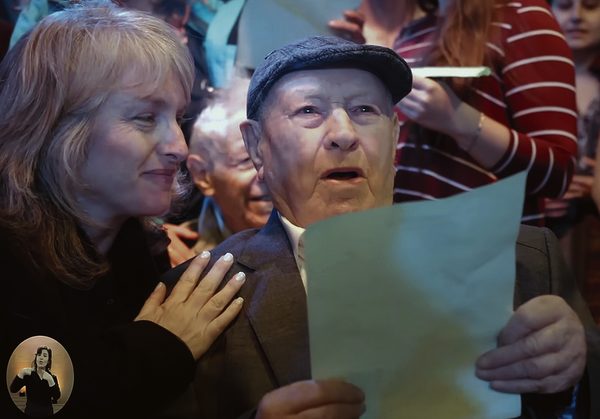
There are songs, and then there are songs that carry entire histories inside their lyrics. Ofra Haza’s Chai, performed at the 1983 Eurovision Song Contest in Munich, is firmly in the second category.
More than four decades on, it remains one of the most emotionally loaded pieces of music Israel has ever produced. And a 2018 performance by Koolulam with Holocaust survivors proved it still has the power to stop a room cold.
Eurovision 1983 took place in Munich just 11 years after the Munich massacre, when 11 Israeli Olympic athletes were murdered by the Palestinian militant group Black September during the 1972 Summer Olympics. Israel showing up in that city, on that stage, to sing a song called Chai was not a coincidence.
Ofra Haza herself visited the Dachau concentration camp and reflected on what significance it would hold for an Israeli song to win in Germany, particularly one carrying the message that “all of Israel is alive.” In the end, the song finished second, but the point had been made.
Written by lyricist Ehud Manor and composed by Avi Toledano, Chai begins as a personal declaration. Haza is acknowledging she is still alive, her eyes still turned toward the light, with many thorns but also flowers, and years stretching ahead. But the song reveals its deeper meaning as it unfolds, moving to the collective – the nation of Israel lives.
Even the costumes worn by Haza and her band were equally loaded with meaning. The yellow worn by the backing performers echoed the yellow star Jews were forced to wear during the Holocaust, while the red flowers served as tribute to fallen soldiers and victims of terrorism. Haza herself wore white – a universal symbol of peace.
Nothing about this performance was accidental.
But, it would be a disservice to reduce Haza to a one-hit wonder in sequins. Of Yemenite-Mizrahi descent, she fused Eastern and Western musical traditions, drawing on Mizrahi and Jewish folk tales and poetry throughout her career. She played a pivotal role in bringing Mizrahi Jewish culture to mainstream and international audiences. Her 1992 album Kirya became the first Israeli album nominated for a Grammy, and in 1994 she performed at the Nobel Peace Prize Concert. She was, in every sense, a cultural giant.
Fast forward to 2018, and Tel Aviv-based social-musical initiative called Koolulam took Chai and handed it back to the people it arguably always belonged to.
Ahead of Holocaust Remembrance Day, 600 Holocaust survivors and their families gathered in Jerusalem at Beit Avi Chai to sing the song together, learning the words in about an hour before performing as one under Koolulam’s direction. The event was co-organised with Zikaron Basalon, a group that facilitates intimate conversations between Holocaust survivors and small groups in private homes.
While the original Chai has a fun, 80s pop vibe, the Koolulam version was slower, heartfelt, and defiant. Many of the older participants took the opportunity to share their life stories with strangers, and meaningful encounters unfolded between survivors and the children and grandchildren who had come from across the country to sing alongside them. A truly generational song.
Chai was always more than a Eurovision entry. Like so many Israeli Eurovision entries since, it is loaded with meaning that continues to speak today.
Eurovision semi final 1 featuring Israel’s Noam Bettan is on SBS on Wednesday, May13 at 5am, followed by semi final 2 on Friday, May 15 at 5am and the final is on Sunday, May 17 at 5am.
comments