



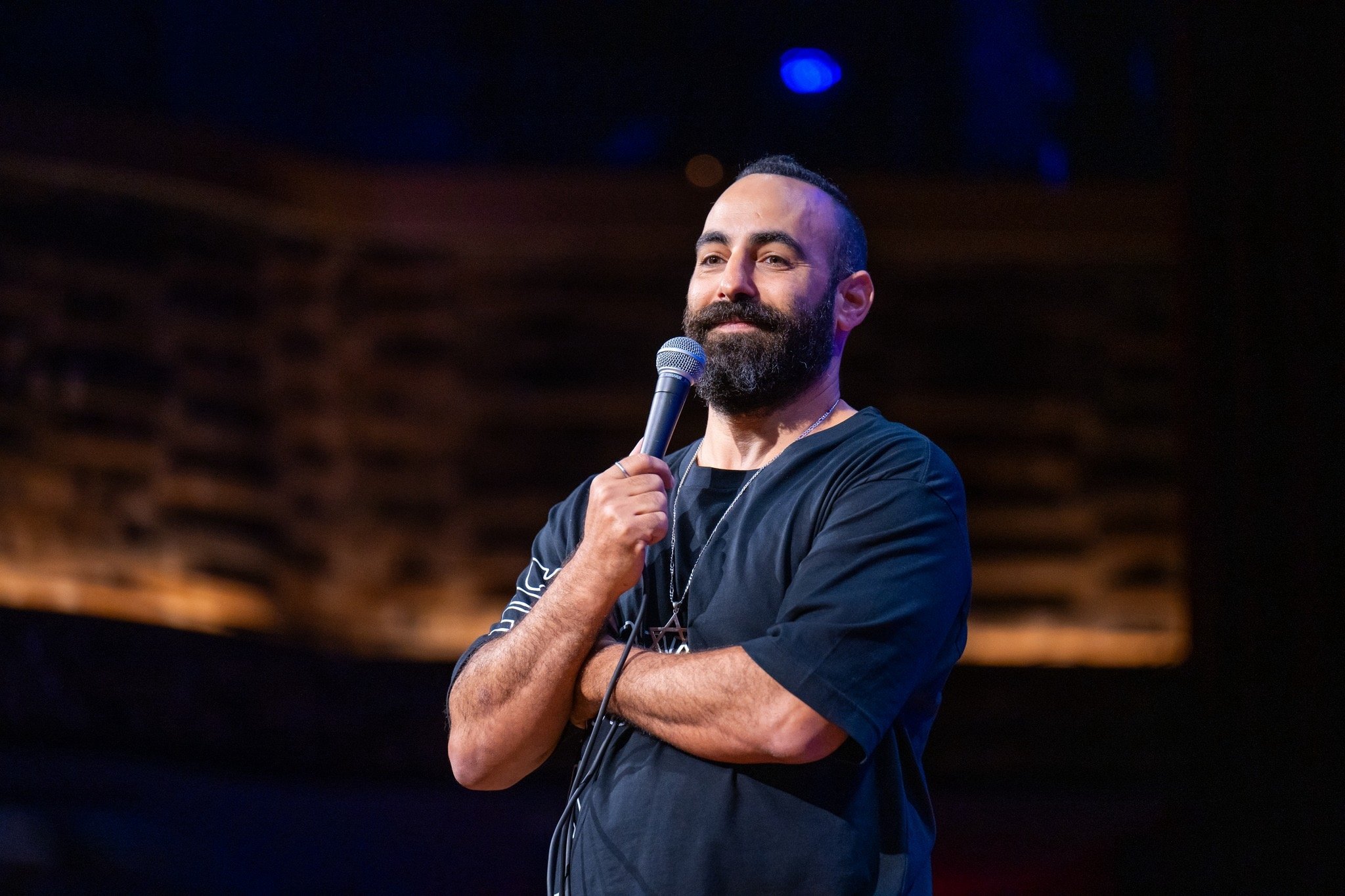
From what I remember, the Aussies, you guys are lovely people. Out of all the Anglos that I’ve met, you guys are number six,” Yohay Sponder joked as he chatted to The AJN over video from Israel.
He was recalling his last visit to Australian shores in early 2024, a visit which was postponed following the October 7 atrocities. “I had such a great time; I love Australia. Such a chill people, chill environment and beautiful views. I’m really happy to come and explore that again.”
Sponder, who has hundreds of thousands of followers across his social media profiles, is returning to Australia to perform his stand-up show, Self Loving Jew. But while he performs in English across the globe now, it took him a while to embrace the language.
“I was a funny, goofy boy in the little village that I grew up in, an agricultural village in the north of Israel; a very open space environment where everyone knew everyone. It was very fun to grow up like this,” he told The AJN.
“I made my friends laugh, and my family. I was just that guy all the time. That’s how it started.”
Sponder explained that after his army service, he just knew he was going to be up on stage, trying to make comedy his profession. He just had to support himself on his way there. Now though, he is one of the most remarkable and honest voices in modern Jewish and Israeli comedy.
Sponder is the son of Holocaust survivors and grew up in a family blending Moroccan and Polish roots. It was an upbringing that was rich in cultural contrasts and storytelling that he has credited with shaping his comedic sensibility.

While his first performances were in Hebrew, after eight years, he started to learn English, and he began to collaborate with fellow comic Shahar Hason, with their weekly show Funny Monday. It quickly grew into a cultural institution and became one of Israel’s leading English-language comedy platforms.
Their ultimate aim was to reach a broader audience. And his followers are forever grateful for this move. His English has improved out of sight since, and whenever he makes mistakes, he simply integrates them into his routine.
“I knew pretty much nothing in English,” he recalled, saying comedy is always funnier in the second or third language. Sponder was last here in 2024 with Hason and Funny Monday, the show that brought Israeli stand-up to English speaking audiences.
At the time, Sponder told The AJN that Israeli comedy is unique because it’s “faster, more direct, raw and very sharp, you can always tell by all of our stage art that this country is really going through a lot.”
The country is, indeed, going through a lot.
Following October 7, Sponder and Hason stopped performing in their traditional sense and started voluntarily visiting the communities down south to bring them a little smile. Sponder, like almost every Israeli, knew people who were murdered and taken hostage.
While heartbreaking, Sponder said it was also a heartwarming time.
“I drove across the country, I met the people. It was intense, very sad, but also very empowering,” he recalled, explaining that comedy is therapeutic, especially when enjoyed together.
“You feel that you win, not necessarily against someone specific, but like within yourself; you feel that you won that hardship that you’ve been through. You had a moment that you felt devastated. You had a moment when you felt that everything was closed on you. And then if you’re laughing, your whole system, your nervous system, the process that happened, it just makes you feel that you’re doing okay. That’s why it’s so therapeutic,” Sponder explained, saying that sometimes, it’s even possible, and helpful, to laugh at specific situations, no matter how tragic. “It’s not escapism. We’re talking about what’s going on here.”
The comedian shared the example of when his father died. Acknowledging that it was the hardest moments of his life, throughout the funeral and the shiva period, Sponder found himself laughing. “It’s crazy. I miss him and I’m the saddest I’ve ever been, but what happened during the shiva, it’s funny. You can’t ignore the fact that it’s funny. And then you feel better.
“That’s comedy. It needs to be identified as a medicine. We’re Jewish, we know one or two things about medicine,” he laughed.
Unfortunately, we also know one or two things about tragedy.
But Sponder has taken this tragedy, and not only tried to make people laugh throughout it, but also inspired people to embrace their true selves.
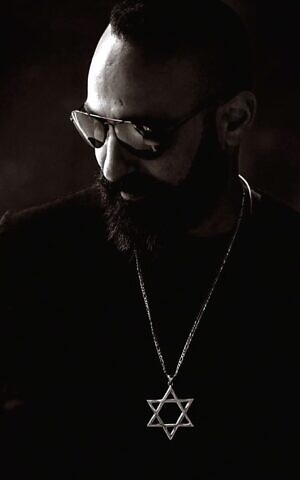
Sponder explained that this pride in his Judaism is part of why he wears his famous big Magen David. The other reason is to honour his late father, David.
“He was my biggest fan,” Sponder recalled. “David also has that energy of fighting the Goliath, fighting lions,” he said, saying David’s disadvantage was power, but he had courage and brain.
Besides the connection to David, Sponder’s giant Magen David speaks to the galvanisation of Jews around the world.
“We were all activated after October 7, as Jews, as a people. Every Jewish person after that, they became a super Jew on their own terms. Even the self-haters, they became super self-hating Jews,” Sponder laughed.
Self Loving Jew is the antidote to the self-hating Jew. Having observed many Jews in the media or the online space using the infamous preface, “as a Jew” before criticising Israel without blaming Hamas for their role while distancing themselves from their Jewish identity, Sponder decided to turn the tide.
He’s a self-loving Jew and bloody proud of it.
“I think, anyway I’m going on stage, I’m going to talk to people, and this is who I am. They’ll come after me anyway. They’ll hate me anyway, those who are not my fans and those who think we’re the bad ones. This is who I am. I’m here to inspire everyone, not just my people. And that’s what the show is about.”
Sponder said every Jew should own who they are. That’s what he is doing.
“Be you. That’s all you can do. And I know it’s crazy and scary to some people. But it’s what you have to do.”
It’s not, though, what every comedian is doing, which frustrates Sponder.
While he acknowledges that he loves observational comedy and that it has its place, he believes that as Jews, we need to address the elephant in the room, and actually deal with it, however we understand how. For him, it’s comedy.
“I was so surprised because when shit was hitting the fan, I thought that’s what we’re all doing, that’s what we’re here for. I thought everyone was going to do that,” he said. “There are some people that do it, but so few. I thought this is what we’re here to do. And people tell me ‘you’re brave’, and I’m thinking ‘am I? That’s what’s happening here?’ Maybe I’m an idiot,” he laughed. “I hope I’m brave and not an idiot. Maybe both.”
Sponder said he didn’t understand why every Jew in the public space isn’t standing up and fighting for what’s right. Explaining that he grew up on the horror stories of how the Holocaust started and the fact that so few people stood up against what was happening, yet so many say they would have fought back. “Well, now you hear what’s going on. What do you have to say?” he asked. “You’re Jewish, what do you have to say about the fact that you’re Jewish and they want to kill you? They’re literally spreading blood libel everywhere. Just the fact that you’re Jewish, you’re under attack, you’re at risk right now. And you have nothing to say about that? With the platform that you have, the fact that you’re on stage and you’re not saying anything. You’re a Trojan Horse.”
Sponder acknowledged that it’s not always easy to stand up and share. There are fears within many people, Jews and non-Jews, to publicly speak up. But, he thinks, now is the time to find a way to do it.
“No one promised you an easy journey,” he pointed out.
Indeed, it hasn’t always been easy for Sponder. His shows have been cancelled throughout the past almost two years, most publicly in Amsterdam, just a week prior to him taking to the stage. The venue blamed antisemitic threats, saying they couldn’t guarantee the comedian’s safety or that of his audience.
Sponder said he was angry because he wasn’t the one causing the situation.
“I’m coming to tell jokes, I’m not a danger,” he said. “The danger is the threats. It was a sold-out show at a place that I love to perform.”
Sponder explained that he had been performing at the venue for almost 15 years and that Hason had done a show completely in Hebrew there a few years prior.
“We were all activated after October 7, as Jews, as a people. Every Jewish person after that, they became a super Jew on their own terms. Even the self-haters, they became super self-hating Jews.”
It was at this point that Sponder brought up perhaps one of his funniest shtick – that of the colonisers blame game. In a clip shared to social media, Sponder questions why Israelis and Jews are called colonisers when no one speaks Hebrew and that you can barely see Israel on the map.
“We just get the disadvantage of the coloniser [name], just the blame and the hate. But not the advantages of being one,” he laughed. “We can’t even colonise ourselves.”
“It’s insane that facts and reality don’t matter anymore,” he continued.
“The truth doesn’t matter to anyone. It’s just an opportunity for people to do another round of ‘everyone against us’.”
Sponder finished the interview by saying he hopes sometime soon that he’s just a regular comedian, doing stupid jokes about regular stuff. While he said it’s fun to have the community around him, the circumstances are sad.
“They’re not happy to come for a laugh. They really need it. It’s necessary. And that makes it sad. But we’ll do it, and we’ll be okay. We are optimistic about it; it will get better.”
Yohay Sponder will be performing across Australia next month. For dates and tickets, visit tegdainty.com/tour/yohaysponder
comments