



I knew I had to return
'Over the four days of my trip, I joined in mourning both the lives violently cut down and the shattering of a long-held sense of security'
In 2017, I served as Visiting Rabbi at the Great Synagogue in Sydney. I was immediately drawn to the warmth and close-knit nature of the city’s Jewish community, its “no worries” optimism, and the pride it took in its deep Australian roots. I embraced the sporting culture and spent countless hours learning to surf, with a debatable level of success, at Bondi Beach.
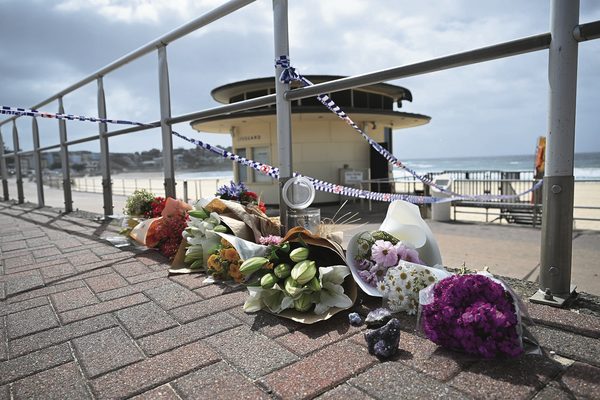
When I heard that a terrorist attack had taken place on the first night of Chanukah I knew that I had to return, if only for a few days, to be with this community that meant so much to me. Over the four days of my trip, I joined in mourning both the lives violently cut down and the shattering of a long-held sense of security. One woman I met spoke of her anger at the terrorists not only for murdering and wounding so many, but also for exposing her children to the reality of human evil. I sensed that it was not only her children’s innocence that had been lost, but to some extent her own as well. I shared her feelings. To an outsider, Australia seems to trade proximity for safety. The attack was a particularly cruel violation of this bargain.
Even from a distance, I knew that for two years shadows had been growing as antisemitic incidents escalated from chants to graffiti to firebombings. The progression was clear, yet the darkness of mass murder was still shocking.
The sages of the Talmud tell us that Adam and Eve never experienced darkness until twilight fell at the end of the first Shabbat. Created during the daylight hours of the sixth day, they were spared nightfall in honor of Shabbat itself. The world they inhabited, the only world they knew or could imagine, was filled entirely with light. When the sky finally began to darken, Adam and Eve feared that the world was coming to an end. They believed the world consisted only of light, and that darkness would overwhelm and destroy it.
Those twilight moments must have felt endless as the world they knew faded away. Yet, the sages explain, just when Adam and Eve feared they would be consumed by darkness, God enabled them to find two flints with which to create fire. This detail is no accident. Earlier, when despair and loneliness descended upon Adam, God created Eve. A single flint alone cannot create light, but in the presence of another it can hold the darkness at bay.
Who knows how long Adam waited in fear before striking the stones together and discovering that even in dark times, human beings can create light. The world of pure, unbroken daylight would never return. Instead, there would be cycles of light and moments of darkness—but together, Adam and Eve could endure the night. Together, they could create light even amidst darkness.
I saw the same light in hospitals, shiva homes, and vigils across Sydney. Families of the wounded were overwhelmed with food and offers of help. Shiva homes overflowed with people seeking to comfort and support mourners. Community members turned to one another for solace and strength at nightly vigils. At the memorial service and candle-lighting ceremony on the last night of Chanukah at Bondi Beach, I stood among 20,000 people just meters from where the attack had taken place. There, we found comfort in prayers, speeches, and songs—but most of all, in one another’s presence.
There is no rushing the process of creating light. Some will need to sit longer in the darkness of grief than others before they are ready to find meaning in loss. Nor will the darkness of antisemitism dissipate easily. But together, we can create a light, of meaning and purpose, that will sustain us until daybreak.
Rabbi Noah Leavitt is Senior Rabbi of Oheb Zedek – Cedar Sinai Synagogue in Cleveland, Ohio, United States.
comments