



Indonesian Muslim groups protest Shoah exhibition
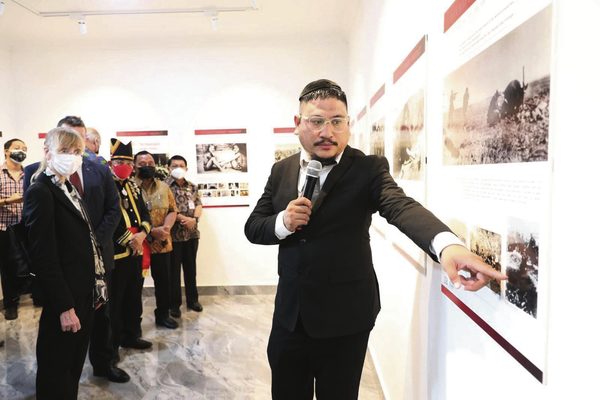
SEVERAL Muslim groups in Indonesia are demanding the closure of the country’s first permanent Holocaust exhibition, charging that it is part of an effort to normalise the country’s relations with Israel.
The exhibition was launched on International Holocaust Remembrance Day last month and is located at Indonesia’s only synagogue, Shaar HaShamayim, in the North Sulawesi province. Titled Shoah: How is it Humanly Possible? it was created by Yad Vashem in Israel.
Yaakov Baruch, Shaar HaShamayim’s rabbi, said his motivation to open the exhibition was personal.
“When I had this idea to build a Holocaust museum, the reason was to remember my family who died in the Holocaust on my grandmother’s side,” said Baruch.
“And I also want to educate Indonesians on the danger of antisemitism, especially the danger of hate crimes.”
However, groups protesting the exhibition say that they see it as part of Israel’s attempts to normalise relations with Indonesia and the occupation of Palestinian-sought territories, according to BenarNews, an online news service affiliated with Radio Free Asia.
“We demand any exhibition be stopped and the museum be cancelled and discontinued,” said Sudarnoto Abdul Hakim, the head of foreign relations and international cooperation of the country’s Indonesian Ulema Council, a top Islamic clerical body known as MUI.
“Jewish communities and the descendants of Jewish people everywhere, including in Indonesia and North Sulawesi, should also see fairly clearly the brutal acts that have been perpetrated by Israeli Zionists against the Palestinian people since 1948,” he added.
MUI – which was once chaired by Indonesia’s vice president Ma’ruf Amin – is known in Indonesia as holding conservative and sometimes controversial religious opinions.
Representatives of other groups have expressed similar sentiments. Hidayat Nur Wahid, deputy speaker of Indonesia’s legislative branch, the People’s Consultative Assembly, and a lawmaker with the faith-based Prosperous Justice Party, told BenarNews that he objected to the exhibition’s ties to Yad Vashem because of the museum director’s ties to Israeli settlements on the West Bank.
Dani Dayan is the former chair of the Yesha Council, an umbrella organisation for West Bank settlements.
Meanwhile, representatives from Nahdlatul Ulama, Indonesia’s largest Islamic organisation – and the largest Islamic organisation in the world – have spoken out in support of the exhibition. The local government was also supportive, according to a source familiar with the situation.
It is not illegal to practise Judaism in Indonesia, but many Jews try to keep a low profile and practise in private. There are only five legally recognised religions – Christianity, Catholicism, Hinduism, Buddhism and Confucianism – meaning that Jews have to identify with one.
Baruch’s ID card says he is Christian, but he says Jews in majority-Muslim areas identify as Muslim.
Baruch estimates that there are only 20 to 30 practising traditional Sephardic Jews at his synagogue and another 20 to 30 Jews in Jakarta who practise at home.
Most, like Baruch, are descendants of Dutch Jews who first came to Indonesia in the 17th century with the Dutch East India Company. The community built a synagogue in Surabaya in 1939, which was destroyed in 2013.
“Once I was attacked with my pregnant wife in Jakarta because I was wearing a kippah,” said Baruch. “But now, my hometown [Tondano, North Sulawesi] is much more safe because there are a lot of Christian people here.”
Baruch added that the local government has provided support and security to the small Jewish community since the synagogue was constructed there in 2004.
Regarding the exhibition, he said, “I will fight for it. This is about our people. I want to remember that my grandmother’s family, that six million Jews, died in the Holocaust.”
JTA
comments