



‘Israel can become the climate innovation nation’
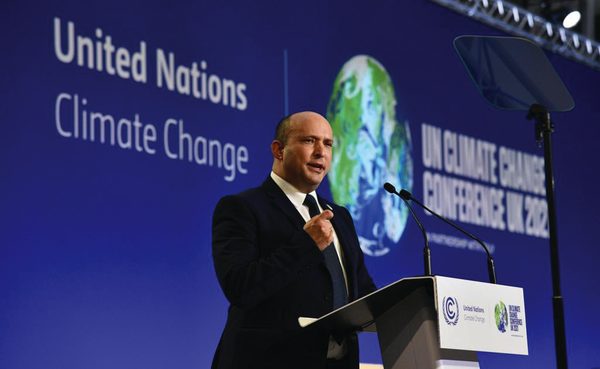
ISRAEL will make its greatest contribution to the global war on climate change by leveraging the technological creativity and inventiveness of its people to find solutions “that have not yet even been imagined”, Prime Minister Naftali Bennett told world leaders at the UN’s COP26 climate conference in Glasgow this week.
Behavioural change to cut emissions would only take the world so far, he said.
“If we’re going to move the needle, we need to contribute Israel’s most valuable source of energy – the energy and brainpower of our people,” said Bennett.
“This is what fuels our innovation and ingenuity. This is where Israel can make a real difference.
“We are less than a third of the size of Scotland. Our carbon footprint may be small, but our impact on climate change can be mighty,” he went on, announcing that he had set up a task force called the Green Sandbox to provide funds for climate tech initiatives and cut red tape.
On Sunday, Bennett had told reporters that the government would establish a special fund to encourage local tech entrepreneurs to invest in green technology.
“Israel may be 60 per cent desert, but we managed to make it bloom,” Bennett told the leaders in Glasgow on Monday. “We may be in one of the driest places on earth, but we managed to become the world’s number one country in water innovation.”
He added, “As the country with the most start-ups per capita in the world, we must channel our efforts to saving the world … Israel can become the ‘climate innovation nation’ and we’re ready to pave the way.”
Bennett appealed to entrepreneurs and innovators in Israel and around the world to be “game changers” and to “help save our planet”.
“Instead of building yet another hyped-up app, why don’t you launch start-ups that will help solve this global threat?” he asked.
Bennett said that on bringing down emissions, Israel was “at the beginning of a revolution”.
He cited the government’s recent decision to set a net-zero emissions target by 2050 and its 100-step plan to get there as evidence that Israel was “currently doing more to promote clean energy and reduce greenhouse gases than at any other time in our country’s history”.
Coal would be phased out by 2025, he said, citing a target set by the previous government led by Benjamin Netanyahu.
“As we gather here today in Glasgow, we know that history will judge our generation’s response to this [climate] threat – not by how ambitious we are, but by the actions we take,” Bennett said.
“As we work to keep people safe today, we will also be working for the resilience of tomorrow, where our children will breathe cleaner air, drink cleaner water and live in a world that treats the planet better than we did.”
Bennett led a 120-strong Israeli delegation to the COP26 Glasgow talks.
Last Friday, Bennett and Energy Minister Karine Elharrar announced that Israel will join the growing number of countries pledging to be carbon neutral by 2050.
The move upends the policy of the previous government, announced in April, which was to cut carbon emissions by 80 per cent across the board by 2050 and emissions from the electricity sector in particular by up to 85 per cent.
Meanwhile, at a meeting on the sidelines of the conference in Glasgow, Bennett and Microsoft co-founder Bill Gates agreed to establish a working group between the State of Israel and the Gates Foundation in the area of climate change innovation.
“Israel is known as the start-up nation, and I think that it’s time we pivot and channel our national energy – which is the energy of the people, the brainpower – to fighting climate change,” Bennett told Gates. “We’re going to take this as a national mission.”
Stressing that his “big belief is that we can solve climate change if we accelerate innovation,” Gates said innovation is “really what Israel is known for, but not so much in the climate space”.
The key, he said, will be “understanding where are the brilliant people in Israel who are thinking about these new techniques”.
He added, “Given the talent that you have and what we’ve seen in the digital space, how do we unleash more of that? So I’d love to take that R&D innovation push and figure out where Israel can partner with us.”
comments