



Israel prays for kidnapped teens
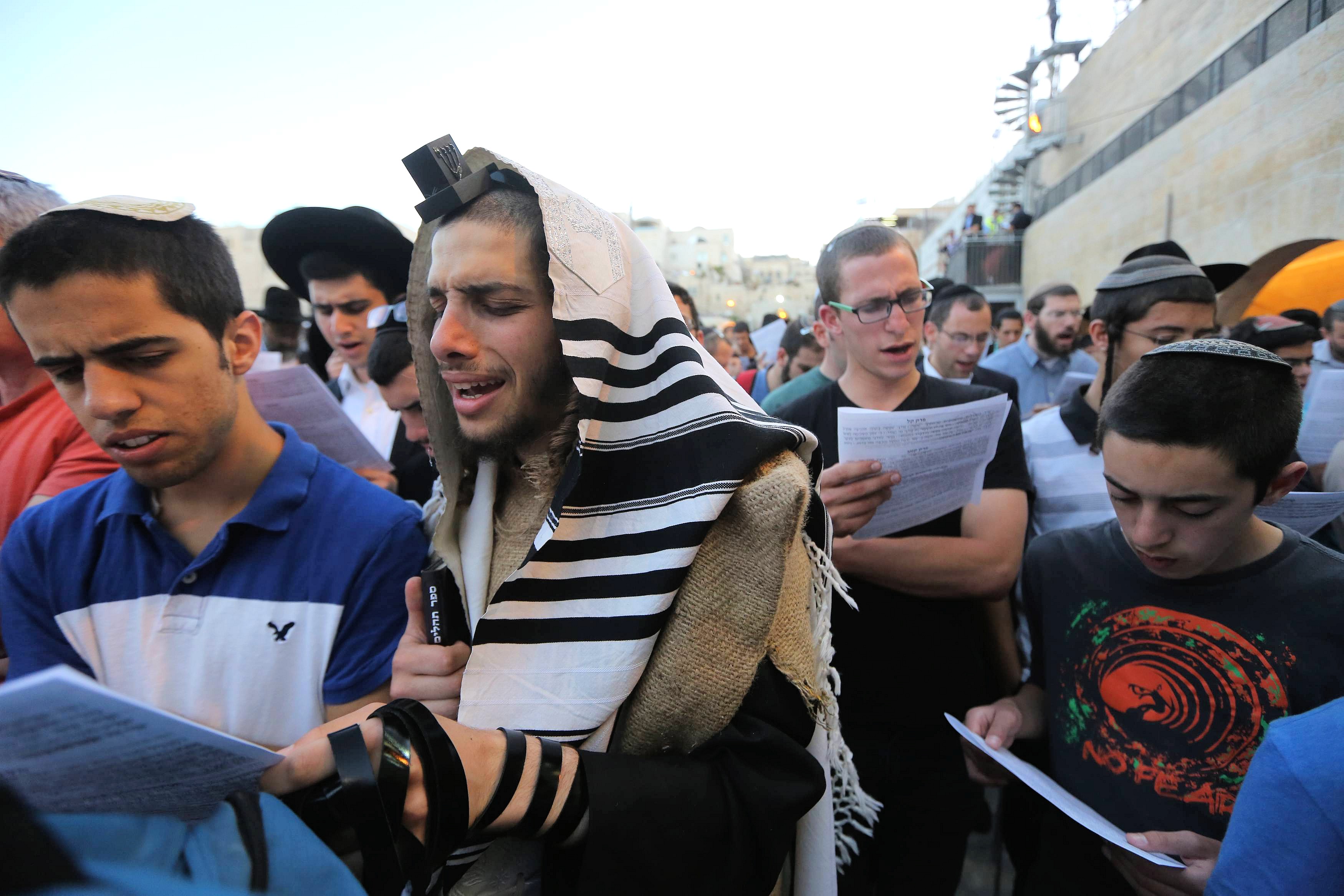
Israel has been in a state of national agony and anguish since Friday, when it emerged that terrorists had kidnapped three Israeli teenagers the previous night.
As Israelis have expressed outrage at the kidnappings, the three young men have quickly become considered sons of the whole nation, with information on their personalities and ambitions building a picture of them in everyone’s minds.
Videos have circulated of 19-year-old Eyal Yifrah, a keen musician, filmed just a few weeks ago. singing a song he composed. Gilad Shaar, 16, is a youth counsellor with a penchant for baking, and Naftali Frenkel, also 16, is a sports fan who was looking forward to watching the World Cup.
The three were making their way from their yeshivot in the West Bank to their homes – two of them in central Israel, one of them elsewhere in the West Bank – when they disappeared, apparently abducted by terrorists.
Their parents have addressed the nation, with a tragic mix of sorrow and gratitude for its solidarity. “The Jewish people is praying for you – look at the beauty of the Jewish people,” said Eyal Yifrah’s mother Iris. Rachel Frenkel, the mother of Naftali, declared herself optimistic and said that her son should “know that Israel is turning the world upside down to bring you home”.
For some Israelis, the pain was too much to continue normal life. When The AJN reached Sherri Mandel, whose son Koby was killed by terrorists in 1991 not far from where Thursday’s abduction took place, she had taken to her bed. “Today I’m in bed just to fall apart,” she said on Monday. “I can’t continue.”
On the kibbutz where the two 16-year-old abductees go to school, Kfar Etzion in the West Bank, residents were trying to find expression for their sorrow, and many chose to do it through prayer meetings.
Kfar Etzion resident Eliaz Cohen told The AJN: “This throws us back to the awful years of the Second Intifada, when there were terrible tragedies happening.” On Tuesday evening, Cohen organised a small prayer gathering attended by both settlers and Palestinians, motivated to keep alive “continuous efforts for coexistence with our Palestinian neighbours.”
Prayers have echoed across the country, including enormous gatherings at the Western Wall and a prayer service at the Knesset where politicians from most of the political spectrum united. Adin Steinsaltz, the prolific Talmud scholar who is revered by secular and religious alike, issued a statement calling upon people to pray as “this has been the Jewish way from time immemorial.” He said that beyond this, there is little to do, as “in a time and place that had seemed to us quiet and serene, we have been thrown into an event that we can do nothing to resolve.”
As the nation prayed, and took to social media to express its fury through hashtags and posts, the military, intelligence services and police gathered their strength. The strategy was to start wide search operations using arrests, intelligence gathering and other methods, to find the captives who are believed to be held by Hamas. The second component was to prevent the captives being moved out of the West Bank, especially to the Hamas-ruled Gaza Strip. And the third component was to prepare forces for a possible rescue operation.
The search operation has involved movement restrictions for Palestinians, especially in Hebron, and has arrested 200 people with links to Hamas, including prominent political figures. In the course of the operation, large quantities of contraband arms were seized. A Palestinian Authority statement decried the measures employed in the search, claiming: “An entire population is being held hostage to the whims of the Israeli occupation.”
On a political level, Israel’s response has been to try to leverage the fact that the western-backed Palestinian Authority has formed a unity government with Hamas to push it to bring about the return of the captives. “I expect you to assist in returning the abducted youths and in apprehending the kidnappers,” he told Palestinian President Mahmoud Abbas by telephone. “The Hamas kidnappers came from territory under Palestinian Authority control and returned to territory under Palestinian Authority control.”
The Palestinian Authority has rejected this logic, saying that it takes no responsibility for the kidnappings, as they took place in a part of the West Bank which is under Israeli administration. In a statement issued on Tuesday, it claimed that it “can’t be blamed for security issues” because “the teens allegedly went missing in a territory under full Israeli control and not in areas controlled by Palestinians.”
Netanyahu hit back, calling the Palestinian position “patently absurd.” He said: “When an attack takes place in Tel Aviv or in London or in New York – all these places have been attacked by terrorists – the question is not where the attack takes place. The question is where it originated.
“The kidnappers in this case set out from territory controlled by the Palestinian Authority, and the PA cannot absolve itself of its responsibility.”
On Monday night, Netanyahu moved to lower the public’s expectations for quick resolution. “We are here in the midst of a complex operation,” he said. “We need to be prepared for the possibility that it may take time.”
The sense of horror has been intensified by the fact that two of the kidnapped Israelis are aged just 16. This prompted the chair of the Knesset’s Committee on the Rights of the Child, MK Orly Levi-Abekasis, to issue a special request to the United Nations. She wrote: “The abduction constitutes a profound infringement of conventions and a blatant violation of the right of Israeli children to lead a peaceful, unthreatened life.”
Taking issue with the description of the youths in Palestinian media as soldiers, she wrote: “These are not soldiers, nor were they engaged in battle – they are three young adolescents who should have been dividing their time between preparation for their final exams and their family circle.”
comments