



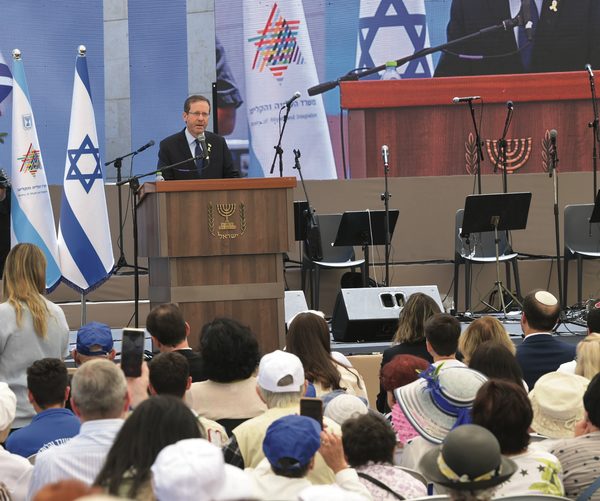
In a meeting room in Sydney five weeks ago, a promising but informal partnership was solidified between a new Israeli museum, the Federal Association of Jewish Ex-Service Men and Women (FAJEX) and the Sydney Jewish Museum (SJM).
It was a fruitful discussion between the visiting board and public council member of the Chaim Herzog Museum of the Jewish Soldier in World War II (MJSWW2) Avinoam Brog, SJM senior curator Shannon Biederman and FAJEX president Dr Keith Shilkin – in which The AJN was a welcome observer.
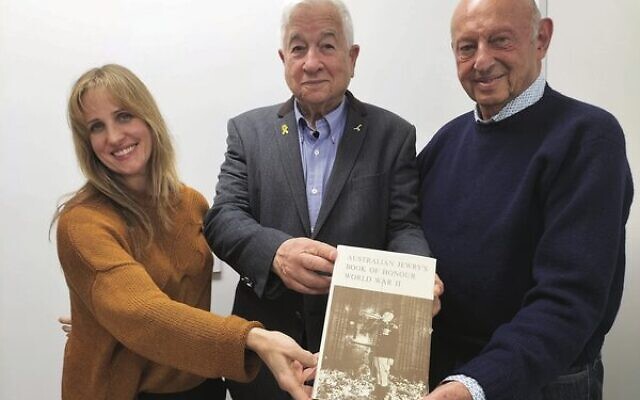
By the end of it the partnership was fully established and Australia was chosen as a model setting to launch an exciting new school education program within the English-speaking Jewish Diaspora.
A new museum with a mission
The MJSWW2, located in Latrun, opened to visitors in 2023 with the mission of telling a vital heroic but often overlooked chapter of the Jewish story in the Second World War.
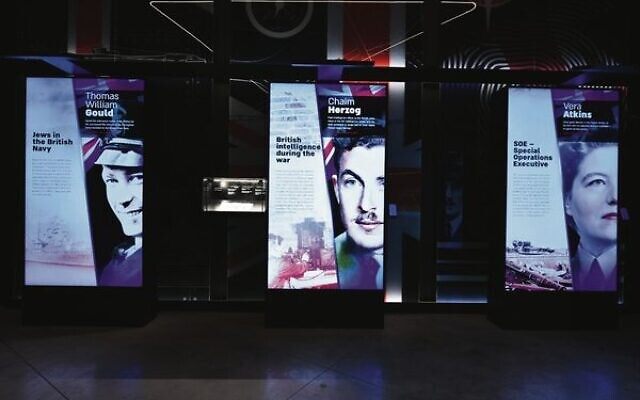
Utilising the latest audio-visual technology, it honours the 1.5 million Jews who served in the Second World War in Allied military forces in Europe, the Middle East and the Pacific, those who served in partisan and resistance movements and the 250,000 who paid the ultimate sacrifice.
Those figures include more than 2900 Jews who enlisted in the Australian Army, almost 1000 in the Royal Australian Air Force and more than 700 in the Royal Australian Navy.
Some 134 Jewish Diggers died during the war and 60 were awarded with decorations including medals of distinction across all ranks, services and divisions.
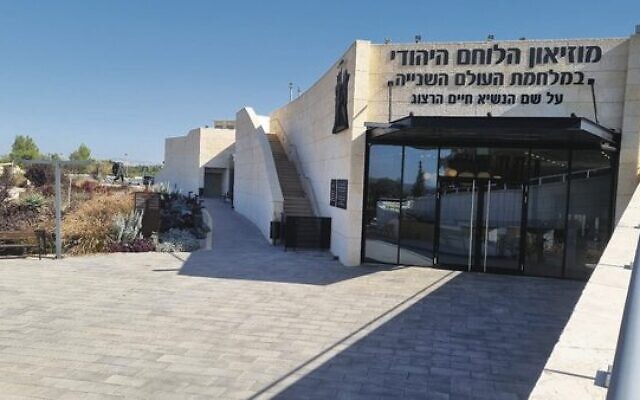
The museum is named after Israel’s sixth president, Chaim Herzog, who served as a British Army intelligence officer in WWII and was involved in the capture and investigation of Heinrich Himmler. Later he participated in battles in Israel’s War of Independence, including in Latrun.
It emerged from an idea first proposed in the mid-2000s by Brigadier General Yitzchak Arad (nicknamed “Tolka”), a Lithuanian-raised partisan fighter in WWII who was aboard the ship Chana Shenesh that took 252 Jewish refugees to Mandatory Palestine in December 1945, evading British patrols in the port of Nahariya.
For a period he was the chairman of Yad Vashem, telling the story of the Shoah. He became the initiator of the idea for a museum dedicated to commemorating another chapter of Jewish history from 1939 to 1945.
The museum is divided into six main sections covering different theatres of war and types of service, from the early years in Western Europe to the Eastern Front and the Red Army, American involvement, partisan resistance and Jewish volunteers from Eretz Yisrael.
A unit in the US Army known as the Ritchie Boys is also featured – German-speaking Jewish refugees who volunteered as translators and interrogators of Nazis and their collaborators.
A story that was only half-told
Brog explained that in the Jewish Diaspora and particularly in Israel itself, while there is what he described as “limited” knowledge and awareness among people about Jewish military service in World War II “from the way we [Israelis] looked at what happened to the Jewish people between 1939 and 1945, it was the story only of the Holocaust and not a story with two chapters.
“One chapter tells of Jews being slaughtered and one tells the story of 1.5 million Jewish soldiers, including Jewish partisan fighters.
“That is, I believe, the full story that should be told and it is now beautifully told through this new museum in Israel.
“In a way, we grew up in Israel believing that courage and service by Jews in wars was something that started with the Palmach, the Etzel [Irgun] and the Lechi, and later on the IDF … which is not the story at all.”
Shilkin added, “There’s still a view or a perception in the world that Jews never fought in WWII and that they were just targets, but that’s just not true.
“In fact there was a higher average proportion of service in the armed forces by Jewish communities across the Diaspora – including Australia’s – than the average for the total population in the countries they served in.
“And not just in WWII but in the First World War.”
Biederman agreed, adding she hopes to travel to the museum next July to experience it for herself.
“I just think it is so wonderful and worthwhile – especially in this day and age when we really have to do a lot to reinforce Jewish pride and agency.
“I think this is an excellent way to go about it.”
The museum’s Australian connection
The Israeli museum’s relationship with Australia began through regular correspondence between its curator, Dr Tamar Ketko, and the SJM’s Biederman in 2011 when the MJSWW2 was in the thick of its preparatory stage and the SJM was developing its permanent exhibition on Australia’s Jewish military history.
In more recent years, Shilkin joined the conversation on behalf of FAJEX.
Shilkin said, “Now with Avinoam visiting Australia on a private visit with his wife, Shannon and I thought we should take the opportunity to formalise and strengthen this relationship.
“We did that at our first in-person meeting with Avinoam and it has opened up some exciting possibilities.”
“There is a really good synergy happening now between our museums,” Biederman added.
Australian partnership to drive education
The three-way collaborative partnership that emerged from the meeting identified three main objectives.
The biggest one focuses on a process towards tailoring the MJSWW2’s school education programs for use by teachers at Australia’s Jewish day schools.
It would start in Sydney, involve the SJM principals and teachers at the city’s Jewish schools and then in time expand to Melbourne and potentially Perth’s Carmel School.
Then, if it proves successful, it could be rolled out in the rest of the English-speaking Diaspora in countries like the United States, Canada, Britain and South Africa.
Brog hopes that Australia can become the model or test case for this.
He explained, “The idea is that we use the audio-visual material that was developed by the museum and already introduced into Israel’s school education system and it would be about translating and adapting it – with your help – to suit the Australian curriculum and the needs of students here.
“How can it later be disseminated to other places?
“You start with the place where you have the best chance to succeed and – having lived and worked in Sydney in the 1980s for UIA Australia – I think Australia’s Jewish community and school network is an ideal size and scope.
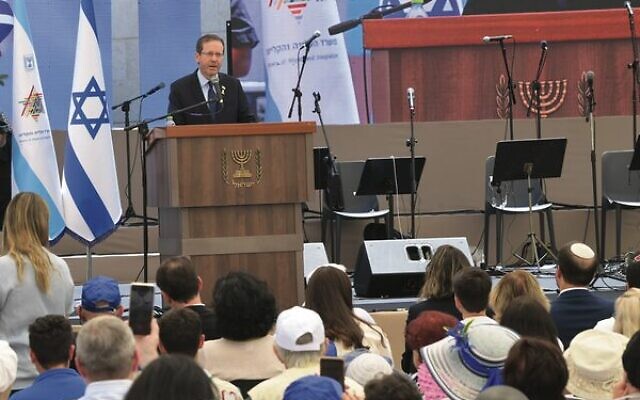
“Australia has one of the best Jewish school systems and a strong Zionist and relatively small-sized community.”
Biederman has embraced the concept and is keen to see where it can go.
“And because the SJM has lots of school students coming in every week and we have been running comprehensive education programs and a well-established system, we are very well-suited to this collaboration,” she said.
“Nationally, schools here are required to commemorate Anzac Day so students at every school are used to having at least some aspect of military history and commemoration,” Shilkin added. “So this would be an opportunity to enlarge and widen that at Jewish schools.”
Preserving and adding stories
The partnership also aims to collect and preserve individual stories from Australian Jewish families with military histories spanning the Second World War.
The MJSWW2 already contains Australian material but there’s scope for expansion through personal testimonies and family records.
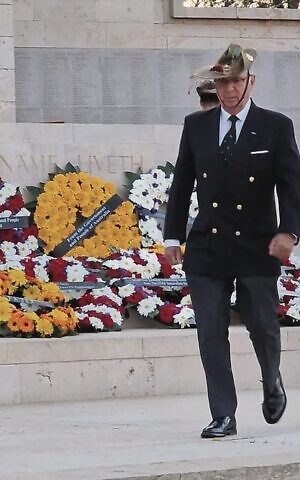
“Absolutely, so if Australians have a story about the war service of their grandparent, for example, they are welcome to share it with us,” Brog said.
The MJSWW2’s website – www.jwmww2.org/en – includes forms for submitting family stories while the SJM can serve as a local contact point for Australian contributions, particularly if there are physical documents or photos available.
Biederman said it is so important to document history “because as generations go by, so much gets forgotten”.
“As the MJSWW2 isn’t a collecting organisation – it’s mainly a digital and audio-visual based museum – we at the SJM are a great repository for physical items like documents, photos and diaries, and we can share it [digitally] with them so I think this can work very nicely.”
Meanwhile Shilkin said that the Australian Jewish Historical Society’s website lists more than 350 Australian Jewish soldiers who died since the Boer War, with detailed narratives for 110 of them already compiled by researcher Peter Allen.
Visiting Latrun and the museum
Another objective of the partnership is to broaden awareness about both museums and encourage visitation.
In the MJSWW2’s case it would be hosting more guided tours for Australians embarking on study missions or tours of Israel that are offered regularly by Australian-based Jewish or Zionist organisations, and including the museum in more itineraries.
Brog mentioned that the latest such visit from Australia happened as recently as September 2 when members on a UIA Australia Solidarity Mission to Israel enjoyed a guided tour.
Looking ahead
While it’s only early days for the MJSWW2, it has welcomed hundreds of visitors weekly since opening and feedback from them indicates the museum is achieving its educational objectives, Brog said.
“I’m sure there’s going to be a big impact and I’ve seen it already.
“My wife has also met with many different groups of people that have been to the museum and they all have the same reactions.
“The first reaction is typically being impressed with the level of sophistication in the museum’s presentation of the information, and the second one is reflection on the fact that we [Israelis] didn’t give enough credit to the contribution and bravery of Jews outside of Israel during the Second World War – especially towards the Allies’ victory over the Nazi monsters.”
Bob Mountwitten is an Australian now living in Israel who lays wreaths on behalf of FAJEX at Anzac Day services there and at Battle of Beersheba annual commemorations in that city’s Anzac Memorial Centre.
His father was well-known Jewish Australian serviceman Sergeant Harry Wittenberg who enlisted in the Australian Army on October 3, 1942, and served until November 1945.
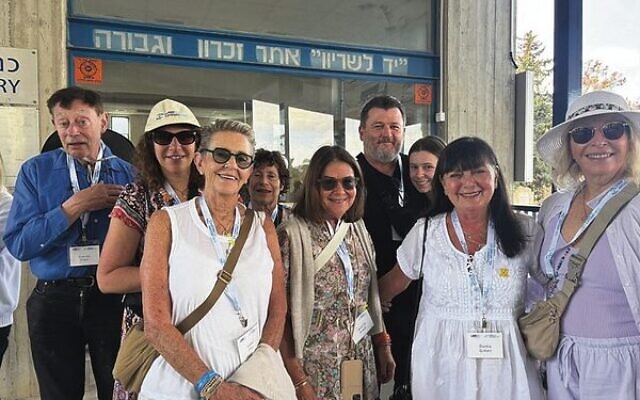
Having visited the MJSWW2 several times, Mountwitten told The AJN, “I found the museum to be quite outstanding and I am greatly moved by it.
“They’ve made it as attractive and interesting for young people as much as possible – they even have a P38 plane dangling from the ceiling.
“We must never forget the terrible sacrifices made so that we may be free.”
When asked if the Israeli public today is aware enough of the contributions and sacrifices of the 1.5 million Jewish servicemen and women who served in World War II, Mountwitten said they are not.
“Israelis know that the Allies finally managed to defeat the Nazis but beyond that they don’t know that Jewish people fought on every front and in every major battle.
“They don’t know that Jews volunteered to fight – comprising more than their ratio in the population.
“This museum can go a great way towards correcting that knowledge gap.”
comments