



Lebanon from the era of the Tanach till today
Lebanon is mentioned 71 times in the Tanach, primarily symbolising majesty, beauty and strength through its famous cedar forests and snow-capped mountains.
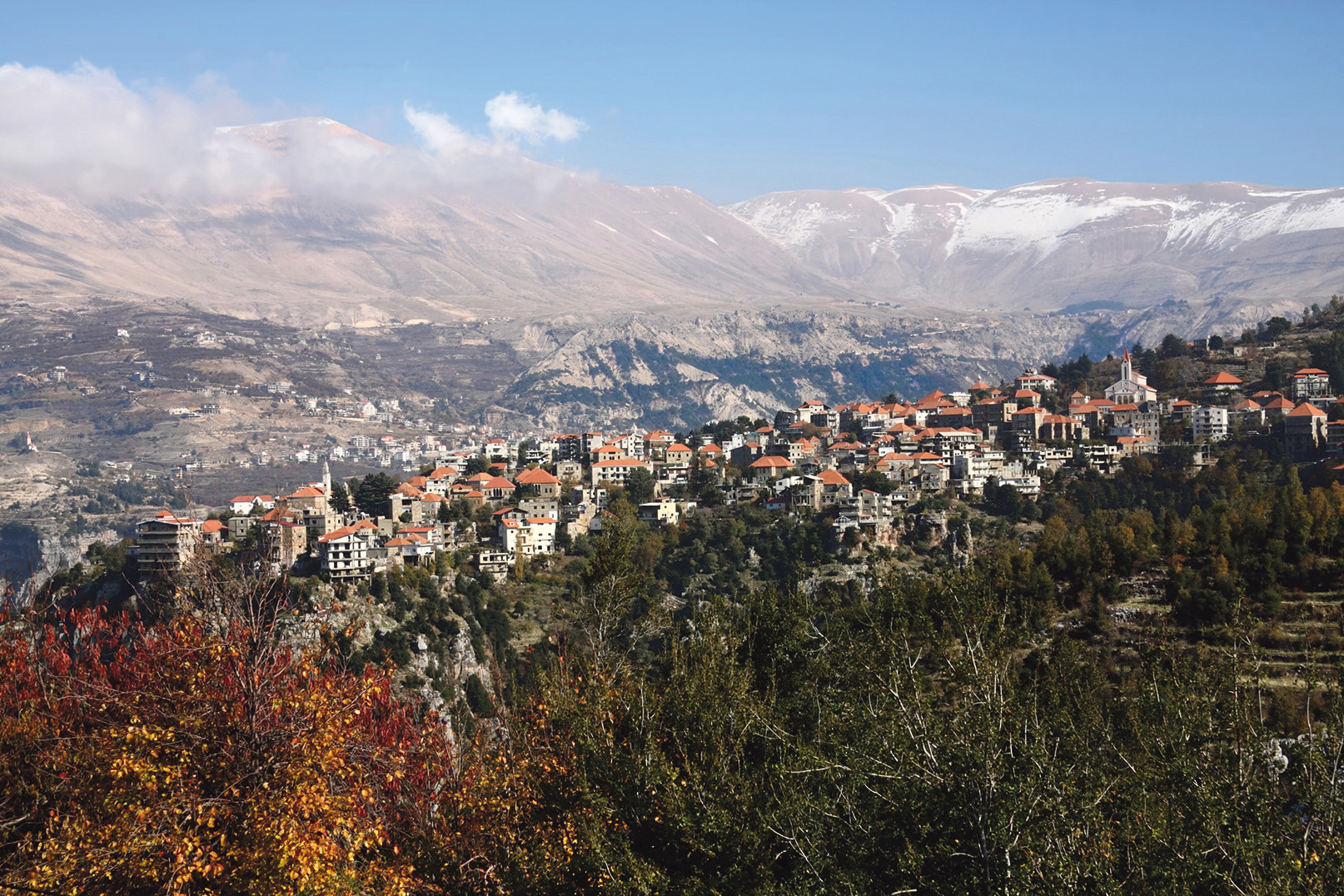
Moshe Rabbenu and Joshua both mention Lebanon when talking about Eretz Israel and its boundaries (Devarim 1:7; 3:25; Joshua 1:4). A key verse is Devarim 11:24, which states, “Every place where you set your foot will be yours: Your territory will extend from the desert to Lebanon, and from the Euphrates River to the Mediterranean Sea.”
The cedar tree of Lebanon, featured on its modern flag, was prized in antiquity because of its high-quality, fragrant timber. King Solomon used cedar wood from Lebanon in the construction of the Beit Hamikdash, as well as in the building of his palace, which was called “the Palace of the Forest of Lebanon” (1 Kings 5:5–6; 7:1–3). Hiram, king of Tyre, had his workers cut the trees, haul the logs to the sea, and float them to a place where Solomon’s men could collect them (1 Kings 5:8–9).
Jews have been present in Lebanon since ancient times. In the Talmudic period various amoraim (talmudic sages), are recorded as having travelled from Eretz Israel to Tyre, where they answered halachic questions. Through the medieval ages, Jews throughout the region often faced persecution: in Lebanon their numbers had dwindled during the Muslim era.
But numbers varied over the centuries as conditions changed. To give but one example, during the early Islamic period, Tyre was home to a substantial Jewish population (estimated at around 4000 prior to the Arab conquest). Then in the 11th century, Tyre’s economic and Jewish communal significance grew, particularly with the temporary relocation of the yeshivah of Eretz Israel to the city between roughly 1077 and 1093. Tyre remained a Jewish centre even during the Crusader period, with Benjamin of Tudela reporting 400–500 Jewish households, a number of synagogues, and a scholarly community. The Jewish presence largely ended with the Mamluk conquest in 1291.
During the Ottoman period, Jews (and the populace generally) tended to live in villages rather than the few larger centres even as they were experiencing signs of urban growth. Deir al-Qamar in the mountains south of Beirut hosted a Jewish community documented by 18th century travellers. The community is also cited in 18th century Responsa literature, indicating it had communal institutions such as a beth din. In the mid 19th century Rabbi Joseph Schwartz who a century later famously visited and documented the geography of the Holy Land and its surrounds estimated the community at 80 householders mostly engaged in trade, also leasing lands for iron production and owning vineyards and olive plantations. Following the 1837 Tzfat earthquake, the Jews of Deir al-Qamar aided the Jews of Tzfat. In 1847, they faced a blood libel incident. The community’s demise came during the 1860 civil conflict in Mount Lebanon, leading to their displacement.
From the beginning of the 19th century, Jews from Italy, Greece, Syria, Iraq, Turkey, Egypt and Iran moved to Beirut, expanding the community there in a city that had become a Mediterranean trade hub From a few hundred at the beginning of the 19th century the Jewish community of Beirut grew to 2500 by 1900 and to 3500 by World War I.
Significant change followed the end of Ottoman domination of the Middle East. Lebanon fell into the French sphere of interest which still has implications today despite its independence. After World War I, the French mandate rulers adopted local political traditions of power-sharing and recognised the autonomy of the various religious communities. The Jewish community was one of Lebanon’s 16 communities and enjoyed a large measure of autonomy, more or less along the lines of the Ottoman millet system also followed by the British in Mandatory Palestine. Thus the 1926 Constitution of Lebanon guaranteed the freedom of religion and provided each religious community, including the Jewish community, the right to manage its own civil matters, including education, and thus the Jewish community was constitutionally protected,. The community founded two major institutions: the Maghen Abraham Synagogue (1926), and the renewed Talmud-Torah Selim Tarrab community school (1927). The community also maintained welfare services like the Biqur-Holim, Ozer-Dalim, and Mattan-Basseter societies.
The Maccabi organisation was recognised officially by Lebanese authorities and was an active centre for Jewish cultural affairs in Beirut and Saida. Its school taught Hebrew language and Jewish history, and was the focus point of the small Zionist movement in the country. There was also a pro-Zionist element within the Maronite community in Lebanon.
Prior to 1948, the Jews in Lebanon had good contacts with those in Palestine, and there were regular visits between Beirut and Jerusalem. However after the 1929 riots in Jerusalem, the Grand Mufti of Jerusalem was expelled from Palestine and he chose to settle in Lebanon, where he continued to mobilise resistance against Zionist claims to Palestine.
Whilst Jewish life in Beirut was generally secure, in November 1945, 14 Jews were killed in anti-Jewish riots in Tripoli. Further anti-Jewish events occurred following the 1948 Arab–Israeli War. The ongoing insecurity combined with the greater opportunities that Beirut offered prompted most of the remaining Jews of Tripoli to relocate to Beirut.
Despite these events, Lebanon was the only regional country whose Jewish population increased after the declaration of the State of Israel in 1948, reaching around 10,000 people.
Nevertheless, after 1948, the security of Jews remained fragile, and the main synagogue in Beirut was bombed in the early 1950s. The Suez crisis did not impact negatively in Lebanon. However after the Lebanon Crisis of 1958, (due to rising sectarian tensions between Christians and Muslims/Druze which even led to American military intervention), many Lebanese Jews left the country, especially for Israel, France, United States, Canada and especially Brazil. Again, in the wake of the 1967 Six-Day War, there was further mass emigration of around 6000 Lebanese Jews to Israel and Western countries. The Jewish population of Beirut, which stood at 9000 in 1948, dwindled to 2500 by 1969.
The Lebanese Civil War, which started in 1975, seriously impacted the already reduced Jewish community, and some 200 were killed in ensuing anti-Jewish pogroms. Most of the 1800 still remaining migrated in 1976, fearing that the growing Syrian presence in Lebanon would restrict their freedom to emigrate. The last rabbi remaining in Lebanon left the country in 1977.
The final exodus of Lebanese Jews commenced in August 1982, when Israeli forces invaded Lebanon and laid siege to Beirut. Over 100 Jewish families were displaced after Israeli forces bombarded the Jewish quarter, leaving it nearly abandoned, and shelled its synagogue which suffered extensive damage. Eleven leaders of the Jewish community were captured and killed by Islamic extremists. The community buildings also suffered during those days. Surprisingly, during the Israeli army’s advance toward Beirut, Yasser Arafat assigned Palestinian gunmen to stand guard at the Maghen Abraham Synagogue, an important symbol of the community, located near Parliament. (Presumably he wanted to show he was not anti-Jewish as long as Jews were not in Israel.) But the synagogue was bombarded by the Israeli Air Force, perhaps on the presumption that it was being used as a weapons depot by Palestinians. War induced emigration further reduced the number of Jews in the country.
By 2005, Almost all Lebanese Jews had fled the country. There were only around 40 Jews left in Beirut, most of them elderly.
In 2010, work began to restore the old Maghen Abraham Synagogue in Beirut that had fallen into disrepair several years earlier. Solidere, a Lebanese company in charge of planning and redeveloping Beirut’s central district, agreed to provide funds for the renovation because political officials believed it would portray Lebanon as an open society tolerant of Judaism. The decision received acclaim from both the Sunni and Shi’ite Muslims. Apparently Hezbollah leader Hassan Nasrallah publicly welcomed the authority’s decision to restore the synagogue!
In 2020, there were only about 29 Jews in Lebanon. The above mentioned project aside, most signs of Jewish life in Lebanon had fallen into disuse by 2022, with synagogues deserted, Magen Davids removed, Jewish cemeteries abandoned. A sad end to millennia of life.
To end this piece based on historical sources I append a personal note. No, unlike many of my contemporaries who served in Tzahal and others including relations and acquaintances sadly still required to do so, I have not been to Lebanon. But while on vacation from yeshivah in 1966 together with a friend I hiked the length of the Lebanese border eastwards from Hanikra and then northwards to Kiryat Shemonah and Metulla. Unlike what I was to experience when I again visited the border under army protection after October 7 when so much of the north had come under fire and was evacuated, it was scenically beautiful and absolutely peaceful. In fact from 1976 to 2000 the border known as the “good fence” served to allow crossing of Lebanese citizens into Israel for work and medical treatment
May such soon be the situation again as peace reigns again to the benefit of Israel as well as our neighbours.
Shabbat shalom,
Yossi
Yossi Aron OAM is The AJN’s religious affairs editor.
comments