



Levin admits bill ‘danger to democracy’
The architect of the government's judicial overhaul plans has conceded that a key piece of his legislation would have led to a situation unacceptable in a democratic country.
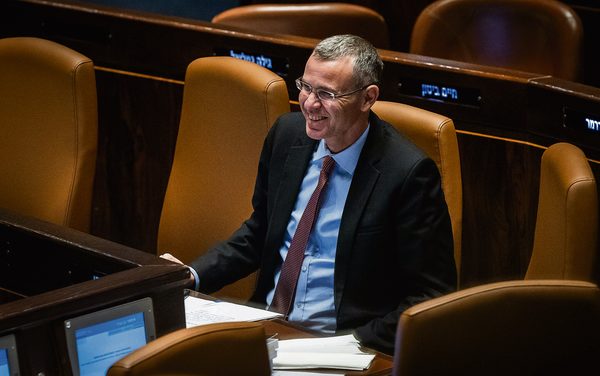
Israeli Justice Minister Yariv Levin, the architect of the government’s judicial overhaul plans, has conceded that a key piece of his legislation would have led to a situation unacceptable in a democratic country, in which the coalition would exercise control over all three branches of government.
In an interview with Channel 14 two weeks ago that circulated online on Monday, Levin said that while many arguments against his proposals were baseless, he accepted criticism against the original judicial appointments bill, which would have handed the coalition an automatic majority on the panel that chooses judges: that such a change would “lead to a situation in which all three branches of government become one branch”.
“This claim, that [the blurring of branches] could ultimately lead to a constitutional crisis, is a claim that can’t be ignored – this cannot happen in a democratic country,” Levin said.
Prime Minister Benjamin Netanyahu halted the judicial overhaul process last week in order to allow for talks on a compromise, hours before the key judicial appointments bill was set to become law.
Levin’s interview snippet was picked up by the Haaretz daily and Ynet journalist Attila Somfalvi on Monday, who charged that the Justice Minister blatantly admitted that his legislation was anti-
democratic.
But Levin also claimed the government responded to the fears by softening the proposal. The ostensibly softened legislation, which now awaits its second and final Knesset readings, gives the coalition full control over the first two Supreme Court justices appointed in each Knesset term – while a third and fourth would require broader agreement – and near-complete control of appointments of other judges.
The average number of Supreme Court justices appointed in a Knesset term is 2.6, meaning that a coalition can still steadily determine the character of the court. Moreover, the legislation allows the coalition to appoint the Supreme Court president, giving it another potential vote in the selection committee and potential control of Supreme Court panels.
Levin had refused to pause the legislation and was reportedly adamantly opposed to efforts to soften it, reportedly threatening to quit the coalition if Netanyahu were to do so.
In the Channel 14 interview, Levin insisted that the overhaul was “good for all citizens of Israel”.
“It will create a Supreme Court that will give everyone a voice and everyone a place, with judges from every colour of the rainbow,” he said.
Shas leader Aryeh Deri said in comments published on Monday that the government would have broken apart had it tried to push through the legislation as planned. But he warned that if negotiations for a broadly agreed-upon reform fail, the government will pass its bills unilaterally.
Deri acknowledged that the coalition had made mistakes in trying to ram its changes to the justice system through parliament.
“I also have criticism for myself and we have some soul-searching to do. We did not act correctly, unequivocally,” Deri said.
“We did not prepare proper explanations, without a strategy how to pass the reforms, how to explain to the public what exactly the reform says and how it would solve problems,” Deri said. “We made a mistake by presenting the whole package together, when everybody knows that you can’t pass it in one go as it takes a long time to legislate these things, section by section.”
Deri has reportedly also become increasingly disillusioned with the functioning of the coalition, particularly far-right ministers Itamar Ben Gvir and Bezalel Smotrich, and has been working behind the scenes to keep moderate voices like suspended defence minister Yoav Gallant in the government.
Meanwhile, senior officials involved in the negotiations aimed at reaching a compromise over the contentious judicial overhaul legislation said on Friday that talks are already dead in the water.
President Isaac Herzog began hosting the talks last week after Netanyahu agreed to temporarily halt the government’s push.
During the early negotiations, the coalition has insisted that it end up with control of the Judicial Selection Committee, a non-starter for the opposition, essentially ending the chances for the negotiations before the talks got off the ground, officials involved in the process told Channel 12.
The makeup of the Judicial Selection Committee – which currently divides power between politicians and justices to decide on new judicial appointments, including to the Supreme Court – is one of the most contentious parts of the overhaul.
Hundreds of thousands of people continued to demonstrate against the judicial overhaul throughout the country on Saturday.
Media reports indicated at least 170,000 people demonstrated in Tel Aviv, while tens of thousands more rallied in numerous cities across the country. Protest organisers claimed over 400,000 demonstrated nationwide.
“We will keep heading to the streets until we are promised the State of Israel will remain a democracy,” organisers said.
TIMES OF ISRAEL
comments