



Lost at Fromelles
CHANTAL ABITBOL
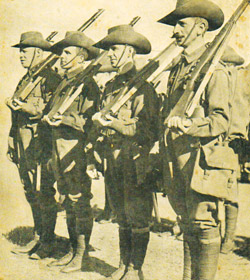
IN a frayed, 1915 promotional “Season’s Greetings” postcard distributed by the Australian Army, World War I Jewish digger Lionel Levy is pictured standing at attention in full army regalia.
The 28-year-old is looking straight ahead, his rifle slung over his left shoulder, fresh-faced and eager, with a hint of a grin creeping across his face.
“Off to the Front!” reads the message on the postcard. “Don’t forget they’re fighting for us!”
But Private Levy, of the 53rd Battalion, never returned. Just a few short months after his family received the post, the former taxidriver from Redfern, who had volunteered to join the Western Front just a year earlier, was killed in the infamous Battle of Fromelles in 1916.
For nearly a century, he has been missing in action and, until recently, it seemed his final whereabouts would remain forever unknown. But that could soon change.
A project is underway to re-inter the remains of 250 Australian World War I soldiers, discovered in a mass grave in an empty field at Pheasant Wood in France, just outside Fromelles, last year.
In September, a team of archaeologists completed the task of recovery. Now the painstaking process of identifying the remains has begun. The project group is currently poring over medical and historical records, along with more than 6000 artefacts recovered — including boots, train tickets and prayer books — to match remains to the diggers’ identities.
Relatives of missing soldiers are also being sought to provide DNA samples to help with the effort.
“We have a huge task at hand,” said Major General Mike O’Brien, senior army representative for the Australian Fromelles Project Group. “We don’t want to get it wrong and jump to any conclusions.”
Often described as “the bloodiest 24 hours in Australia’s history”, the Battle of Fromelles is the military’s biggest single loss of life to date. Overnight, from July 19-20, 1916, it resulted in 5553 Australian casualties, including almost 2000 dead.
Based on detailed analysis of records and eyewitness accounts, the army has compiled a list of 191 Australian soldiers it believes may be buried at the site, but it’s not conclusive, stressed O’Brien. “In Australia, there were over 1300 soldiers who died in the battle with no known grave. You can’t exclude anyone.”
Earlier this year, Peter Allen, a distant relative of Levy, heard about the project and started to do his own research. Decades earlier, his late mother had talked about a second cousin who died in France during World War I. But little else was known.
Going on a hunch, the Sydney resident tracked down Levy’s service records on a national archives website, which confirmed Allen’s suspicions that he had died at Fromelles. His search also led him to discover a few other token relics remaining from the digger’s past: the postcard, a weathered newspaper clipping and letters from Levy’s family pleading with authorities for more information on his final resting place.
“I was motivated by curiosity, pride and immense gratitude, and I felt I’d better act now,” he explained. “For me, it’s symbolic of the fact that Jews have played their role in helping Australia be what it is now.”
However, by this stage it had also become a personal mission. “It is sad reading the heart-wrenching letters from Lionel’s wife and mother. For their sake, I’d like to have closure.”
It was never going to be an easy task. With Levy not among those on the army’s working list, Allen realised that in order to yield any meaningful results, he would somehow have to locate a living relative closer up on the family tree to Levy who was willing to provide a DNA sample.
After scouring family records, Allen traced back the lines, finally honing his sights on Aubrey Levy, another distant relative on his mother’s side, who was also Lionel Levy’s second cousin.
But time was running out. In early October, the 95-year-old was living in a Penrith nursing home, battling prostate cancer. Allen rushed to the man’s side.
Aubrey, a former digger and World War II veteran, readily agreed to give his DNA, but it took weeks for a sample kit from the army to arrive.
With his health ailing, Aubrey and his daughter took matters into their own hands and convinced the home’s nurses to take their own swab sample. Twenty minutes later, Aubrey died — coincidentally on November 11, Remembrance Day.
Around the same time Allen started up his search, military historian Ben Hirsh was also carrying out his own research on Fromelles from Melbourne.
Inspired by the discovery of the gravesite last May, he became curious about the number of missing Jewish diggers whose remains could possibly be among those unearthed.
He began sifting through a list of 1500 Jewish servicemen who had died in World War I, checking dates and cross-referencing his findings with other military records.
In the end, he came up with his own list, surmising that at least 11 Jewish diggers died at the battle — 10 of whom had no known grave.
“There may be others,” said Hirsh, president of the Victorian Association of Jewish Ex-Servicemen and Women. “I’m not discounting that, but I would certainly hope there are no more.”
Among those mentioned on the project’s working list is Lieutenant Barrol Mendelsohn, a former clerk from Mosman in Sydney, who enlisted at the age of 24 and served in Gallipoli before heading to the Western Front in 1916.
According to military records, he was hit by a shell during the advance near the German trenches on July 20 and died instantly. His body was never recovered. One eyewitness observed: “He did not seem to suffer. He was a game man all right.”
The other is Private Sydney Hyams, from Sydney’s Paddington, who joined the 31st Battalion. He was reportedly killed in action at the tender age of 19. The Red Cross noted that he was last seen 400 yards over the German trenches.
Hirsh said he hasn’t been able to track down relatives of either digger. But he won’t stop trying, and is appealing to the Jewish community for help.
“They deserve a Jewish burial after all these years. Unless someone comes forward and volunteers information, you don’t know where to start.”
Whether or not any of the Jewish diggers are identified, Hirsh is committed to organising a Jewish memorial at the site.
“The Jewish community contributed [to the efforts] in WWI in a greater percentage than the general community, and a lot of [people] aren’t aware of it. We have to keep reminding them because this is an important part of our history.”
For Allen and Levy’s other descendants, the wait for closure continues.
The Fromelles project is currently collating its data, which will be analysed by a team of experts in January. Their findings will later be presented before a joint-identification board in March for a final ruling.
Those positively identified will then finally be laid to rest in marked graves, which will be unveiled in a commemorative ceremony at Fromelles on July 19.
Allen said he remains hopeful that Levy will be among them and receive a proper Jewish burial.
“It is distressing to think how so many young men were buried in mass graves, unidentified. I’d like future generations to appreciate the ideals that these young men died for, and understand how they are still relevant today.”
To find out more on the Fromelles project, go to www.army.gov.au/fromelles.
comments