



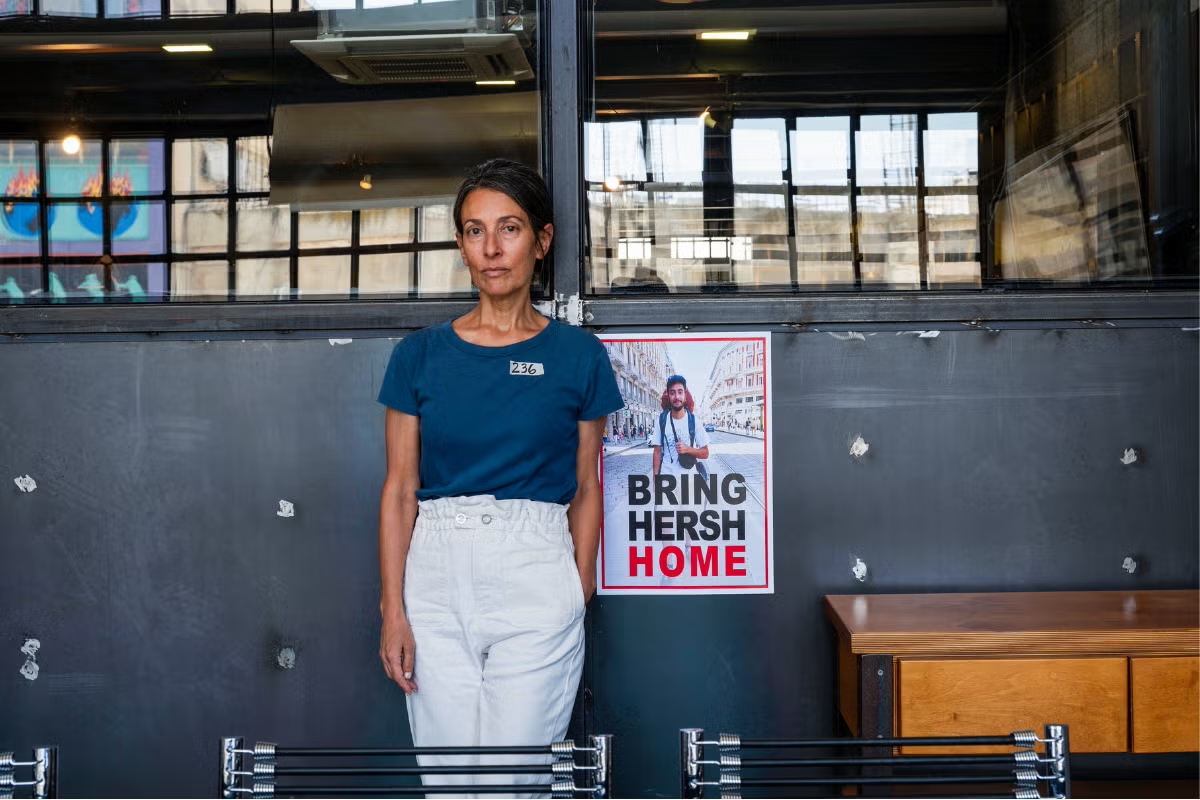
For many in the Melbourne Jewish community, the name Rachel Goldberg-Polin carries a familiarity that feels deeply personal, predating the global headlines of the past two and a half years. Long before she became ‘The Voice of the Mothers’ on the world stage, Goldberg-Polin was a student at Melbourne University.
And according to Goldberg-Polin, she was adopted wholeheartedly by the Caulfield community during a formative year abroad. It was here, among Melbourne’s Holocaust survivors, that she first observed the quiet, fierce discipline of moving forward after unimaginable horror. It’s a lesson she would find herself forced to practice decades later.
Now, Goldberg-Polin shares that journey in her new book, When We See You Again. Rather than being a standard memoir, the book is a searing chronicle of love, loss, and the “ever-after”.
“I think that really what perhaps this book is is it’s a love letter that’s doused in pain or it might be a pain letter that’s saturated in love…”
Before the world knew her son, Hersh Goldberg-Polin, as a face on a poster, he was a 23-year-old “wide-eyed idealist” living in Jerusalem. Born in Berkeley, California, Goldberg-Polin describes him as a “voracious reader” who loved music festivals and was a devoted fan of the Hapoel Jerusalem soccer team. He decorated his room with a banner reading “Jerusalem is everyone’s” and was deeply committed to social justice.
Hersh was vegetarian, left-handed, and possessed a “magnetic” personality. He had been meticulously planning a two-year journey across the globe since the first grade. The trip was supposed to begin with a flight to India on December 27, 2023. In the book, Rachel reconstructs him in full, sharing intimate details from the shape of his “kidney bean” nostrils to his “cookies” eyes and floppy brown hair. She chose not to include a photo insert of Hersh, wanting her words alone to rebuild his essence so he wouldn’t be reduced to a statistic.
Speaking to Katie Couric, Rachel explained why she views the book as more than just a history of her family.
“I think that really what perhaps this book is is it’s a love letter that’s doused in pain or it might be a pain letter that’s saturated in love,” she said.
Rachel’s writing captures the warm life they led before the storm. A life of Friday night walks to synagogue and the mundane joys of parenting. But as she told Jessica Steinberg for the What Matters Now podcast, the writing was a reflexive attempt to shoulder a soul “buckling from the pain”,
“This book is me parceling out my pain because I just didn’t know how to keep it in this backpack that is always on my back,” she described.

Goldberg-Polin’s life changed at 8:11am on October 7, 2023, when Hersh sent two WhatsApp texts: “I love you” and “I’m sorry”.
He was abducted from a cramped roadside bomb shelter near the Supernova festival. In that shelter, his dominant left arm was blown off by a grenade as his best friend, Aner Shapiro, heroically threw back at least seven unexploded grenades to save those inside before being killed.
For 330 days, Goldberg-Polin and her husband, Jon Polin, became global faces of hope. They met with the Pope, the UN, and the US President, all while Goldberg-Polin wore masking tape marked with the number of days since her son’s disappearance. She is blunt about the writing process for this period, calling it “elegant vomit”, and describing it as a desperate, reflexive discharge of trauma.
In her interview with Jewish Insider, Rachel noted that the book acts as an answer to the questions people frequently ask her.
“It’s like little Tupperware of pieces of a life that was, and then figuring out a life that is, and how do you do this? How do we do this, breathing in a world where we no longer have air?”
In their interview with The AJN last year, the Goldberg-Polins reflected on the importance of telling the “un-sanitised” truth about the state in which Hersh’s body was recovered from a tunnel in Rafah in August 2024, alongside five other hostages known as the “Beautiful Six”.
Goldberg-Polin was clear that the world needs to understand the brutality they endured.
“When Eden was found she weighed 36kg, Hersh was 53kg and Alex lost a third of his body weight,” she said. “These people were skeletal, and the only difference is that Hersh and the other beautiful five he was with were filthy from not bathing at all for months preceding their deaths and they were all multi-bullet ridden.”
Polin added that the “surprise” expressed by politicians was unacceptable.
“They don’t have the right to be surprised, because 161 days earlier, six bodies were found and taken out, and those bodies were in the same or worse condition as these hostages who came out. Our upper echelons in Israel and around the world were exposed to those details, so nobody has the right to act surprised.”
Rachel described the lasting impact of this trauma during her UIA Gala appearance.
“We have all been hit by a truck that is still on us. Often that truck hits you and drives off, but with October 7, that truck has hit us and remains there.”
Central to the narrative is the philosophy that Hersh shared with his fellow captives in the tunnels. Many who met him recall hearing him tell them that “he who has a why can bear any how”.
Borrowed from Holocaust survivor Viktor Frankl’s Man’s Search for Meaning, this mantra became a survival tool for the hostages. After his release, freed hostage Or Levy met with the Goldberg-Polins and shared a detail that provided a rare moment of comfort. Hersh had heard Rachel’s voice on a radio broadcast while he was in the tunnels.
Rachel admits she is still searching for her family’s new “why,” describing herself now to Jessica Steinberg as a “tragic optimist”:
“I am optimistic and I’m also really tragic and I think there’s no shame in it. The tragedy is so defining and I allow it to define me. I think that to deny who I am right now would do more damage.”
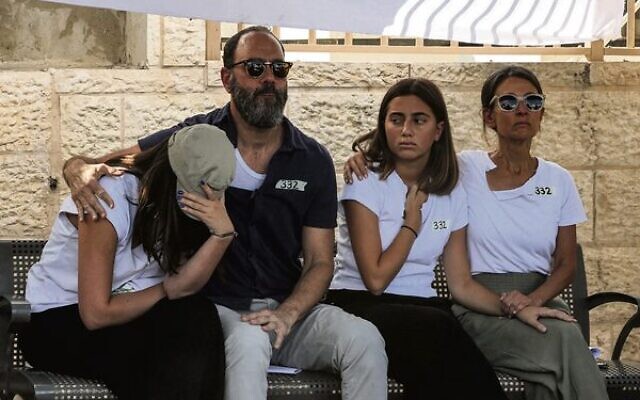
Despite everything they have endured, Polin remains steadfast in his mission to show their daughters, Orly and Leebie, that they are a “strong and resilient” family. In his interview with The AJN, Jon shared his belief that Hersh’s essence remains a guiding force for them.
 “We knew Hersh pretty well and Hersh was somebody who embraced life, celebrated life, infused goodness and fun into situations. We both have no doubt that Hersh is sitting above us, saying it’s okay to grieve me for a little bit, but don’t let this situation hold you back. You need to live,” he said.
Ultimately, When We See You Again is one way the Goldberg-Polin refuses to let Hersh be reduced to a mere symbol or a statistic. The book’s weight lies heavily in its final sections, which chronicle Rachel’s journey as a bereaved mother navigating a world she now shares with those she calls “The Broken”. It is not a standard tell-all but, as Rachel describes it, it’s desperate attempt to figure out how to breathe in a world that seemingly no longer has air.
Drawing on sources as varied as the Talmud, Elisabeth Kübler-Ross, and Viktor Frankl, Rachel seeks to map out a path through the type of crushing grief that no one ever truly emerges from.
It’s a testament to Goldberg-Polin’s belief that “words are redemptive” and that, even in a world where her family can no longer find air, hope remains mandatory.
When We See You Again is published by Hachette Australia, available from May 5, $34.99 rrp
comments