



Marion Wiesel’s incredible legacy
'Marion pored over every sentence of Elie's work with astonishing insight into his interior world, his literary mind.'
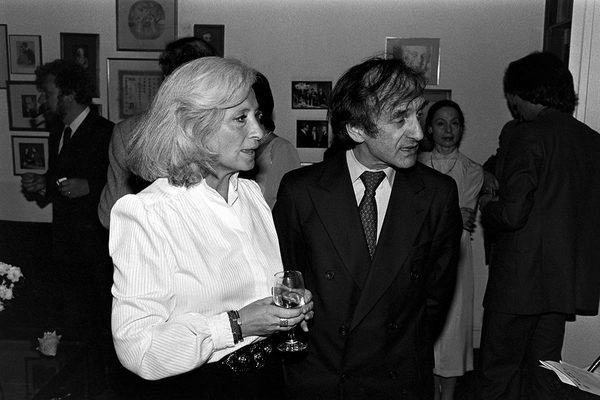
(Kveller) – Marion Wiesel could have ended up in Auschwitz, just like her husband, author Elie Wiesel.
Instead, the translator and activist, who passed away last week at age 94, and her family managed to escape the French concentration camp they were in – the Gurs internment camp – before the Jews were deported to Eastern Europe, the majority of them perishing in the Nazi death camp.
Marion was born Mary Renate Erster in Vienna in 1931, the daughter of a Jewish furniture salesman. After the Anschluss, her father, who was also a social democrat, couldn’t stay in the country and escaped with her older sister to Belgium. Mary and her mother soon followed. It was there she reclaimed her name as Marion. The family kept running all through the war, and finally ended up in Switzerland. In 1949, they made their way to the US, where Marion tried to build a life for herself, attending college, finding a job and getting married to her first husband F. Peter Rose and had a daughter, Jennifer.
When she met Elie, that first marriage had disintegrated.
Aside from their tales of survival, the two had so much in common: a love of languages, books and social justice. The two married in Israel in 1969, and welcomed their son, Shlomo Elisha – named after Wiesel’s father who perished in the Holocaust – in 1972.
Marion was instrumental in creating Elie’s legacy, translating 14 of his books, and making Night a bestseller with her English translation. Of the 10 million copies of the book sold worldwide, three million were of her translation.
“As his translator from the French,” their editor, Ileene Smith, told The New York Times, “Marion pored over every sentence of Elie’s work with astonishing insight into his interior world, his literary mind.”
She was instrumental in shaping Wiesel’s iconic speech, asking president [Ronald] Reagan not to visit the Bitburg Cemetery where SS soldiers were buried. “That place, Mr President, is not your place,” he decried. “Your place is with victims of the SS.”
Marion also found ways to keep the memory of the Holocaust alive outside of her husband’s work. She edited a collection of Roman Vishniac’s photography about Jewish life before World War II in Eastern Europe, titled To Give Them Light, and wrote and directed a documentary about children killed during the Holocaust, Children of the Night.
In 2001, Marion was awarded a Presidential Citizens Medal by president Bill Clinton for her “mission of hope against hate, of life against death, of good over evil”. Clinton said that despite the horrors she survived, she “summoned the courage to commit her life to teaching others, especially children, about the human cost of hatred, intolerance and racism”.
“The curtain descends on a story, and lead character, for the ages,” Elisha Wiesel wrote of his mother on X.
comments