



Mission to stop the Shoah
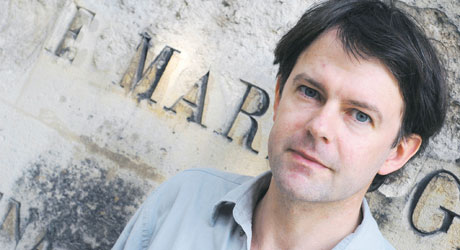
FRENCH author Yannick Haenel’s controversial book on the life of Jan Karski, a Polish World War II resistance fighter who undertook to persuade the governments of the United States and Britain to act against the Nazi genocide of the Jews, is an intriguing blend of fact and fiction.
Titled The Messenger, it has just been released by Text Publishing to coincide with his current Australian visit.
The book is divided into three parts, beginning with Karski’s personal account of the mission relayed to acclaimed Jewish filmmaker Claude Lanzmann in his 1984 movie Shoah. Karski agreed to the on-camera interview 35 years after the event, when Lanzmann discovered that he was still alive and persuaded him to talk. Karski died in 2000.
The second part of the novel describes Karski’s life based on his own book, Story of a Secret State, published in the United States in 1944, where he tells his story, including how he joined the Polish underground after escaping from a Soviet detention camp in 1939.
Karski served as a courier, ferrying messages between occupied Poland and exiled Polish leaders, until he was captured by the Nazis. Escaping from the Germans, Karski was smuggled into the Warsaw Ghetto to witness the horrors there firsthand, and then sent on an important mission to meet with US President Franklin D Roosevelt and other allied leaders in Washington. He reportedly warned them of the planned mass extermination of European Jewry, but received an indifferent reception.
The final chapter of the book is a fictional account in which Haenel presents Karski’s life after the end of the war and reflects on the vital meeting with Roosevelt.
It is this chapter that has provoked criticism and debate in the French media, including strong attacks by Lanzmann, who says the conclusions have no connection to historical reality.
“My objection to Haenel’s book stems from the fact that, in the third chapter, he made up scenes that did not really happen,” Lanzmann is reported to have said.
Haenel, who moved from Paris to Florence last month with his wife Barbara Puggelli and seven-month old baby Lucia, defends his approach to writing the book, which has been published in French, Italian, Spanish and German.
“The third chapter is about the silence,” he explains by phone from Italy, before heading to Australia.
“When I had to write it, I realised that there are no documents because it is impossible to document silence, so fiction was the solution.
“I know that there is a danger to make fiction with a real character, and for the story of Jan Karski it was a challenge.”
Haenel maintains it was necessary to write The Messenger in this way.
“The first and second chapters are historical fact, but the third is a novel. It is stated on the cover that it is a novel!
“For the reader, after reading the first two chapters, he knows everything we know about Jan Karski, so the third chapter is fiction and although it is full of ambiguity, it is a powerful fiction.”
Haenel says Karski’s meeting with President Roosevelt was a pivotal moment in his life. “Nobody knows exactly what happened between Jan Karski and President Roosevelt; there were several versions of this meeting,” he says.
“I imagine that this meeting was terrible for Jan Karski, because he really thought that he could save European Jewry. I can’t prove this story; nobody can prove this story.
“I know that this way of writing a story is not scientific, but I am a writer and we have to think about finding new forms of telling the memory of the Holocaust.”
Haenel says it is important to continue telling the story of the Holocaust because those who experienced it will soon no longer be with us. “As survivors are dying, how do we continue to tell their stories? Even if it is a little dangerous, I think that fiction is a possibility. When there is nobody, we have to imagine it – imagination is a form of language and knowledge,” he says.
“Perhaps it is the only way for literature to continue their memory. I am a young writer searching for another way to write for today and tomorrow, and I don’t know if my book is a solution. Maybe it is a prototype to answer the questions of how to write and think after the survivors have died.”
The original book, published in France in 2009, was titled Jan Karski and won several literary prizes. The English version, titled The Messenger, has a special introduction by Mark Baker, director of Monash University’s Australian Centre for Jewish Civilisation and Associate Professor of Holocaust and Genocide Studies at the university.
Haenel plans to continue writing on a full-time basis.
“I used to work as a teacher until about six years ago, but now I am concentrating full-time on writing.”
Yannick Haenel’s The Messenger is published by Text Publishing. $32.95 (RRP).
REPORT: DANNY GOCS
PHOTO: Author Yannick Haenel. Photo: Catherine Helie
comments