



Mizrachi movement reaches milestone
For the Mizrachi World Movement the Jewish blessing ‘to 120’ has been achieved, but in this case it is a beginning, not an end.
The current year 5782 sees celebration of the 120th anniversary of the Mizrachi World Movement founded by Rabbi Yitzchak Yaakov Reines in 1902 and now a dominant force in religious Zionism worldwide, including Australia
Rabbi Reines came from a background steeped in difficulty and tragedy, and at the same time, enveloped in hope and optimism. His father, Rabbi Shlomo Naftali Reines, was one of the followers of the Vilna Gaon who moved from Lithuania to Eretz Yisrael in 1809 motivated by a mystical conviction that mandated living in the Holy Land in anticipation of messianic redemption. They settled in Tzfat.
However in 1834, local Arabs initiated a vicious pogrom against the Jews of Tzfat leaving many destitute. At the request of communal leaders, Rabbi Shlomo Naftali travelled to Russia and Poland to raise funds for the Tzfat community.
Tragically, while in Warsaw his entire family – his wife and seven children – became victims of the January 1, 1837 earthquake that devastated Tzfat. Rabbi Reines remained in Europe and settled in the city of Pinsk-Karlin. The following year he remarried, and in 1839 had a son, Yitzchak Yaakov.
Yitzchak Yaakov Reines studied in various Lithuanian yeshivot including the famed Volozhin yeshiva where he attained semichah. From 1867 he served as rabbi in various Lithuanian communities, but was well aware of the need for communal change.
In 1884, he opened a yeshivah of his own where he introduced a groundbreaking integrated curriculum which included Tanach, Talmud, Halacha and general studies – all aimed at training rabbis who would be firmly rooted in tradition while also able to operate amongst assimilating Russian-Jewish communities.
By 1890 Rabbi Reines had become involved with the Chovevei Tzion movement. But as secular Zionism began to develop, many rabbis who had supported Chovevei Tzion became horrified by the prospect of an irreligious Jewish state and openly criticised Zionism and its secular leadership.
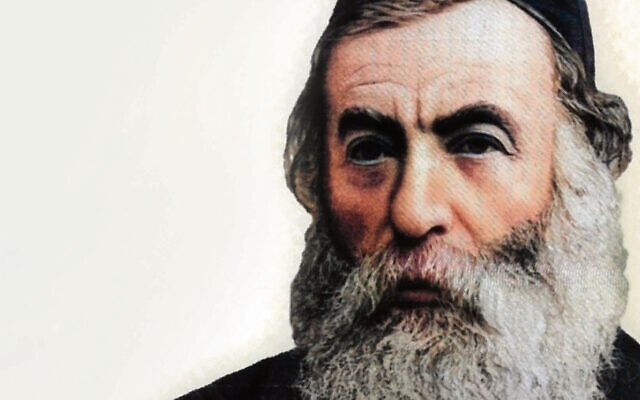
Initially, despite his deep interest in the nascent Zionist movement, Rabbi Reines remained neutral. But in 1899, he decided that the issue of Jewish hegemony over Eretz Yisrael was too important to be set aside for any other considerations. He formally joined the World Zionist Organisation and as a delegate attended the Third Zionist Congress in Basel. Overwhelmed by the experience, he became a devoted proponent of the Zionist cause.
He later wrote that after returning home, some of his anti-Zionist colleagues tried to persuade him to leave the Zionist movement. But firmly believing that Zionism was the only way forward for Torah-observant Jews, he was determined to lead an Orthodox group within the Zionist movement that would become a beacon of Religious Zionism.
At the fifth Zionist Congress in 1901 followers of Achad Ha’am’s philosophy of cultural Zionism successfully sought to introduce secular cultural values into the movement’s mission. The religious faction within the movement was now faced with a painful dilemma. As long as Zionism focused on material and practical goals such as political activism and support of the settlement enterprise, Rabbi Reines and those with a similar outlook believed that all Zionists could be united.
But now they worried that the critics of Zionism might be correct. How could they remain committed to a Zionist movement that was explicitly committed to secularism?
Some did indeed leave, even helping to found Agudat Yisrael. But Rabbi Reines and others sought to stay in the movement without compromising their values and religious authenticity. To achieve this, they created their own distinct faction within the Zionist movement. On 25 Adar I 5662 (March 4, 1902) Rabbi Reines and 70 colleagues founded the Mizrachi Movement.
Mizrachi is an acronym for “merkaz ruchani”, a “spiritual centre” and its mission was to synthesise modern Zionism with Judaism’s age-old spiritual mission. A Religious Zionist revolution had begun.
The outcome? Alongside the socialist pioneers of HaShomer HaTza’ir, HaPoel HaMizrachi pioneers settled the land, building religious yishuvim and communities. As the new Yishuv developed, Mizrachi built a religious education system, providing a Torah education for tens of thousands of children on the eve of the Declaration of the State.
And following the establishment of Israel, Mizrachi, through Knesset representation as the National Religious Party, fought to ensure that Israel would be not only a State for the Jews, but also a Jewish state in which Shabbat observance and kashrut would be recognised and honoured, if not yet observed by all.
Another rabbi involved in Mizrachi from its outset was Rabbi Yehuda Leib Maimon (Fishman). In 1947, when a United Nations Special Committee on Palestine (UNSCOP) delegation was to prepare a report that would play a critical role in determining United Nations support for the founding of a Jewish State, David Ben-Gurion asked Rabbi Maimon to speak to the committee about the religious foundation of Zionism. His speech is a powerful summary of the Mizrachi worldview: “There is an insoluble bond between the people of Israel and its Torah, and there is similarly a strong and enduring tie between our people and this land, the like of which is not to be found elsewhere. The bond was maintained throughout the ages and throughout the lands of exile. From the days of Daniel to the present day, every Jew has turned his face towards Jerusalem as he says his prayers…
The Mizrachi Organisation, which is wholly religious in character, has been enabled … to take part in the reconstruction of the country. Dozens of [Mizrachi] villages have been established together with elementary and secondary schools, and they exert a most profound influence … Religious Jewry wants to see the new Jewish life in this country built upon the foundations of the law of Israel…”
A signatory to the Declaration of Independence, Rabbi Maimon would even serve as a Minister in the first Knesset.
A further significant rabbinic name associated with Mizrachi, is that of Rabbi Joseph B Soloveitchik, best known as “the Rav’’ for his decades of service at the helm of Yeshivah University. Interestingly, in 1935 he had visited mandatory Palestine and submitted his candidacy to become the Chief Rabbi of Tel Aviv as the representative of Agudat Yisrael. Although he would never again visit Eretz Yisrael, in 1944 Rabbi Soloveitchik was already the chairman of the Central Committee of the Religious Zionists of America.
Rabbi Soloveitchik’s shift in allegiance from Agudat Yisrael to Mizrachi resulted from a painful re-evaluation of his philosophy in response to the Holocaust. Witnessing the destruction of European Jewry, Rabbi Soloveitchik came to believe that Mizrachi’s activist approach to building a Jewish future in the Land of Israel had saved Judaism and the Jewish people from extinction.
Reflecting in subsequent years on Mizrachi’s role in the miracle of modern Israel, Rabbi Soloveitchik wrote in The Rav Speaks: Five Addresses on Israel, History and the Jewish People: “If not for Mizrachi, Torah-true Judaism would not have participated in the building of the Land of Israel and the establishment of the State. It has written a glorious chapter in the annals of the Jewish people and salvaged our honour.”
No doubt much more will be written and published regarding Mizrachi during the course of 5782. By 1943 (if not earlier) the Mizrachi movement was already sprouting in Australia; its history too is currently the subject of research. However for the information in this short piece I am indebted to the commemorative edition of HaMizrachi published in Yerushalayim by World Mizrachi of which Rabbi Danny Mirvis, formerly rabbi of the Melbourne Mizrachi, is Deputy CEO.
Shabbat shalom
Yossi
Yossi Aron OAM is The AJN’s religious affairs editor
comments