



Navigating change: The three main challenges ahead
After decades of steady growth, the NSW Jewish population finds itself at a crossroads.
The New South Wales Jewish community is sailing uncharted waters, and they are becoming increasingly choppy.
But I am not talking about the current political climate which presents its own challenges but, rather, the demographic landscape ahead of us. Data from the 2021 Census has revealed far more than just Jewish headcounts; behind every number lies a story of families and neighbourhoods – in short, a portrait of who we are as a community and where we are headed.
After decades of steady growth, the NSW Jewish population finds itself at a crossroads. Our community peaked in size around 2016 and ever since, our numbers have gently dipped, reminding us that growth is never guaranteed. In short, after years of plain sailing, we face some unfamiliar challenges. But taking the view that challenges are really opportunities for us to think and do things differently, I want to highlight three of the most important ones.
The first challenge is demography. Our community is greying. Our median age, already six years older than the average in the state, climbs ever upwards. The once steady flow of young families into Sydney is giving way to a swelling cohort of retirees.
Usually the young far outnumber the old but by the next census, just a year away, it is likely that for every five Jewish people aged in their thirties in NSW – in their prime family-forming years – there will be six or even seven Jews aged in their 80s, at that stage in their lives when one’s health inevitably deteriorates and care needs steadily rise.
That the cohort in its eighties is likely to outnumber the cohort in its thirties ought to sound alarm bells. It doesn’t just signal a sizeable health care burden on the community but also one that will take place alongside an inevitable decline in the community’s youthful vibrancy. What does growth look like in an ageing world?
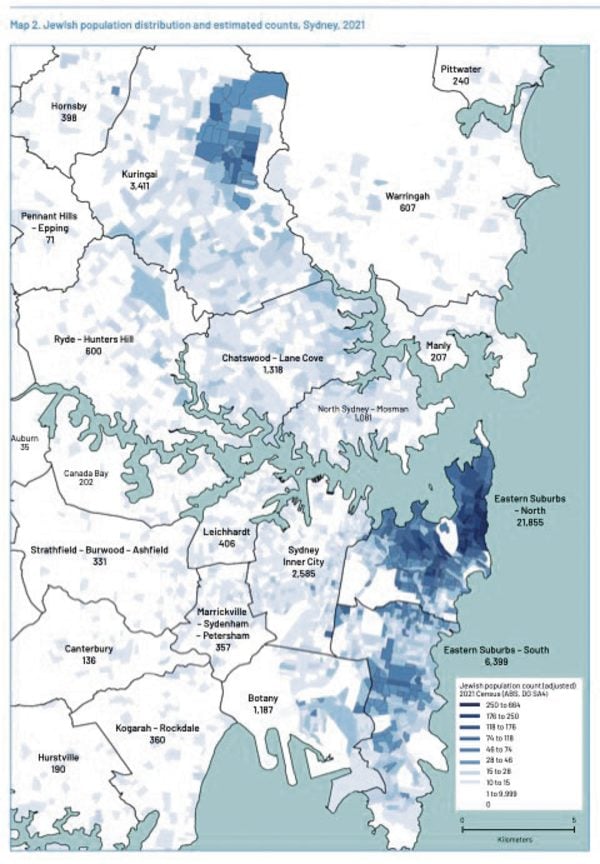
The second challenge is migration on several scales. Within Sydney, our geographical movement southward continues apace. Ku-ring-gai in the north saw its Jewish population decline by a further 25 per cent in the decade to 2021, while in Botany, south of Maroubra, there was growth of 64 per cent. Though this wasn’t a zero-sum shift, it nevertheless presents challenges given bricks and mortar, from which shules and schools are built, are rather less mobile than people.
In addition, NSW is a consistent net Jewish population exporter to the rest of Australia, particularly to Victoria and Queensland, driven by concerns about housing affordability, especially in “Jewish areas”, as well as lifestyle choices and Jewish preferences.
Even so, these migratory challenges pale in comparison to the one presented by the international picture. In the early 2000s, net overseas Jewish migration was still substantial, driven by South African arrivals whose numbers towered over all others. In time, that dominance has sharply eroded and for the 2016 to 2020 period, Israel overtook South Africa to become our single largest source of Jewish overseas migration. In fact, even the number of American Jews arriving here has almost eclipsed the South African count.
But the number of these new Jewish arrivals are nowhere near as high as they were two decades ago. Overall, there has been a tremendous reshaping of the Jewish migratory scene. The challenge is how to thrive without the luxury of endless Jewish net overseas migration?
The third challenge is Jewish schools. As recently as 2011, over half of all Jewish school children in NSW attended Jewish schools. But by 2021, overall take-up of Jewish day schools dipped below 45 per cent for the first time. The data all point to a softening in enthusiasm for Jewish day-school enrolment.
Notably, this decline is matched by growth in the non-Jewish private sector suggesting that cost may not be the only driver of change, at least for some. Yet affordability remains a significant challenge with the data revealing a huge gulf between the household incomes of Jewish families with children attending private schools (including all Jewish schools) and Jewish families whose children attend public schools.
The challenge here is twofold: how to keep Jewish schools vibrant and sustainable while also providing Jewish educational opportunities to the majority – and increasing – cohort of Jewish children outside the Jewish school sector?
The 2021 Census numbers are compasses for communal strategy as we chart our course through these demographic, migratory and educational shifts. The future of Jewish life in NSW will depend on how creatively and collaboratively we respond to these challenges.
Dr David Graham is a demographer and social research consultant to JCA NSW.
Read the full NSW Census report here: jca.org.au/findings-nswjewishpopulation-21census
comments