



Oscar nods against the odds
ACCORDING to producer Emile Sherman, there was a raft of elements working against his acclaimed period drama The King’s Speech.
There was the perception of “sophisticated historical dramas” as akin to box-office poison, a huge GFC-inspired budget cut at the 11th hour, and a reported email campaign from inside the Academy of Motion Picture Arts and Sciences beseeching a boycott of the film, which opted not to tackle the alleged Nazi-leanings of its central character, King George VI.
Add to this the film’s low budget of $15 million and the fact that it is an independent British production, and members of the Academy had every reason to snub The King’s Speech when it came to Oscar nominations.
But they didn’t.
The film garnered a staggering 12 nominations, more than any other film in contention, including its main rival and the film many are touting as an early frontrunner for film of the decade, The Social Network, which managed nine nominations.
In the 83-year history of the Academy Awards, only 25 films have managed 12 or more nominations and the most received by any film is 14 (Titanic and All About Eve).
Still basking in the afterglow of his Oscar nomination in the best film category, Sherman told The AJN the film’s galactic success didn’t figure in anyone’s thinking.
“This is absolutely the stuff you dream about,” Sherman said of his Oscar nomination.
“Well, actually it’s beyond what we dreamed about, and certainly not something one expects when you go into making a movie.”
As for the attempted boycott, Sherman says he is comfortable with his film’s version of events.
“Smear campaigns are part and parcel of this world,” he says.
“I’m Jewish, the writer (David Seidler) is Jewish – his parents died in the Holocaust – and I feel really comfortable with what I know about King George VI. We’re telling a story, the film isn’t an analysis of his political leanings.”
The son of prominent patrons of the Sydney arts scene Brian and Gene, Sherman is an experienced producer with credits including Rabbit-Proof Fence and The Kings of Mykonos, but he admits the whirlwind of acclaim, awards and box-office bonanza that has followed The King’s Speech is something altogether different.
“It was at the Telluride Film Festival in Toronto, where the film was officially launched, that we first really knew it was connecting,” says Sherman.
“Since then, its been an incredible ride where every week there’s been something truly momentous that’s happened in the life of this film, which has just taken it to the next level. It’s been an extraordinary process, really extraordinary.”
The film is in the running for 14 British Academy of Film and Television awards, four Screen Actors Guild awards and has already won a Golden Globe, a Director’s Guild of America gong and 46 other international awards of note. It has also taken in more than $122 million worldwide at the box office.
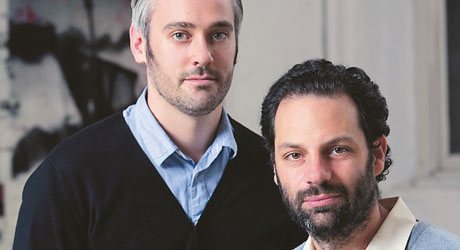
Sydneysider Sherman and partner Iain Canning (based in London) started See-Saw Films in 2008 and were approached by Gareth Unwin, who had an early copy of David Seidler’s screenplay for The King’s Speech, soon after.
Unwin liked the symmetry of a UK/Australian production company handling the film, which, at its heart, is the story of the unlikely relationship between a British monarch and an Australian commoner.
“It just felt like it would be a wonderful film to launch our company with, so we developed the script over a number of drafts and brought on the director and the cast. It happened quite quickly because Geoffrey Rush had some scheduling issues and we needed to shoot him out before Christmas,” says Sherman.
But more than just another near-perfect Oscar-nominated performance, Rush’s commitment to the film from the outset was instrumental in getting it off the ground.
Rush, also a producer on the film, stars as Lionel Logue, speech therapist to a stammering King George VI, played by Colin Firth, who was nominated in the best actor category.
Luckily or unluckily for Sherman, depending on how you look at it, 2011 represents some of the stiffest competition in the best picture category at the Oscars in recent memory – despite its expansion in 2010 to incorporate 10 films, five more than in years gone by.
To win, The King’s Speech will have to beat The Social Network, regarded by many as an early contender for film of the decade; the Coen brothers’ remarkable update of the John Wayne classic True Grit; and Darren Aronofsky’s chilling Black Swan. Plus 127 Hours, The Kids Are All Right, Toy Story 3, The Fighter, Winter’s Bone and Inception are all realistic chances to win.
“It’s good for the industry that there are so many good films at the moment. When we were making The King’s Speech the prevailing wisdom was that more sophisticated adult fare was dead. But then you look at the line-up this year and how well all these films are doing … they’re really wonderful films and it’s great for the industry and for the film’s we want to make,” adds Sherman.
The Academy Awards will be announced in Los Angeles on February 27.
The King’s Speech is screening nationally.
REPORT: ADAM KAMIEN
PHOTO: Emile Sherman (right) with fellow The King’s Speech producer Iain Canning. Photo: Laurie Sparham
comments