



Peace talks back on after three years
JERUSALEM – There is jubilation on the Israeli left and trepidation on the right following America’s announcement that new peace talks will begin.
The last time the Israeli and Palestinian negotiating teams met there was no such thing as an iPad, the global economic crisis was only just starting, and there had been no Arab Spring.
Since the last meeting, Israel has had more success closing a deal with the hard-line Hamas – for the release of Gilad Shalit – than making any major agreements with the moderate Palestinian Authority.
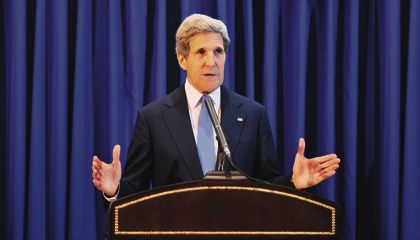
US Secretary of State John Kerry called the decision to resume talks “a significant and welcome step forward”.
Kerry praised the leaders on both sides, saying: “We know that the challenges require some very tough choices in the days ahead. Today, however, I am hopeful.”
Nevertheless, as of press time, there were some objections from the Palestinians regarding the conditions for the talks, indicating that while they are expected to participate, there could be a last minute glitch.
Israel’s President Shimon Peres telephoned his Palestinian counterpart Mahmoud Abbas and told him: “There is no alternative to peace, not for us and not for you. You took a brave and historic decision to return to negotiations – don’t listen to the sceptics, you did the right thing.”
Abbas said that he shares Peres’ hopes.
Both Abbas and Israeli PM Benjamin Netanyahu face opposition from within their own political camps – and both are trying to placate that opposition.
Abbas failed to win over the Palestine Liberation Organisation and its Fatah faction – both of which he heads. Netanyahu faces strong opposition from within his political party Likud to any agreement that would place large tracts of land under Palestinian control and/or lead to a Palestinian state.
In a veiled warning, Danny Danon, head of Likud’s central committee and Deputy Defence Minister, said: “I fully trust Prime Minister Benjamin Netanyahu who knows so well the dangers of returning to the 1967 borders.”
He went on to insist: “We must not repeat the injustice of the past and uproot thousands of Jews from their homes.” Danon is determined to use Likud’s party infrastructure to block any agreement that leads to the creation of a Palestinian state.
Meanwhile, Naftali Bennett, Economy Minister and leader of the hawkish Jewish Home party, has said that he will block the state budget – effectively dismantling the coalition – unless guarantees are given that any draft peace deal would be put to a referendum before being signed.
Netanyahu has agreed to this demand, and Abbas has also said that he would resort to a referendum among his public.
Hinting at a possible uprising if talks do not yield results, Abbas told a Jordanian newspaper: “If there is no agreement, all options are open.”
NATHAN JEFFAY
comments