



Rabbi reaches 25-year milestone
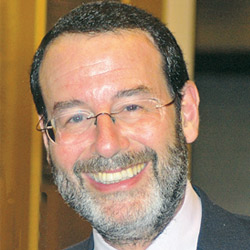
RABBI Fred Morgan's 25 years in the rabbinate, which is being celebrated this month, has transformed him from an analytical student of faiths to a hands-on congregation builder.
PETER KOHN
AFTER a quarter-century in his profession, a rabbi can look beyond the everyday horizons and see a bird’s-eye view of what’s been and what might yet evolve.
Rabbi Fred Morgan’s 25 years in the rabbinate, which is being celebrated this month, has transformed him from an analytical student of faiths to a hands-on congregation builder.
Asked what other profession he might have followed, Temple Beth Israel’s (TBI) senior rabbi wonders how he might have fared as an academic theologian, but voices misgivings.
“I was an academic of a particular sort,” he says, referring to his teaching of comparative religion in the UK, “but I don’t think I could have kept it up, as a researcher. I wanted to be engaged with people.”
It was an urge that led him to Leo Baeck College, Britain’s Liberal rabbinical seminary, where he recalls the grilling that prospective students underwent before beginning their studies. Asked why he wanted to become a rabbi, he replied: “To repay the blessing that Judaism has given me.”
The blessing for this 61-year-old American was being raised in an upstate New York home, and taking part in the activities of the US National Federation of Temple Youth. It was a family and community youth that encouraged Jewish customs and traditions, he says.
But it was an environment he later distanced himself from to discover Hinduism and Buddhism at Columbia University. He graduated with a degree in oriental studies, which he later continued in India.
Judaism’s monotheistic essence and the lure of engaging with a congregation eventually drew him back to his roots, in a faith inspired by his parents, but “not [his] parents’ Judaism”. He nominates iconic British rabbis, Hugo Gryn, Dr Louis Jacobs and Leo Baeck College principal Jonathan Magonet among those who inspired him.
As a newly minted rabbi, he led North West Surrey Synagogue near London, where he was struck by the compassion of the congregants. “They seemed to have a knack for understanding how to take care of others in the congregation.”
It was a model of synagogue development Rabbi Morgan later brought to Australia, his fourth continent, when he became senior rabbi of TBI in 1997; a template he set out in his induction drashah, and one he believes has been met in part. The outcome, he says, is that TBI’s doors are seldom shut nowadays.
But a whole lot more needs to be done, he states. “There should be more activities, perhaps spaces where people can just sit and have a coffee and talk, perhaps about what’s in this week’s Jewish News.”
Rabbi Morgan sees communal engagement -— his own and his congregants’ -— as an experience that begins with the particular, not the general, whether that specific attraction is to one of TBI’s chavurah groups or the Social Justice Group.
“That’s especially true of a large congregation like Temple Beth Israel. Look at all the shtiebels that are forming in Australia now.”
He believes it is a sign that people want a closeness from their Judaism, not an edifice.
Beyond TBI, he hopes his work in the Union for Progressive Judaism has helped develop Jewish life in the smaller states. And he says his contribution to the Moetzah, the Progressive Beth Din, has been to help it make groundbreaking policy decisions on issues of Jewish status, including the controversial move last year to allow Progressive rabbis to perform same-sex commitment ceremonies.
What about the reaction to the commitment ceremonies? “Well, there wasn’t that much of a reaction,” he says, describing Australian Jewish life today as “lacking the ideological force” he encountered when he, his wife Sue and their three children arrived more than a decade ago.
But an endemic “insecurity” lingers, he says, and manifests itself in some corners whenever the Israeli-Palestinian conflict or interfaith outreach are raised, triggering deep angst in a community with so many Shoah survivors.
Given his past, a yen for interfaith work comes naturally to Rabbi Morgan, and as part of his 25th anniversary, he delivered an address last month to the Council of Christians and Jews, an organisation he has strong ties to.
He outlined liturgical scholar Rabbi Lawrence Hoffman’s three stages in the Jewish-Christian relationship — disputation (two millennia of Jewish persecution), diplomacy (a polite coexistence since the Shoah and Nostra Aetate) and dialogue.
“We’re now reaching that third phase, seeing dialogue slowly taking hold. But you can’t have true dialogue unless you allow yourself to be vulnerable and that’s not something that Australian Jewry is quite ready for.”
comments